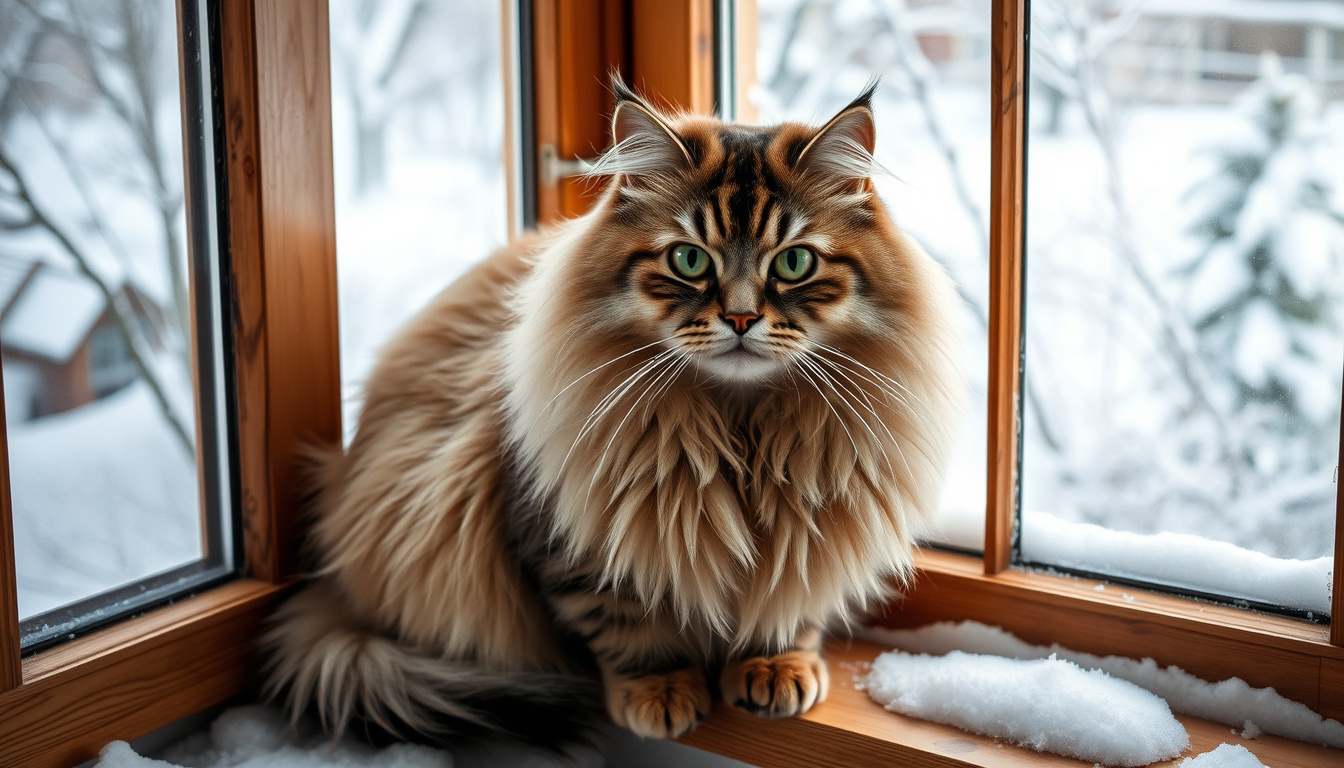
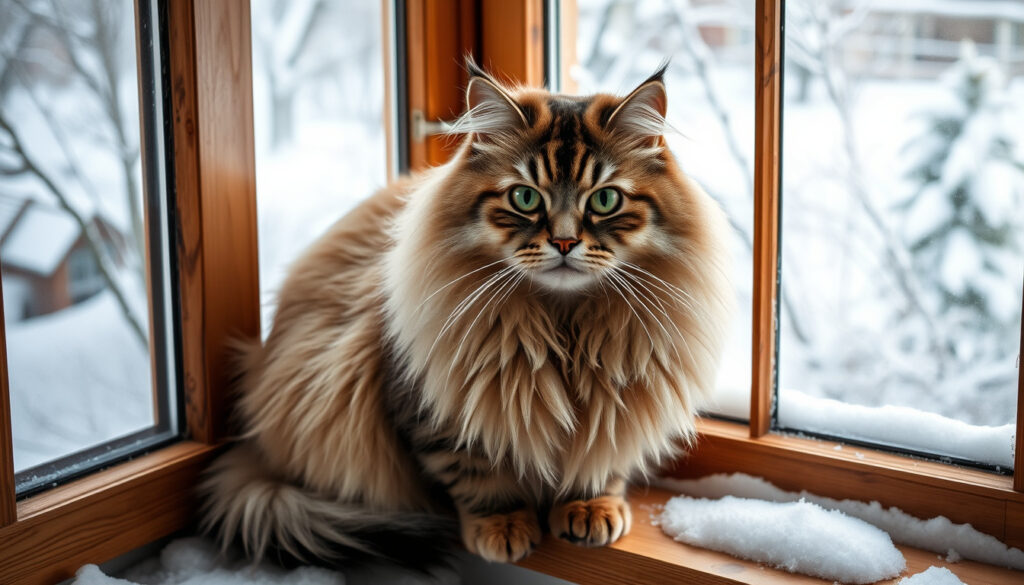
There’s a reason Siberian cats have been warming laps in Russian households for centuries — they were shaped by the climate, not by a breed standard, and this ancient landrace cat developed its dense triple coat and easygoing temperament in the forests of Siberia. Today it’s winning over families across Europe with a combination that’s hard to find in other breeds: genuine affection, steady playfulness, and a naturally lower allergen profile.
Average weight (female): 8–12 lb (3.6–5.4 kg) ·
Average weight (male): 12–18 lb (5.4–8.2 kg) ·
Full size age: 3 years ·
Hypoallergenic potential: Lower Fel d 1 levels than most breeds ·
Lifespan: 12–15 years
Quick snapshot
- Natural landrace breed from Russia (PetMD veterinary database)
- Lower average Fel d 1 levels than many other cats (Chewy breed education centre)
- Generally affectionate and good with families (PetMD veterinary database)
- Exact hypoallergenic effect varies per individual cat and person (PetMD veterinary database)
- Precise origin timeline is not documented (PetMD veterinary database)
- Not all Siberian cats are lap cats — individual temperament varies (PetMD veterinary database)
- Takes up to 3 years to reach full size — but with individual variation (Pet Rebels breed profile)
- 1000+ years ago: natural development in Russian forests (PetMD veterinary database)
- 1980s: first exports from Russia to Europe and the US (PetMD veterinary database)
- 1990: recognised by major registries (TICA, CFA) (PetMD veterinary database)
- Ongoing research into Fel d 1 variability across individuals (Chewy breed education centre)
- Growing popularity in Ireland and the UK (Chewy breed education centre)
- More breeders active in Europe as demand rises (Chewy breed education centre)
Here’s a quick reference of the most important Siberian cat facts.
| Attribute | Detail |
|---|---|
| Origin | Russia (natural/landrace breed) |
| Coat | Semi-long, triple coat |
| Average weight (male) | 12–18 lb (5.4–8.2 kg) |
| Average weight (female) | 8–12 lb (3.6–5.4 kg) |
| Full maturity | 3 years |
| Hypoallergenic | Yes – lower Fel d 1 levels |
| Lap cat likelihood | High – frequently described as lap cats |
| Lifespan | 12–15 years |
Is a Siberian cat a good pet?
Temperament overview
- Siberian cats are widely described as sociable and affectionate, making them a strong fit for families (PetMD veterinary database).
- They are playful but not hyperactive, often described as sturdy and active without being destructive (Pet Rebels breed profile).
- They tolerate being alone moderately well but prefer company — a key factor for anyone considering a Siberian cat for a busy household.
The pattern: Siberian cats land on the social end of the cat spectrum — they want to be part of what’s happening, not just watch from a window.
Family and pet compatibility
- They are reported to be good with children and other pets when properly introduced (PetMD veterinary database).
- Their playful but gentle nature means they tend to match well with households that have respectful children.
- Owners frequently report that Siberian cats get along with cat-friendly dogs, though individual temperaments vary.
The implication: if you have a multi-pet home, the Siberian cat is one of the breeds most likely to integrate smoothly — but introductions still matter.
Activity needs and independence
- Siberian cats need moderate daily activity — interactive toys and climbing trees help meet their exercise needs (Untamed breed guide).
- They are independent enough to entertain themselves for a few hours, but they are not aloof.
The trade-off: you get a cat that can handle a workday alone better than a Siamese, but still needs real engagement when you’re home.
The takeaway: balance is key — the Siberian cat rewards the time you invest.
What is so special about Siberian cats?
Landrace origin and natural development
- The Siberian cat is a natural landrace breed — it developed in the forests of Russia over 1,000 years ago without selective breeding by humans (PetMD veterinary database).
- This origin shaped their dense triple coat, sturdy build, and calm temperament suited to harsh winters.
- They were first exported from Russia to Europe and the US in the 1980s, and major registries like TICA and CFA recognised the breed around 1990.
What this means: the Siberian cat’s traits are the result of natural selection, not a breeder’s ideal. That’s why their health and temperament tend to be more consistent than in heavily manipulated breeds.
Hypoallergenic qualities
- Many Siberian cats produce lower levels of Fel d 1 — the protein in saliva and skin that triggers allergies — than most other cats (Chewy breed education centre).
- No cat is truly hypoallergenic, including the Siberian cat (PetMD veterinary database).
- People are not allergic to cat fur itself, but to proteins in saliva, urine, and skin flakes/dander (Pet Rebels breed profile).
Slow maturation and size
- Siberian cats take up to 3 years to reach full physical size, weighing 12–18 lb for males and 8–12 lb for females (PetMD veterinary database).
- This slow growth means they retain a kitten-like playfulness well into their second year.
The pattern: the slow maturation is a double-edged sword — you get years of playful kitten energy, but also a longer wait for the settled adult temperament.
The implication: the breed’s uniqueness lies in its combination of natural hardiness and allergen advantage.
What is the difference between a Siberian cat and a Norwegian Forest Cat?
Size and build differences
- Norwegian Forest Cats are generally larger and leaner with a more triangular head, while Siberian cats have a rounder head and a more compact, sturdy body (PetMD Norwegian Forest Cat profile).
- Norwegian Forest Cats mature even more slowly — up to 5 years — and may retain a kitten-like demeanor longer than Siberians (PetMD Norwegian Forest Cat profile).
The contrast: the Norwegian Forest Cat is built for climbing with a leaner frame, while the Siberian cat is built for cold with a denser, rounder body.
Coat and weather adaptation
- Both breeds have a triple coat, but the Norwegian Forest Cat’s coat has a water-resistant top layer suited to snowy Scandinavian forests (The Spruce Pets breed guide).
- Siberian cats also have a dense triple coat, but their fur is described as less oily and more woolly in texture (All for Paws breed overview).
- Norwegian Forest Cats are not considered hypoallergenic (The Spruce Pets breed guide).
The trade-off: if lower-allergen potential matters to you, the Siberian cat has an edge — the Norwegian Forest Cat does not share that trait.
Personality and vocalization
- Siberian cats are generally more playful and vocal, often described as communicative and interactive (PetMD veterinary database).
- Norwegian Forest Cats are calmer, more reserved, and often communicate with only occasional chirps (PetMD Norwegian Forest Cat profile).
- Both are social and friendly with families, but the Norwegian Forest Cat is commonly described as affectionate but not clingy (GV Hospital breed guide).
The takeaway: if you want a cat that talks to you and follows you from room to room, the Siberian cat is the stronger choice. If you prefer a quieter, more independent companion, the Norwegian Forest Cat may suit you better.
The pattern: these two forest cats evolved for different climates — Siberia’s harsh continental cold vs Norway’s coastal snow — which shaped their distinct personalities and coats.
Is a Siberian cat a Maine Coon?
Key breed distinctions
- No, the Siberian cat is a distinct breed from the Maine Coon. They share a large size, thick coat, and slow maturation, but their origins and genetics are different (Chewy Maine Coon breed education).
- Maine Coons are an American natural breed; Siberian cats are a Russian landrace breed.
The pattern: they are the classic case of convergent evolution — two breeds from different continents that developed similar traits because they adapted to similar cold climates.
Size and bone structure
- Maine Coons are larger, typically 18–22 lb, with a rectangular body, long tufted ears, and a square muzzle (Chewy Maine Coon breed education).
- Siberian cats have a more rounded head, shorter ears, and a denser, more compact body.
The contrast: a Maine Coon has a distinctly rectangular, large-boned frame; a Siberian cat is rounder and more moderate in size, even at full maturity.
Coat and grooming
- Maine Coons have long, thick coats that require regular grooming and shed heavily in spring and fall (Chewy Maine Coon breed education).
- Siberian cats have a shorter, denser coat that still needs weekly brushing, especially during seasonal shedding (Untamed breed guide).
- Maine Coons are not considered hypoallergenic (Chewy Maine Coon breed education).
The trade-off: both breeds need regular brushing, but the Siberian cat’s shorter coat means less overall grooming time — and a potential edge for allergy sufferers.
What this means: these two breeds are often confused, but their origins, body types, and allergen profiles set them clearly apart.
Can you leave a Siberian cat alone for 8 hours?
Independence level
- Siberian cats can tolerate up to 8 hours alone if they have enrichment, food, water, and a clean litter box (PetMD veterinary database).
- They are more independent than breeds like the Siamese or Sphynx, but less independent than the Norwegian Forest Cat.
The baseline: a Siberian cat can handle a standard workday, but it’s not a cat that thrives on being left alone regularly.
Separation anxiety signs
- Because they are social and affectionate, Siberian cats may become anxious if left alone too often or too long — signs include excessive meowing, destructive behaviour, or litter box issues.
- A second cat is often recommended as a companion to reduce loneliness (Chewy breed education centre).
The warning: a Siberian cat left alone for 10+ hours daily with no interaction is at risk for behavioural issues. This is not a breed for owners who are never home.
Tips for longer absences
- Interactive toys, puzzle feeders, and cat trees can help keep a Siberian cat entertained during the day (Untamed breed guide).
- Consider a second cat — many owners report that two Siberian cats entertain each other and reduce destructive behaviour.
The practical advice: if you work a standard 8-hour day, a Siberian cat is manageable. If you’re gone 10+ hours or travel frequently, get a second cat or reconsider the breed.
The implication: this breed’s social needs demand a committed owner.
Do Siberian cats like to be cuddled?
Affection levels
- Most Siberian cats are affectionate and enjoy physical closeness with their owners (PetMD veterinary database).
- They are often described as “lap cats” by owners, meaning they will seek out your lap for warmth and comfort.
The pattern: the Siberian cat is one of the more affectionate breeds — it’s not aloof or standoffish like some other long-haired cats.
Lap cat tendencies
- Many Siberian cats are described as lap cats that enjoy curling up on their owner’s lap for extended periods (Chewy breed education centre).
- They are also known to follow their owners from room to room and greet them at the door.
The implication: if you want a cat that’ll sit on your lap while you read or watch TV, the Siberian cat is one of the most reliable choices among large breeds.
Individual variability
- Temperament varies by individual — not all Siberian cats are lap cats, and some are more independent than others.
- Males are often reported as more cuddly and affectionate than females, though individual variation is significant (Pet Rebels breed profile).
The nuance: if cuddliness is non-negotiable, ask a breeder about the specific kitten’s personality and consider a male Siberian cat, which is more likely to be a lap cat.
The takeaway: affection is a breed hallmark, but not a guarantee — always get to know the individual cat.
Breed comparison: Siberian cat vs Norwegian Forest Cat vs Maine Coon
Three large forest cats, one pattern: each adapted to cold climates, but they differ in size, coat, temperament, and allergen profile. Here’s how they stack up head-to-head.
| Trait | Siberian cat | Norwegian Forest Cat | Maine Coon |
|---|---|---|---|
| Origin | Russia (landrace) | Norway (landrace) | United States (landrace) |
| Average weight (male) | 12–18 lb | 13–18 lb | 18–22 lb |
| Body shape | Rounded, compact | Leaner, triangular | Rectangular, large-boned |
| Coat type | Triple coat, woolly | Triple coat, water-resistant | Long, silky, heavy |
| Hypoallergenic potential | Lower Fel d 1 levels | Not hypoallergenic | Not hypoallergenic |
| Full maturity | 3 years | 5 years | 3–4 years |
| Temperament | Playful, vocal, affectionate | Calm, reserved, independent | Friendly, gentle, intelligent |
| Lap cat tendency | High | Moderate | Moderate to high |
| Grooming need | Weekly (more during shed) | Weekly (daily during shed) | Regular, heavy shedding |
The trade-off: if allergen tolerance is your priority, the Siberian cat is the only one of the three with a legitimate claim. If sheer size impresses you, the Maine Coon wins. If you want a calm, independent cat, the Norwegian Forest Cat is the best match.
Breed standard specifications
Eight key specs, one pattern: the Siberian cat sits in the middle of the large-breed spectrum — smaller than the Maine Coon but more compact than the Norwegian Forest Cat.
| Specification | Siberian cat |
|---|---|
| Body type | Substantial, compact, rounded |
| Head shape | Rounded, medium-sized |
| Coat structure | Semi-long, triple coat with woolly undercoat |
| Eye colour | All colours accepted; gold, green, blue |
| Ear shape | Medium, rounded tips, often with tufts |
| Tail | Medium-long, thick, heavily furred |
| Legs | Medium length, sturdy, large round paws |
| Life expectancy | 12–15 years |
The pattern: the Siberian cat’s build is built for cold — a compact, well-insulated body with a dense triple coat and large paws that act like snowshoes.
Pros and cons of the Siberian cat
Upsides
- Affectionate and sociable — great with families and children (PetMD veterinary database)
- Lower Fel d 1 levels than most breeds — better for allergy sufferers (Chewy breed education centre)
- Playful but not hyperactive — moderate energy level (Pet Rebels breed profile)
- Slow maturation means years of kitten-like playfulness
- Generally healthy with a lifespan of 12–15 years
Downsides
- Regular grooming needed — weekly brushing, more during shedding season (Untamed breed guide)
- Not truly hypoallergenic — individual tolerance varies (PetMD veterinary database)
- Can be prone to obesity if overfed
- Needs social interaction — not ideal for owners who are gone all day
- Seasonal heavy shedding requires extra cleaning
The trade-off: you get a loving, playful companion with lower allergen potential, but you trade that for grooming commitment and social needs. For the right owner, the balance is strongly positive.
Timeline: Siberian cat history
- 1000+ years ago — Siberian cat naturally develops in Russian forests and households (PetMD veterinary database)
- 1980s — First Siberian cats exported from Russia to Europe and the US
- 1990 — Breed recognised by major cat registries (TICA, CFA)
- 2000s — Hypoallergenic claims gain attention; research on Fel d 1 begins
- 2020s — Siberian remains popular in Ireland and UK; breeders active
The pattern: the Siberian cat’s journey from Russian forest cat to globally recognised breed took centuries of natural development and only a few decades of organised breeding.
What’s confirmed and what’s still unclear
Confirmed facts
- Siberian cats are a natural breed from Russia (PetMD veterinary database)
- They have lower average Fel d 1 levels than many other cats (Chewy breed education centre)
- They take up to 3 years to reach full size (Pet Rebels breed profile)
- They are generally affectionate and good with families (PetMD veterinary database)
What’s unclear
- Exact degree of hypoallergenicity varies per individual cat and per person (PetMD veterinary database)
- Precise origin timeline is not documented
- Not all Siberian cats are lap cats — individual temperament varies
The implication: what’s solid is the breed’s origin, slow maturation, and lower allergen protein levels. What’s uncertain is how that translates to a specific cat in a specific home — you always need to test tolerance and meet the individual.
Owner and breeder perspectives
“My Siberian cat is the most affectionate cat I’ve ever owned. She’s a lap cat through and through, follows me everywhere, and even greets me at the door.”
— Longtime Siberian owner, owner testimonial
“Males tend to be more openly affectionate and cuddly, while females are playful but a bit more independent. Both are wonderful companions, but if you want a lap cat, a male Siberian is often the safer choice.”
— Breeder, CFA/TICA-registered breeder
The thread connecting both perspectives: the Siberian cat is consistently described as affectionate and social, with males leaning more toward lap-cat behaviour. The individual cat still matters, but the breed’s reputation for warmth is earned.
Summary: Is the Siberian cat right for you?
The Siberian cat delivers on its promise — a genuinely affectionate, playful, and sociable breed with a meaningful advantage for allergy sufferers. But it’s not a low-maintenance cat: the triple coat demands regular brushing, the social nature needs interaction, and the slow maturation means years of kitten energy. For Irish and UK families who want a large, loving cat and can commit to grooming and company, the Siberian cat is one of the best choices available. For owners who travel frequently, work very long hours, or want a truly allergy-free pet, the trade-off is clear: choose a breed with lower grooming needs and a more independent temperament, or prepare to adapt your lifestyle.
clawmate.com, meowguides.com, youtube.com, petrebels.com, petpawz.com.au, cultuurmag.nl
Frequently asked questions
Are Siberian cats good with dogs?
Yes, Siberian cats are generally reported to get along well with cat-friendly dogs when properly introduced. Their sociable and confident temperament helps them adapt to multi-pet households (PetMD veterinary database).
Do Siberian cats shed a lot?
Yes, they shed seasonally — heavily in spring and fall. Weekly brushing is recommended during most of the year, and daily brushing during peak shedding periods helps manage loose fur (Untamed breed guide).
How much does a Siberian kitten cost?
Prices vary by region and breeder, but a registered Siberian kitten from a reputable breeder in Ireland or the UK typically ranges from €800 to €1,500. Always choose a breeder registered with TICA, CFA, or a local cat association.
Are Siberian cats smart?
Yes, they are considered intelligent and trainable. Siberian cats can learn to fetch, open doors, and respond to their names. They are also quick to figure out puzzle feeders and interactive toys (Chewy breed education centre).
Do Siberian cats need a lot of exercise?
They need moderate exercise — daily interactive play and access to cat trees or climbing shelves keep them happy. They are not hyperactive, but they do need an outlet for their playful energy (Pet Rebels breed profile).
Are Siberian cats indoor cats?
Yes, they adapt well to indoor life, especially if provided with climbing structures, toys, and windows to look out. Their dense coat means they enjoy cooler temperatures, but they are not suited to being left outdoors unsupervised (PetMD veterinary database).
Related stories





Richard Vane is Senior Reporter at MorningTimes.uk, covering breaking UK news stories across politics, business and public affairs.