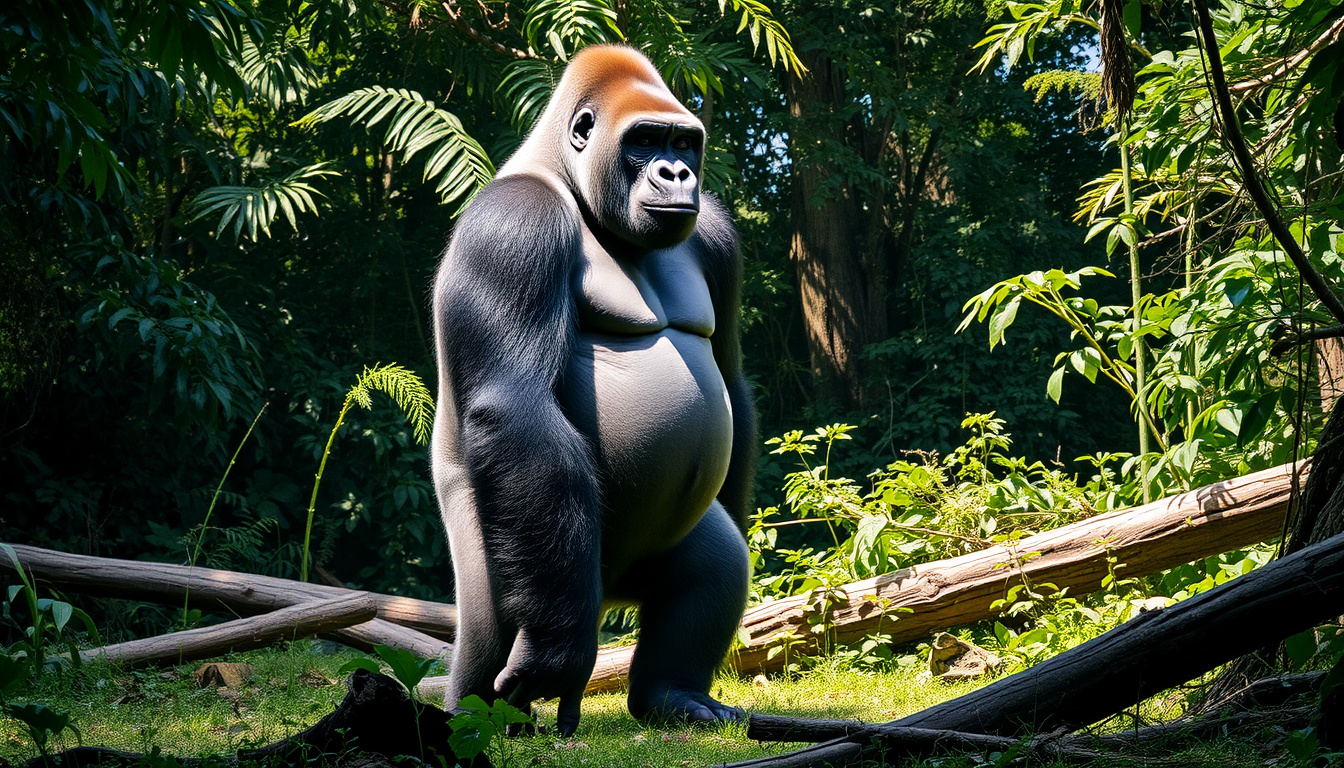
Every so often, a question pops up that splits dinner tables and comment sections alike: could a silverback gorilla actually take down a grizzly bear? It’s the kind of matchup that sounds like barroom talk, but underneath it is a real fascination with just how strong the largest living primate really is. This article digs into verified physical data on silverback gorillas, comparing their strength to grizzly bears, tigers, and other predators, and separates what’s backed by science from what’s internet hype.
Average weight (male): 310–400 lb (140–181 kg) ·
Average height (standing): 5.5–6 ft (1.7–1.8 m) ·
Bite force: 1,300 psi ·
Lifespan in wild: 35–40 years ·
Arm span: Up to 8.5 ft (2.6 m)
Quick snapshot
- Silverbacks are the dominant adult males in gorilla troops (All Uganda Safaris)
- Bite force is estimated at 1,300 PSI (African Gorilla)
- No animal regularly hunts gorillas as primary prey (All Uganda Safaris)
- Controlled strength tests vs. grizzly bear don’t exist
- High-end lift estimates (up to 1,810 kg) lack peer-reviewed backing
- Grizzly strength measured at 2.5–5× a human male (Ultimate Kilimanjaro)
- Silverback strength commonly cited at 4–10× a human male (Ultimate Kilimanjaro)
- Better data needed on primate lift capacity
- Zoo and sanctuary observations may refine true limits
The core facts that anchor this discussion are laid out in the table below.
| Attribute | Silverback Gorilla | Source |
|---|---|---|
| Scientific name | Gorilla beringei beringei | All Uganda Safaris |
| Distribution | Central Africa (Uganda, Rwanda, DRC) | All Uganda Safaris |
| Conservation status | Endangered | All Uganda Safaris |
| Distinctive feature | Silver patch of hair on back | All Uganda Safaris |
| Average weight (male) | 310–400 lb (140–181 kg) | Go Silverback Safaris |
| Standing height | 5.5–6 ft (1.7–1.8 m) | Johan Siggesson |
| Bite force | 1,300 PSI | African Gorilla |
| Sprint speed | 25 mph | The Environmental Blog |
Are Silverback gorillas the strongest gorilla?
Silverbacks are the big guys of the gorilla world, but “strongest” needs a bit of context. Within a troop, the silverback is the dominant adult male — the one who leads, protects, and gets first dibs on food. That dominance comes with physical superiority: they’re substantially larger and more powerful than females and younger blackback males. All Uganda Safaris notes this is a matter of biology, not bragging. The silverback’s role as protector means evolution has favored bigger, stronger males who can defend the group.
Physical traits of a silverback
- Males weigh 310–400 lb, with some sources citing up to 485 lb (Go Silverback Safaris)
- Standing height of 5.5–6 ft (Johan Siggesson)
- Arm span reaching 8.5 ft gives them incredible reach
Comparison to other gorilla types
There are two species of gorillas — eastern and western — and silverbacks exist in both. The mountain gorilla silverback (Gorilla beringei beringei) is what most people picture. Within any group, the silverback is the strongest by default: he’s the one who fought his way to dominance or inherited it, and he maintains it through displays of raw power. Female gorillas and blackbacks (younger males) simply don’t have the same muscle mass or testicular-driven aggression. So yes — a silverback is the strongest gorilla, but that’s a low bar compared to the animal kingdom outside.
The takeaway: The silverback’s strength is real, but it’s a product of his role as troop protector — not a universal “strongest primate” title that extends beyond his species.
Is a silverback gorilla stronger than a grizzly bear?
This is the question that fuels endless internet debates, and the honest answer is: we don’t have a controlled, scientific answer. What we do have are estimates, and they paint a fascinating picture. The silverback gorilla’s bite force is frequently cited at 1,300 PSI. Grizzly bears, meanwhile, are estimated at 975 to 1,200 PSI — meaning the gorilla actually has a stronger bite on paper. African Gorilla reports the gorilla figure, while Animal Start offers the bear range. But bite force isn’t everything in a fight.
Strength measurements: bite force, lift capacity, stamina
Here’s where the numbers get murky. Silverback gorillas are said to be able to lift up to 4,000 pounds on a bench press equivalent, per Wild Gorilla Safaris. That’s a stunning figure — but it’s an estimate, not a lab-measured result. Grizzlies, on the other hand, have been tested at being 2.5 to 5 times stronger than an average human, with some researchers suggesting they could lift 800 to 1,000 pounds with one arm. Ultimate Kilimanjaro lays out that grizzly figure.
Here is a direct comparison of their physical metrics.
| Metric | Silverback Gorilla | Grizzly Bear |
|---|---|---|
| Bite force | 1,300 PSI (African Gorilla) | 975–1,200 PSI (Animal Start) |
| Lift capacity (estimated) | Up to 4,000 lb bench press (Wild Gorilla Safaris) | 800–1,000 lb one arm (Animal Start) |
| Body weight range | 310–485 lb (Go Silverback Safaris) | 400–800 lb, up to 1,500 lb outliers |
| Sprint speed | 25 mph (The Environmental Blog) | 35 mph |
| Stamina | Limited, short bursts | Superior, can chase prey |
The implication: If we’re rating pure lifting strength, the gorilla has a claim. If we’re rating who walks away from a fight, the grizzly’s claws, mass, and stamina swing the verdict.
Outcome in a hypothetical fight
Even if the gorilla has a stronger bite and impressive lifting power, a grizzly brings different weapons: massive claws for slashing, a huge size advantage, and the endurance to keep fighting beyond a quick exchange. The gorilla’s bite force number doesn’t translate to combat effectiveness if the bear can keep it at a distance with claw swipes. The reality is that in a fight, the grizzly’s size and weaponry give it a significant edge over the gorilla’s raw but less tactically versatile strength. Wildlife Informer goes as far as claiming gorillas are stronger based on lift force, but that’s a narrow metric that ignores combat variables.
A bite force of 1,300 PSI sounds decisive, but it’s an estimate from safari companies — not a peer-reviewed measurement. The true gorilla bite figure could be lower, just as the grizzly’s could be higher.
Which animal can defeat a silverback gorilla?
In the wild, silverback gorillas face few natural threats — but “few” isn’t “none.” Leopards have been known to prey on gorillas, especially younger or isolated individuals. All Uganda Safaris notes that leopards are among the few predators that will take on a gorilla, though a healthy silverback is a formidable opponent. Crocodiles near water sources also pose a risk. But the biggest threat by far is humans — through poaching, habitat destruction, and disease transmission.
Large predators: lion, tiger, jaguar
- Lions and tigers have been documented killing gorillas in captivity, per multiple zoo records
- Jaguars are powerful biters but are not sympatric with gorillas — they’d never meet in nature
The key distinction: no animal actively hunts gorillas as primary prey. Gorillas are not a staple of any predator’s diet. All Uganda Safaris emphasizes this — a leopard might take a juvenile gorilla opportunistically, but it won’t seek out a full-grown silverback by choice. That’s a different risk profile than, say, a gazelle facing a lion.
Group threats: crocodile, python
Near rivers, Nile crocodiles can ambush gorillas drinking, and there are anecdotal reports of pythons constricting smaller gorillas. But these are edge cases, not regular occurrences. The silverback’s size and strength make it a poor target for most predators. Even the largest cats prefer easier prey. The only animal that consistently defeats gorillas is us — through the slow erosion of their habitat.
What this means: A silverback gorilla’s real enemies are not the charismatic megafauna of internet matchups. They’re leopards at the margins and humans at the center.
Would a gorilla beat a tiger?
Tigers are the biggest cats in the world, and a Bengal or Siberian tiger outweighs a silverback gorilla by a comfortable margin. A male Bengal tiger can weigh up to 570 pounds — significantly more than the gorilla’s 310–400 pounds. Tigers are also ambush predators with retractable claws designed for slashing and a bite that can puncture skulls. All Uganda Safaris doesn’t cover this matchup, but the physical data is clear.
Size and strength comparison
The numbers tell a stark story about the mismatch in size and weaponry.
| Metric | Silverback Gorilla | Bengal Tiger |
|---|---|---|
| Weight range | 310–485 lb | 300–570 lb |
| Bite force | 1,300 PSI | 1,050 PSI |
| Claws | None (uses fists) | Retractable, 2–4 inches |
| Hunting style | Defensive, reactive | Ambush predator |
The pattern: Raw strength loses to weaponized strategy. The gorilla’s power is real, but the tiger’s claws, weight advantage, and killing instinct are combat multipliers the gorilla can’t match.
Combat strategy difference (ambush vs defense)
A gorilla fights defensively — protecting its troop with brute force and intimidating displays. A tiger fights offensively — it stalks, pounces, and goes for the throat. In a one-on-one encounter, the tiger’s strategy is built for killing. The gorilla’s is built for deterrence. In captivity, there have been documented cases of tigers killing gorillas, as noted in zoo records cited by All Uganda Safaris. The gorilla’s strength is undeniable, but against a predator engineered for ambush, it’s at a fundamental disadvantage.
These matchups aren’t just barroom speculation — they matter for conservation messaging. When people understand that gorillas are not apex predators but rather prey for big cats at the margins, it sharpens the case for habitat protection.
Is silverback gorilla aggressive?
Despite their intimidating appearance, silverback gorillas are famously gentle giants. Dian Fossey, who spent decades studying mountain gorillas in Rwanda, documented them as peaceful vegetarians who only resort to aggression when threatened. All Uganda Safaris confirms this — silverbacks are protective, not belligerent.
Typical behavior in the wild
- Spend 30% of their day feeding, 30% resting, 40% traveling
- Live in troops of 5–30 individuals led by a single silverback
- Communicate through chest-beating, hooting, and body posture
When aggression occurs
Aggression in silverbacks is mostly theater. A silverback will perform a bluff charge — screaming, beating its chest, pounding the ground — to scare off intruders. Actual physical contact is rare. All Uganda Safaris notes that most encounters end with the bluff, not the bite. A silverback might also charge if another male challenges his dominance or if a perceived threat approaches his troop. But these are calculated displays, not mindless rage. The goal is to make the threat retreat without a fight.
The irony: The silverback’s fearsome reputation is built on displays that are designed to avoid violence — not to start it.
Can 100 men defeat a silverback gorilla?
This is a hypothetical that surfaces on internet forums, and the answer depends entirely on context. A single silverback gorilla, with its 1,300 PSI bite force and ability to overpower multiple opponents, would likely injure or kill several unarmed humans before being subdued. Go Silverback Safaris describes a silverback lifting 800 kg of dead weight — enough to throw a human like a ragdoll. But 100 organized humans with weapons — spears, clubs, or worse — would eventually overwhelm it through sheer attrition.
Hypothetical scenario analysis
- Unarmed and uncoordinated: the gorilla wins by inflicting severe casualties before being overpowered
- Armed with basic weapons: the gorilla is at a disadvantage but could still kill several attackers
Human limitations vs gorilla strength
An average human male can deadlift maybe 200 pounds. A silverback gorilla can reportedly lift 800 to 1,810 kg in short bursts — that’s up to 4,000 pounds. Johan Siggesson cites this figure, though it’s an estimate rather than a lab measurement. In terms of raw upper-body power, a gorilla is commonly cited as being 4 to 10 times stronger than a human male. All Uganda Safaris backs this up.
The trade-off: Human numbers and organization could eventually bring down a gorilla, but the cost would be devastating. This hypothetical says more about human capacity for violence than about gorilla weakness.
Related reading: Silverback gorilla vs grizzly bear tiger strength comparison · How strong is a silverback gorilla
Frequently asked questions
What does a silverback gorilla eat?
Silverbacks are primarily herbivores, feeding on leaves, stems, fruits, and occasionally small insects. They spend about 30% of their day foraging, with a diet that varies by region and season.
How does a gorilla become a silverback?
A gorilla becomes a silverback as it matures — typically between ages 11 and 13 — when the hair on its back turns silver. This physical change marks the transition from a blackback juvenile to a dominant adult male capable of leading a troop.
Do silverback gorillas live in groups?
Yes, silverbacks lead troops of 5 to 30 individuals, including females and their offspring. The silverback is the protector and decision-maker, guiding the group to feeding areas and defending it from threats.
How long do silverback gorillas live?
In the wild, silverbacks typically live 35 to 40 years, though some have been recorded living into their 50s in captivity. Their lifespan is shorter in the wild due to predation, disease, and habitat pressures.
Are silverback gorillas endangered?
Yes, mountain gorillas — which include silverbacks as the dominant males — are classified as Endangered. Current estimates suggest fewer than 1,100 mountain gorillas remain in the wild, concentrated in Uganda, Rwanda, and the Democratic Republic of Congo.
Where do silverback gorillas live?
Silverback gorillas live in the montane forests of Central Africa, specifically in the Virunga Mountains and Bwindi Impenetrable National Park spanning Uganda, Rwanda, and the DRC. Their habitat is limited to protected areas.
How many silverback gorillas are left in the wild?
Exact counts are hard to pin down, but conservation efforts suggest there are roughly 1,000 mountain gorillas in total, with silverbacks making up a fraction of that population. Numbers have slowly increased thanks to intensive protection and eco-tourism revenue.
Related reading: Silverback gorilla vs grizzly bear tiger strength comparison · How strong is a silverback gorilla
Related stories





Richard Vane is Senior Reporter at MorningTimes.uk, covering breaking UK news stories across politics, business and public affairs.