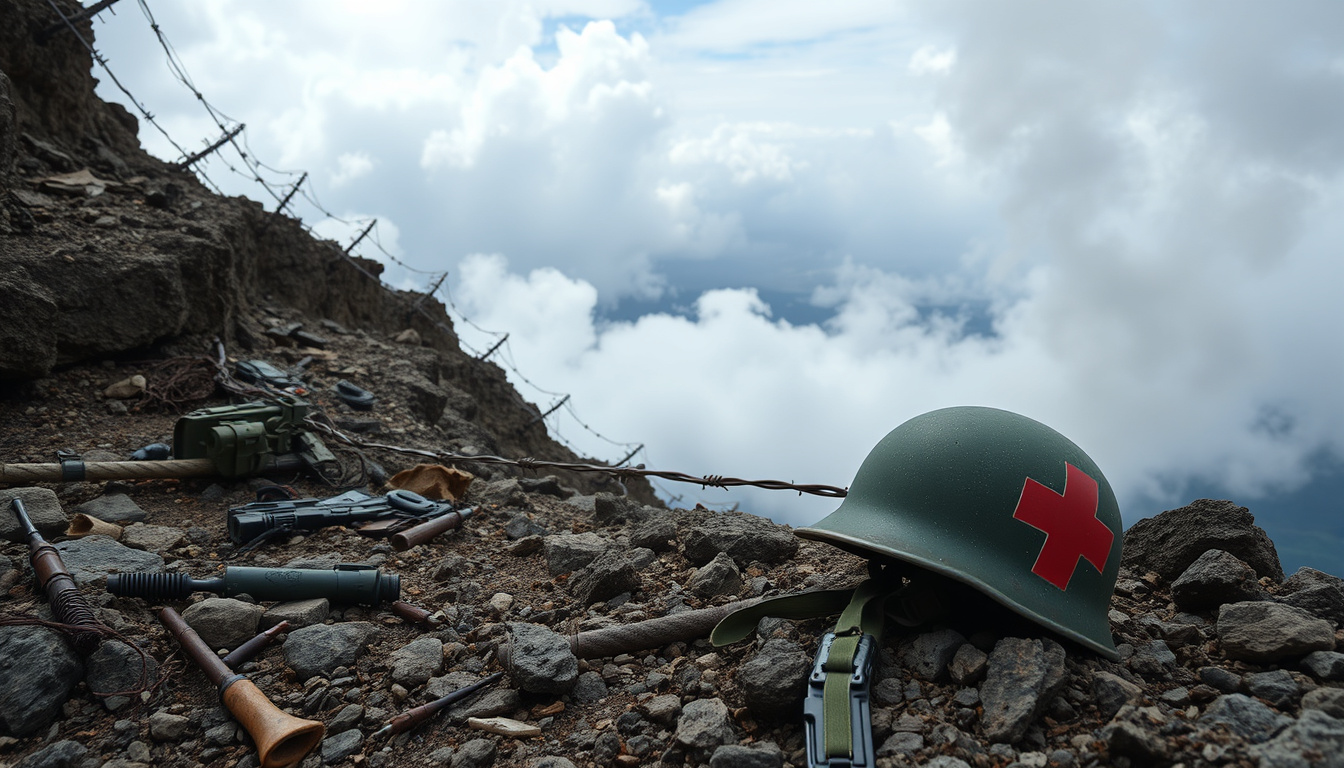
There’s a reason Hacksaw Ridge keeps starting the same argument after the credits roll: the true story already sounds like a script. Desmond Doss was a U.S. Army medic who refused to carry a weapon, yet came home from Okinawa with a Medal of Honor and a rescue count — commonly cited as 75 men by the National WWII Museum — that still makes people ask for a second look.
Lives saved on Hacksaw Ridge: 75 men (commonly cited) · Medal of Honor awarded: 1945 · Conscientious objector status: first to earn the Medal of Honor · Born – Died: 1919 – 2006
Quick snapshot
- Doss rescued 75 men from the escarpment in the fight for the Maeda plateau (National WWII Museum, WWII history museum).
- He never carried a weapon into combat; his role was medic, not rifleman (U.S. Army Center of Military History, official Army historical office).
- The Library of Congress identifies him as the only Medal of Honor recipient to serve under conscientious objector status (Eisenhower Foundation, presidential memorial foundation).
- The exact rescue count — 75 is official, but some accounts range up to 100 (Eisenhower Foundation, presidential memorial foundation).
- Why the Japanese never cut the ropes — no surviving account explains it (AskHistorians discussion, historian-moderated forum).
- Whether a sniper was involved in Doss’s wounding — the documented record points to grenade shrapnel (HH History, historical retelling).
- The Medal of Honor citation covers April 29 – May 21, 1945 — about three weeks of action, not a single night (Desmond Doss Official Website, family-estate biography).
- Doss served with the Medical Detachment of the 307th Infantry Regiment, 77th Infantry Division (see the key facts below). (Desmond Doss Official Website, family-estate biography)
- The 2016 film Hacksaw Ridge turned his story into a global reference point (U.S. Army, official military source).
- Historians and viewers still argue about what the movie changed — and why. (U.S. Army, official military source)
The snapshot shows a story that is both extraordinarily documented and frustratingly incomplete.
Key facts at a glance
Six quick reference points, one pattern: the official record is quieter — and more specific — than the screenplay.
| Label | Value |
|---|---|
| Full name | Desmond Thomas Doss (Wikipedia, community encyclopedia) |
| Born | February 7, 1919, Lynchburg, Virginia (Library of Virginia, state archives) |
| Died | March 23, 2006, Piedmont, Alabama (Wikipedia, community encyclopedia) |
| Unit | Medical Detachment, 307th Infantry Regiment, 77th Infantry Division (Desmond Doss Official Website, family-estate biography) |
| Role | Combat medic; conscientious objector (U.S. Army Center of Military History, official Army historical office) |
| Portrayed by | Andrew Garfield in Hacksaw Ridge (2016) (CBR, film culture outlet) |
The pattern: the movie needed a leading man; the record needed a witness. Both found the same person.
How many people did Desmond Doss really save?
Seventy-five is the number that follows Doss everywhere, and it is the commonly cited count. It is also a number with a range attached: the Eisenhower Foundation’s summary of the battle describes “at least 75 to 100” wounded soldiers rescued over the action’s full course. The gap exists because the official tally counted the men who came down the escarpment in Doss’s rope lowers, while unit-level accounts include the wider three-week fight around the Maeda plateau.
The debate over 75 versus 100 misses the point of the citation: Doss’s Medal of Honor was awarded for a method, not a scoreboard — one man, under fire, lowering the wounded by rope until his arms gave out.
Readers who want a single number can keep saying 75, and the record supports it. Readers who want the full scope can say 75 to 100. The honest answer to “how many?” is that the Army counted what it could count, and Doss stopped counting altogether.
How accurate was Hacksaw Ridge?
The film’s biggest change isn’t a scene — it’s time. The real actions that earned Doss’s Medal of Honor ran from April 29 to May 21, 1945, a stretch the movie folds into what feels like a single breathless sequence. CBR’s film-accuracy review flags that compression as one of its most significant departures from the record.
Did they really wait for Doss to finish praying?
- Veterans’ accounts, carried in the U.S. Army profile of Doss, say yes: the unit learned to wait while he prayed before going into combat.
The detail matters because it marks the unit’s arc. The same soldiers who mocked Doss during training later treated his faith as a kind of armor, and the film’s version of that wait is one of its most accurate emotional beats.
What the movie adds is a courtroom showdown that never happened. Doss was not arrested or court-martialed over his refusal to carry a weapon during training, a point the accuracy record returns to again and again.
The film’s biggest invented set piece — the court-martial — wasn’t needed to make Doss heroic. The bureaucracy he wore down was already the obstacle.
The historical record confirms the core while leaving the cinema’s embellishments on the cutting-room floor.
Was Desmond Doss shot by a sniper?
The wounding is real; the sniper is the part that varies. Historical summaries of Doss’s story agree that he was wounded on the ridge, but the specific mechanism differs across retellings — the documented version centers on grenade shrapnel, not a marksman’s bullet.
Did Desmond Doss actually help Japanese soldiers?
- Historical accounts of Doss’s service describe a medic who treated wounded Japanese soldiers as well as Americans, a detail the film keeps (Wikipedia, community encyclopedia).
- The detail fits the record: a man willing to die without a weapon had no interest in dividing the wounded by uniform.
The implication: the mercy is the least disputed part of the story — which says a lot about the kind of war Doss fought and the kind of soldier he refused to become.
How many wives did Desmond Doss have?
One — Dorothy Schutte. The Desmond Doss Official Website, the family-estate biography, documents the marriage that anchored Doss through the war and the long recovery that followed. The film’s romance is not a fabrication; it is the love story the record actually shows.
The pattern: everyone close to Doss described the same man — steady, private, and anchored by faith rather than attention. Dorothy was the one who saw that faith up close and built a life around it.
Why didn’t the Japanese cut the ropes at Hacksaw Ridge?
This is the question that follows every screening, and it has no clean answer. No surviving operational record explains why the ropes stayed in place overnight. The most common theory, raised in the historian-moderated AskHistorians discussion of the film, is also the simplest: the Japanese defenders did not expect anyone to come back up the cliff, so they never bothered to cut the one route that kept carrying Americans toward them.
Part of the confusion comes from the movie itself, which makes the escarpment look like a towering wall. The real Maeda Escarpment was steep, but it was a working battlefield with multiple approaches — which made an overlooked rope ladder more plausible than Hollywood’s version suggests.
The unsolved ropes question is the best proof the story isn’t a screenwriter’s fantasy: real battles leave loose ends that Hollywood would never allow.
The catch: the loose end is exactly the kind of detail a fiction writer would tie up. The fact that it stayed loose is a sign the story is true.
What happened to Desmond Doss after the war?
Doss came home to a ceremony unlike any other in the Army’s medal record: he was the first conscientious objector to receive the Medal of Honor, the distinction the Library of Congress still uses to introduce him. Then came a quieter fight. The same faith that carried him up the ridge carried him through tuberculosis, the loss of a lung, and a life in Georgia that he never turned into a performance, according to the historical retelling that tracks his full life.
He died in Piedmont, Alabama, on March 23, 2006 — a decade before Hacksaw Ridge reached theaters. The real man never needed the movie to validate him, and the movie, in its best moments, seems to know it.
What this means: the hardest part of Doss’s story isn’t the cliff. It’s the 60 years he spent living quietly with what he’d done on it.
Movie vs. reality: the key differences
Three points of comparison, one pattern: the film stays faithful to the man and reshapes the battlefield around him.
| Point of comparison | In Hacksaw Ridge | In the historical record |
|---|---|---|
| The 75-man rescue | Doss carries and lowers 75 men off the ridge in a concentrated sequence. | 75 is the official count; the Eisenhower Foundation describes “at least 75 to 100” rescued over the full battle. |
| The court-martial | Doss is formally tried for refusing to carry a weapon. | No court-martial over his weapon refusal during training; the scene is a dramatization, per film-accuracy reviews. |
| The escarpment | A towering, nearly vertical cliff. | A steep ridge — dramatized on screen, as the historian-moderated discussion notes. |
The trade-off: the filmmakers didn’t need to invent a better man — they needed to compress a longer one. The compressions are the fiction; the center is documented.
Key dates in Desmond Doss’s life
- — Born in Lynchburg, Virginia (Library of Virginia, state archives).
- — The actions at Hacksaw Ridge that anchor the Medal of Honor citation.
- — Receives the Medal of Honor, a first for a conscientious objector.
- — Dies in Piedmont, Alabama.
The pattern: almost everything that made Doss famous happened inside a three-week window — and the consequences lasted six decades.
What’s confirmed, what’s still unclear
Confirmed facts
- Doss served as a combat medic and never carried a weapon (Library of Congress, U.S. national library).
- The Medal of Honor citation covers a three-week stretch of actions, April 29 – May 21, 1945 (Desmond Doss Official Website, family-estate biography).
- The rescue count of 75 is the official figure in the record (National WWII Museum, WWII history museum).
What’s unclear
- The exact rescue count: 75 is official, but postwar accounts stretch the range (Eisenhower Foundation, presidential memorial foundation).
- Why the Japanese left the ropes uncut: no definitive account survives (AskHistorians discussion, historian-moderated forum).
- Whether a sniper was involved in Doss’s wounding: the documented record points to grenade shrapnel (HH History, historical retelling).
The dividing line: everything Doss controlled — his refusal to fight, his willingness to climb back up — is confirmed. Everything the Army couldn’t count is where the questions live.
Voices from the record
“I couldn’t stay back while my buddies were in trouble.”
— Desmond Doss, quoted in the Library of Congress Veterans History Project (U.S. national library)
“I’m proud of you.”
— President Harry S. Truman, presenting the Medal of Honor on October 12, 1945, as recorded by the National WWII Museum (WWII history museum)
Two voices, one description: the same man showed up at the cliff, at the ceremony, and at home. That consistency is what makes the film’s accuracy debate feel so unnecessary.
Why the true story still matters
The record is clear enough for a verdict: Desmond Doss was a real man who did the things the film says he did, minus the theatrical packaging. The count is debated at the edges, the ropes question has no clean answer, and the court-martial is a screenplay invention — but the center holds. For moviegoers who want the truth, the decision is clear: check every dramatic beat against the Medal of Honor citation, or accept the film for what it is — two hours of a story that never needed exaggeration.
Frequently asked questions
How did Desmond Doss become a conscientious objector?
Raised as a Seventh-day Adventist, Doss took the commandment “Thou shalt not kill” as a personal boundary. The Library of Congress documents how he resolved the conflict: serve as a medic, carry no weapon, and let the faith he practiced at home travel with him to the Pacific.
What weapon did Doss carry?
None. He refused to carry a weapon and the Army eventually assigned him to a Medical Detachment, where his equipment was medical kits and ropes. That fact appears throughout the record cited above.
Was Doss ever court-martialed?
Not over his refusal to carry a weapon during training. The court-martial scene in Hacksaw Ridge is a dramatization, according to film-accuracy reviews.
Did Desmond Doss’s brother survive WWII?
Yes. Harold “Hal” Doss served in the U.S. Navy and survived the war, a biographical point that sits inside the broader accuracy record tracked by historian-moderated discussions of the film.
How old was Doss when he died?
87. He was born in 1919 and died in 2006 — the dates sit in the key facts above.
These answers resolve the most common points of confusion around Doss’s extraordinary life.
Related reading
- Harriet Tubman: Biography, Underground Railroad, Family & Legacy
- Thomas Cromwell: His Life, Death, and Lasting Legacy
Both internal pieces share the same editorial DNA — separating popular myth from documented fact.
Related stories




Richard Vane is Senior Reporter at MorningTimes.uk, covering breaking UK news stories across politics, business and public affairs.