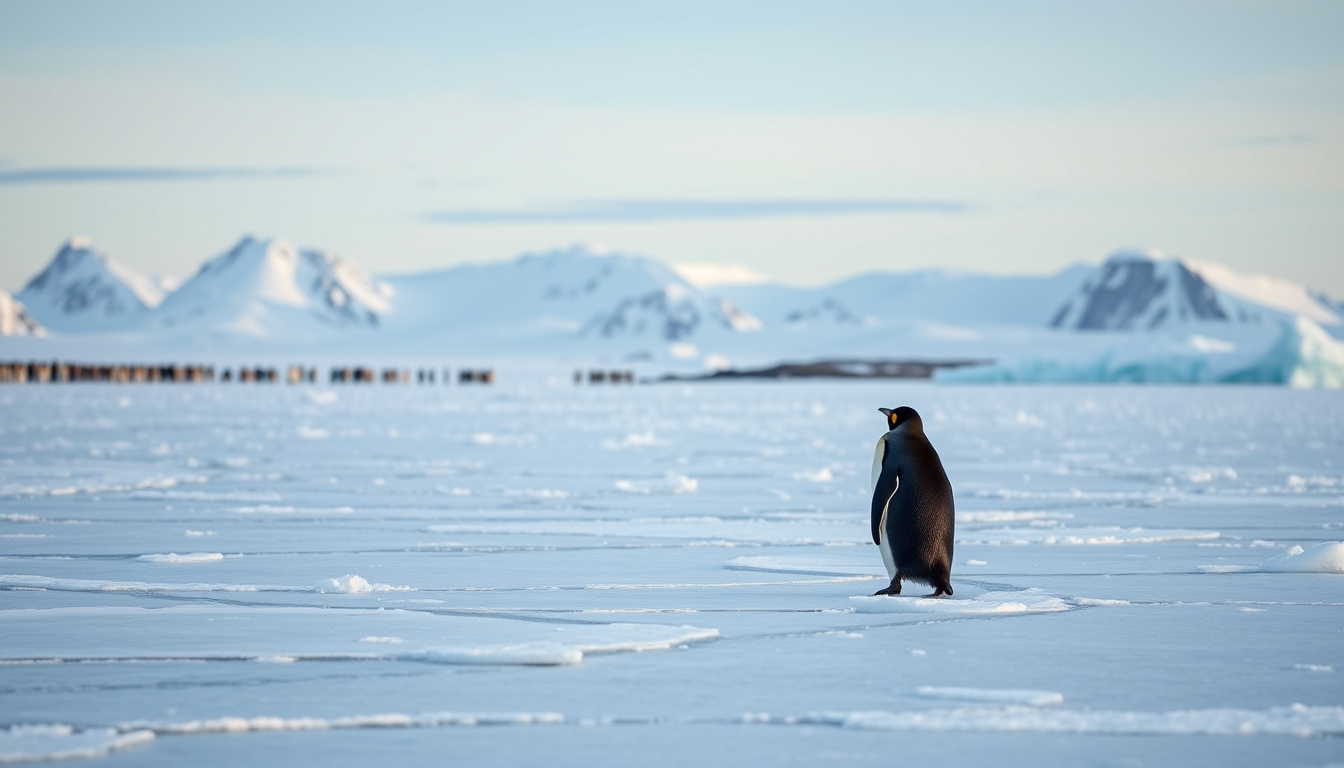
Few sights in the natural world rival the calm dignity of an emperor penguin standing alone on Antarctic sea ice. But that ice — the species’ entire reason for existing — is vanishing, and in April 2026 the IUCN officially moved the emperor penguin from Near Threatened to Endangered.
Average height: 122 cm (48 in) · Average weight: 23 kg (51 lb) · Population estimate: ~265,000–278,500 breeding pairs · Conservation status: Endangered (IUCN 3.1) · Endemic region: Antarctica · Largest penguin species: Yes
Quick snapshot
- Tallest penguin species (CBC News (Canadian public broadcaster))
- Breeds exclusively on stable Antarctic sea ice (IUCN (global conservation authority))
- Males incubate a single egg for 65–75 days without eating (British Antarctic Survey (polar research institute))
- Can dive deeper than 500 meters (The New York Times (premium news outlet))
- Exact impact of climate change on individual colony survival rates (IUCN Red List Species of the Day PDF (scientific record))
- Complete winter foraging behavior of juvenile emperor penguins (British Antarctic Survey (polar research institute))
- Precise total population count with annual variation (IUCN Red List (species assessment))
- April 2026: IUCN reclassifies emperor penguin as Endangered due to sea‑ice loss (IUCN (global conservation authority))
- Populations projected to halve by the 2080s under current climate trends (IUCN (global conservation authority))
The table below summarizes key physical and ecological data for the emperor penguin.
| Attribute | Value |
|---|---|
| Scientific name | Aptenodytes forsteri |
| Average height | 122 cm (48 in) |
| Average weight | 23 kg (51 lb) |
| Lifespan | 15–20 years in the wild |
| Diet | Fish, squid, krill |
| Conservation status | Endangered (IUCN 3.1) |
| Population | ~265,000–278,500 breeding pairs |
| Region | Antarctica |
Which penguin is bigger, king or emperor?
Emperor penguins are the undisputed heavyweight champions of the penguin world. An adult emperor stands roughly 122 cm tall and weighs about 23 kg, while a king penguin — the next largest — reaches only 95 cm and tips the scales at 18 kg. The difference is driven by the emperor’s need to survive the brutal Antarctic winter; its greater mass provides better insulation and energy reserves. When comparing the two side by side, the emperor is taller, heavier, and built for an environment that would quickly overwhelm its southern cousin.
How tall is an emperor penguin compared to a king penguin?
The side-by-side comparison reveals the size difference clearly.
| Feature | Emperor penguin | King penguin |
|---|---|---|
| Average height | 122 cm (48 in) (CBC News (Canadian public broadcaster)) | 95 cm (37 in) |
| Average weight | 23 kg (51 lb) (The New York Times (premium news outlet)) | Up to 18 kg (40 lb) |
| Breeding habitat | Stable Antarctic sea ice (IUCN (global conservation authority)) | Sub‑Antarctic islands and beaches |
| Breeding season | Winter (March–September) | Spring–Summer |
| Egg incubation | Male alone for 65–75 days (British Antarctic Survey (polar research institute)) | Both parents, shorter duration |
| Maximum dive depth | Over 500 m (The New York Times (premium news outlet)) | ~300 m |
The implication: Emperor penguins are larger because they must endure longer fasting periods and colder temperatures. Their extra body mass is not just for show — it’s a survival tool.
What is the weight difference between emperor and king penguins?
A typical emperor penguin weighs about 5 kg more than a king penguin, but the gap can reach 27 kg when the emperor is fully fed and the king is lean. That extra bulk allows emperor penguins to store enough fat to survive the 65‑ to 75‑day incubation fast.
Why are penguins called emperors?
The common name “emperor” was chosen to reflect the species’ majestic size and stature — it is the largest living penguin, commanding the same sort of visual dominance that an emperor holds over a kingdom. The scientific name Aptenodytes forsteri carries its own history: “Aptenodytes” comes from Greek words meaning “featherless diver,” while “forsteri” honors the German naturalist Johann Reinhold Forster, who first described the species in 1844. Earlier explorers had glimpsed emperor penguins during the 1820s, but Forster gave the bird its official place in taxonomy. For more on explorers who faced extreme conditions, see our article on Bodies on Everest: Famous Corpses, Death Toll & Rules.
Forster’s labeling gave science a name, but the bird’s common title — “emperor” — is a human measure of its visual presence, not a biological function. That human lens has often masked the species’ real vulnerability: even a majestic bird can be undone by ice that no longer stays frozen.
The pattern: size earned the emperor its regal name, but the same size now ties its survival to a vanishing habitat.
Who discovered the emperor penguin?
Explorers on early Antarctic expeditions likely saw emperor penguins in the 1820s, but the species was formally described by Johann Reinhold Forster in 1844 based on specimens collected during James Cook’s voyages. Forster, a naturalist aboard the HMS Resolution, also gave the bird its enduring scientific name.
What does the scientific name Aptenodytes forsteri mean?
“Aptenodytes” combines Greek words for “without” and “feather diver” — a reference to the bird’s inability to fly and its superb diving ability. “Forsteri” is a latinized tribute to Johann Reinhold Forster. So the name literally translates to “Forster’s featherless diver.”
“The reclassification to Endangered is a direct result of climate-driven sea-ice loss, which is eroding the species’ breeding habitat.” — IUCN (global conservation authority)
Are emperor penguins friendly?
Emperor penguins are not aggressive toward humans, but they are wild animals that should never be approached. Researchers who study them in Antarctica describe them as curious — they will sometimes waddle closer to examine a scientist — but they can peck or bite if threatened. Their behavior is driven by instinct and survival, not friendliness in the human sense. Among penguin species, the gentoo penguin is often considered the most tolerant of human presence, while the emperor remains cautious but not hostile.
“Emperor penguins are uniquely adapted to Antarctic sea ice, but that adaptation becomes a liability when the ice disappears.” — British Antarctic Survey (polar research institute)
What are 5 fun facts about emperor penguins?
Here are five remarkable traits of the emperor penguin:
- Deep divers: They can dive deeper than 500 meters—among the deepest of any bird. (The New York Times (premium news outlet))
- Winter breeders: Emperor penguins are the only penguin species that breeds during the Antarctic winter. (IUCN (global conservation authority))
- Male incubation marathon: Males incubate a single egg for 65–75 days without eating. (British Antarctic Survey (polar research institute))
- Huddle for warmth: They form tightly packed huddles of thousands to conserve heat in temperatures as low as -60°C. (British Antarctic Survey (polar research institute))
- Chick crèches: Chicks gather in crèches for protection while both parents forage. (British Antarctic Survey (polar research institute))
The takeaway: These adaptations let emperor penguins thrive in the world’s most extreme environment, but they also lock the species to a habitat that is shrinking rapidly.
What is the emperor penguin’s habitat?
Emperor penguins are exclusive to Antarctica. They breed on stable sea ice—fast ice attached to the coastline or grounded icebergs—and forage in the surrounding open ocean. Sea ice is not just a platform; it is central to their breeding, molting, and feeding cycles. As Antarctic sea ice reaches record lows, colonies face unprecedented habitat loss. (IUCN (global conservation authority))
The catch: Emperor penguins’ entire life cycle is timed to sea ice. When the ice breaks up early, chicks may drown or starve before they can fledge.
The threat: Without sustained sea ice, emperor penguins cannot breed successfully, and the species faces a projected population decline of 50% by the 2080s.
phys.org, bas.ac.uk, wwf.org.uk, penguinscience.com, bbc.com, wwf.org.uk, kulturview.se
Frequently Asked Questions
How tall do emperor penguins grow?
Emperor penguins reach an average height of 122 cm (48 in), making them the tallest penguin species.
What do emperor penguins eat?
Their diet consists mainly of fish, squid, and krill, which they catch during deep dives in Antarctic waters.
How long do emperor penguins live?
In the wild, emperor penguins typically live 15–20 years.
Are emperor penguins endangered?
Yes, as of April 2026 the IUCN lists them as Endangered due to climate-driven sea-ice loss.
Where do emperor penguins live?
Emperor penguins are endemic to Antarctica, breeding exclusively on stable sea ice around the continent.
How do emperor penguins keep warm?
They rely on thick blubber, dense feathers, and huddling behavior to survive Antarctic winter temperatures.
Do emperor penguins have predators?
Adults are occasionally hunted by leopard seals and killer whales; chicks and eggs are vulnerable to skuas and giant petrels.
How deep can emperor penguins dive?
They are known to dive deeper than 500 meters, with recorded depths exceeding 565 meters.
For a biographical perspective on notable figures, see James Baldwin: Biography, Works, Quotes, and Beliefs Explained.
The emperor penguin’s fate now depends on global efforts to curb climate change and protect Antarctic sea ice. Without decisive action, the world’s largest penguin could lose its place on the ice.

Richard Vane is Senior Reporter at MorningTimes.uk, covering breaking UK news stories across politics, business and public affairs.