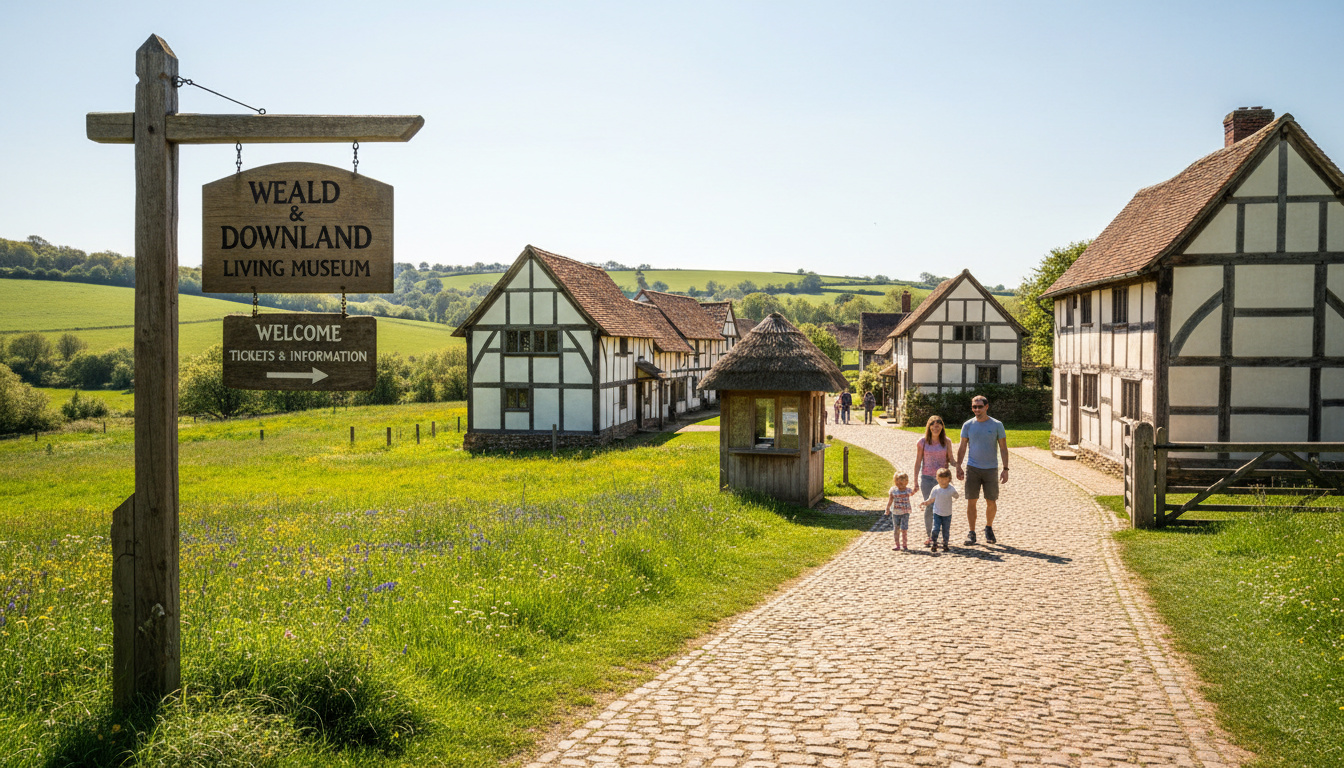

The Weald & Downland Living Museum preserves over 50 historic buildings across a 40-acre site in Singleton, West Sussex. Founded in the 1970s and relocated to its current location in 2015, the open-air museum rescues and reconstructs structures dating from 950AD to the 19th century.
Visitors encounter medieval houses, working farms, and traditional craftspeople demonstrating rural trades. The museum operates as a registered charity, offering educational programs alongside its public exhibitions.
This guide consolidates verified visitor information including seasonal hours, ticket pricing structures, directional guidance, and accessibility protocols based on official documentation and third-party verification.
What are the Weald and Downland Museum opening times?
The museum maintains distinct seasonal schedules. During winter months (2 January to 29 March 2026), the site opens from 10am to 4pm, with last admission at 2pm for general visitors and 3pm for members. Summer operations (30 March to 31 October 2026) extend hours to 10am through 5pm, with last entry at 3pm for standard tickets and 4pm for members. Historic houses close 30 minutes before the museum’s final closing time. The café operates from 9am to 4pm in winter and 9am to 5pm in summer, serving hot food until 3pm year-round. The facility typically closes around Christmas, though specific 2026 dates require direct confirmation.
Singleton, Chichester, West Sussex, England
50+ rescued historic buildings spanning 1,000 years of English history
40 acres with gardens, farm animals, and woodland walks
Open-air living history museum
- Book tickets online in advance to secure lower pricing tiers
- Historic houses cease admission 30 minutes before museum closing
- Dogs permitted on short leads throughout the grounds
- Site operates daily excepting potential Christmas closures
- Allow approximately four hours for comprehensive exploration
- Café accessible without museum admission ticket
- Telephone 01243 811363 for event-specific scheduling variations
| Fact | Details |
|---|---|
| Established | 1970s; relocated to Singleton site 2015 |
| Buildings | Over 50 structures, 950AD to 19th century |
| Winter Hours (2026) | 10am–4pm (last admission 2pm general, 3pm members) |
| Summer Hours (2026) | 10am–5pm (last admission 3pm general, 4pm members) |
| Café Hours | 9am–4pm winter; 9am–5pm summer |
| Contact | 01243 811363 |
| Policy | Non-smoking and no-vaping throughout site |
| Ticketing | Available via official site and Digitickets platform |
The museum operates daily barring holiday periods, though some secondary documentation references slight variations such as 10:30am openings during early winter periods. The official website provides the authoritative 2026 schedule. Location details place the museum in Singleton, Chichester, accessible via public transport or private vehicle, with specific routing available through WhichMuseum listings and Visit Southeast England.
How to get Weald and Downland Museum tickets and prices?
Admission pricing operates on a dual-tier system distinguishing between peak season (30 March to 31 October) and off-peak periods (1 November to 29 March). Online advance booking generates significant savings compared to walk-in rates. Children aged 0–4 enter without charge, though visitors 17 and under require adult accompaniment. The museum additionally offers Universal Credit concessions exclusively through online purchase, pricing adult tickets at £5 and child tickets at £1.
What are the specific ticket categories and costs?
| Category | Off-Peak Online | Off-Peak Walk-In | Peak Online | Peak Walk-In |
|---|---|---|---|---|
| Adult | £14.90 | £16.75 | £16.90 | £18.75 |
| Senior (60+) | £13.10 | £14.75 | £15.10 | £16.75 |
| Student 18+ (ID required) | £11.30 | £12.75 | £13.30 | £14.75 |
| Child 5–17 | £6.80 | £7.75 | £8.80 | £9.75 |
| Disabled + Carer | £6.80 | £7.75 | £8.80 | £9.75 |
| 1 Adult Family (1+3) | £25.80 | £29.00 | £29.80 | £33.00 |
| 2 Adult Family (2+3) | £42.00 | £47.00 | £46.00 | £51.00 |
What discount schemes provide value equivalent to 2-for-1?
No explicit 2-for-1 promotional offers appear in current documentation. However, family tickets deliver proportional value, with the 2 Adult Family option covering two adults and three children. The Art Fund National Art Pass provides 50% off standard entry, reducing walk-in peak admission to approximately £9.38. Annual membership, costing roughly 2.5 times a single ticket price, enables unlimited repeat access throughout the year. Daytime events remain included within standard admission unless specifically designated as ticketed separately.
Online reservations via the museum’s official ticketing portal or Digitickets reduce individual admission costs by up to £1.85 per ticket. While visitors may stay as long as desired once admitted, pre-booking guarantees entry during capacity-limited periods.
How does the Art Fund discount work?
According to Art Fund, National Art Pass holders receive 50% reduction on standard entry fees. This applies to the walk-in rate of £18.75 during peak season, resulting in a £9.38 admission charge. The discount requires presentation of a valid membership card at the admission desk.
Where to find Weald and Downland Living Museum photos?
Visual documentation of the museum’s collections appears across multiple platforms. The official website hosts galleries depicting the 40-acre landscape, rescued medieval structures, and working craft demonstrations. Third-party tourism sites provide visitor-generated imagery showcasing the watermill, dairy, bakehouse, and 18th-century barn and stable complex known as May Day Farm.
What architectural subjects appear in official photography?
The museum’s building collection spans residential, agricultural, and industrial typologies. Recent exhibit additions include a dairy and bakehouse positioned near the operational watermill, alongside an 18th–19th century barn and stable structure. These join existing medieval houses and farmsteads relocated from their original sites throughout the Weald and Downland region.
Where can prospective visitors view user-generated imagery?
TripAdvisor hosts extensive visitor photography illustrating rural trades, seasonal activities, and animal encounters. Sussex Modern provides curated visual documentation emphasizing the site’s architectural significance within contemporary contexts. The official museum website maintains authoritative photographic records of current exhibitions.
Can you host a wedding at Weald and Downland Museum?
No specific information regarding wedding venue availability or private event hosting protocols is publicly available. The museum’s operational focus centers on living history exhibitions, public educational courses in rural crafts and building conservation, and daytime visitor programming. The site’s charitable status and emphasis on heritage preservation suggest limited flexibility for private functions.
Who should couples contact regarding venue inquiries?
Direct communication with the administration office represents the sole verified channel for event questions. The telephone number 01243 811363 connects to the museum’s operational headquarters, where staff can clarify current policies regarding private bookings, available spaces within the historic buildings, and any restrictions applicable to evening or weekend events.
No official wedding packages, capacity figures, or ceremonial guidelines appear in publicly accessible records. Interested parties must initiate direct inquiry to obtain current availability and pricing structures.
The museum functions primarily as a daytime educational charity. Evening access, catering restrictions, and noise limitations may affect event feasibility. Verification of these parameters requires administrative consultation prior to planning.
How has the Weald and Downland Living Museum developed over time?
- 950AD: Construction of earliest surviving buildings later acquired by the museum
- 1970s: Museum foundation with mission to rescue threatened historic structures
- 2015: Relocation to current Singleton site, enabling expanded collection display
- Ongoing: Continued building rescue operations and conservation education programs
The chronological progression reflects shifting approaches to architectural preservation, from individual building salvage to comprehensive landscape interpretation. The 2015 relocation marked a significant institutional evolution, providing permanent infrastructure for the growing collection of vernacular architecture.
What information is verified versus uncertain?
| Established Information | Information That Remains Unclear |
|---|---|
| 2026 seasonal opening times (10am–4pm/5pm) | Exact Christmas closure dates for 2026 |
| Peak/off-peak pricing tiers and online discounts | Specific wedding venue packages or availability |
| Singleton, Chichester location | Detailed internal site map with accessibility markings |
| Over 50 buildings spanning 950AD–19th century | Precise building count variations in different sources |
| Dogs permitted on short leads | Specific indoor building access for assistance animals |
What distinguishes this museum from other heritage sites?
The Weald & Downland Living Museum occupies a distinct position within British heritage preservation through its emphasis on relocation and reconstruction rather than static site interpretation. Unlike properties maintaining original locations, this institution physically deconstructs threatened buildings throughout the Weald and Downland region, transporting and rebuilding them within the Singleton landscape. The approach creates a chronological architectural panorama spanning medieval, early modern, and Victorian periods within a single visitor experience. For those interested in European holiday traditions, Німецькі різдвяні ярмарки 2025 offers a comprehensive guide.
The living history methodology further differentiates the museum from artifact-focused institutions. Working craftspeople demonstrate traditional building techniques, agricultural practices, and rural trades using authentic tools and methods. This operational philosophy aligns more closely with experimental archaeology than conventional museum display, prioritizing functional interpretation over exhibition aesthetics. For visitors seeking alternative historical experiences, the Ashby de la Zouch Castle Guide documents a contrasting approach to medieval heritage preservation through ruined structure conservation.
Educational programming constitutes a primary charitable objective, with courses in historic building conservation, traditional craft skills, and rural trades offered throughout the year. This instructional mission generates revenue supporting the site’s maintenance while preserving endangered knowledge systems alongside physical structures.
What do official sources document about the collection?
Over 50 rescued historic buildings
— Weald & Downland Living Museum official documentation
40 acres with gardens, farm animals
— Visitor site analysis and descriptive records
Historic houses close 30 minutes before museum closing
— Operational guidelines, official visitor information
What should visitors prioritize when planning a visit?
Advance online ticket purchase delivers optimal value, reducing admission costs while securing preferred entry times. Visitors should allocate approximately four hours for comprehensive site exploration, accounting for the 40-acre terrain and multiple historic interiors. Checking the “What’s On” calendar before arrival ensures awareness of special events or unexpected closures. Those seeking additional UK cultural destinations might consult the Manchester Things to Do guide for urban historical contrasts.
Frequently Asked Questions
Are dogs allowed at the Weald and Downland Museum?
Yes. Dogs are permitted throughout the 40-acre site provided they remain on short leads. Owners must maintain control of animals near livestock and historic building interiors where access is permitted.
Is smoking or vaping allowed on the premises?
No. The museum maintains a strict non-smoking and no-vaping policy across all outdoor and indoor areas, including gardens, building interiors, and café terraces.
How long does a typical visit last?
Official recommendations suggest allowing four hours for full exploration of the 50+ buildings, gardens, and craft demonstrations. Visitors may remain on site until closing once admitted.
Can I visit the café without purchasing a museum ticket?
Yes. The café operates independently of museum admissions, accessible to non-visitors during operational hours (9am–4pm winter, 9am–5pm summer).
What discount does the Art Fund National Art Pass provide?
The Art Pass grants 50% reduction on standard walk-in admission, reducing peak adult entry from £18.75 to approximately £9.38. Present valid membership at the ticket desk.
Are all historic buildings fully accessible?
No. Due to the ancient nature of reconstructed medieval and early modern structures, not all buildings offer full wheelchair or mobility accessibility. Terrain varies across the 40-acre rural site.
Do I need to book tickets in advance?
While walk-in admission is available, advance online booking guarantees entry during capacity-limited periods and reduces ticket prices by up to £1.85 per person.
Related stories





Marcus Bell covers UK politics, public policy and government for MorningTimes.uk.