Frank Lloyd Wright’s buildings don’t just sit on the land — they often seem to grow out of it. By the time he died in 1959, he had designed over 1,000 structures, though only about 532 were ever built, according to the Frank Lloyd Wright Foundation (official foundation).
Structures designed: over 1,000 ·
Completed buildings: approximately 532 ·
Years active: 1887–1959 ·
Famous project: Fallingwater (1935) ·
Architectural movement: Prairie School / Organic Architecture ·
UNESCO World Heritage sites: 8 (including Taliesin and Fallingwater)
Quick snapshot
- Designed over 1,000 structures (Frank Lloyd Wright Foundation)
- Pioneer of organic architecture (Encyclopaedia Britannica)
- Fallingwater is among the greatest 20th‑century buildings (Fallingwater)
- Three legal marriages and seven children (Frank Lloyd Wright Foundation) (Frank Lloyd Wright Foundation)
- Exact number of completed buildings varies: Foundation says 532, Britannica says about 380 (Encyclopaedia Britannica)
- Details of his relationship with Mamah Borthwick remain debated by historians
- The total number of designs he authored ranges from 1,000 to 1,114 depending on the source (Frank Lloyd Wright Foundation)
- 1867: Born in Richland Center, Wisconsin (Frank Lloyd Wright Foundation)
- 1935: Designed Fallingwater (Frank Lloyd Wright Foundation)
- 1959: Died; Guggenheim Museum opened (Frank Lloyd Wright Foundation)
- Eight Wright sites designated UNESCO World Heritage (Frank Lloyd Wright Foundation)
- Fallingwater continues to draw over 150,000 visitors annually (Fallingwater)
- His principles of organic architecture influence contemporary sustainable design
Six key facts that anchor Wright’s biography:
| Fact | Detail |
|---|---|
| Full name | Frank Lloyd Wright Sr. |
| Born | June 8, 1867, Richland Center, Wisconsin |
| Died | April 9, 1959, Phoenix, Arizona |
| Main style | Prairie School / Organic Architecture |
| Number of designs | Over 1,000 |
| Most famous work | Fallingwater (Mill Run, Pennsylvania) |
Wright’s career spanned seven decades, yet he never joined the American Institute of Architects — and publicly criticized it. His refusal to play by the profession’s rules helped him break the mold but also kept him perpetually in debt.
What is Frank Lloyd Wright famous for?
Pioneer of organic architecture
- Wright coined the term “organic architecture” to describe buildings that harmonize with their inhabitants and environment (Encyclopaedia Britannica).
- The philosophy is most clearly exemplified by Fallingwater (Fallingwater).
- He believed a building should appear to grow easily from its site and be shaped to harmonize with its surroundings (Encyclopaedia Britannica).
Wright is widely regarded as the greatest American architect. The Frank Lloyd Wright Foundation notes that the American Institute of Architects itself awarded him that title. His influence extends beyond buildings: he authored 20 books and hundreds of articles (Fallingwater).
Designer of over 1,000 structures
- Wright’s office produced designs for 1,114 architectural works, and 532 were realized (Frank Lloyd Wright Foundation).
- His output included homes, churches, museums, office buildings, and a mile‑high skyscraper that was never built.
- Eight of his buildings are UNESCO World Heritage sites, including Taliesin and Fallingwater (Frank Lloyd Wright Foundation).
The pattern: Wright’s volume alone would mark him as prolific, but it’s the range — from low‑cost Usonian houses to the spiral of the Guggenheim — that secures his fame.
His prolific output often came at a cost: many clients struggled with cost overruns and leaking roofs. Wright’s artistic vision rarely bowed to budget realities.
What is Frank Lloyd Wright’s style of architecture called?
Prairie style characteristics
- The Prairie style emphasizes horizontal lines, low-pitched roofs, and deep overhangs that echo the flat landscape of the American Midwest (Encyclopaedia Britannica).
- Open floor plans replaced the compartmentalized rooms of Victorian homes.
- Windows are grouped in bands to visually stretch the building outward.
Wright developed the Prairie School in the first decade of the 1900s, producing houses such as the Robie House (1909) that became icons of modern domestic design.
Organic architecture principles
- Organic architecture treats the building as a unified whole where every element relates to every other element and to the site (Encyclopaedia Britannica).
- Wright was influenced by Japanese design, which he encountered at the 1893 World’s Columbian Exposition, and by the natural forms of the Wisconsin landscape where he grew up (Illinois Historic Preservation Division).
- The Illinois Historic Preservation Division calls Wright an architect, designer, artist, and educator — a total designer rather than a mere builder.
The catch: “Prairie style” and “organic architecture” are often used interchangeably, but Wright saw organic architecture as a deeper philosophy that spanned his entire career, while Prairie was a specific early expression of it.
What is Fallingwater?
Design and construction (1935)
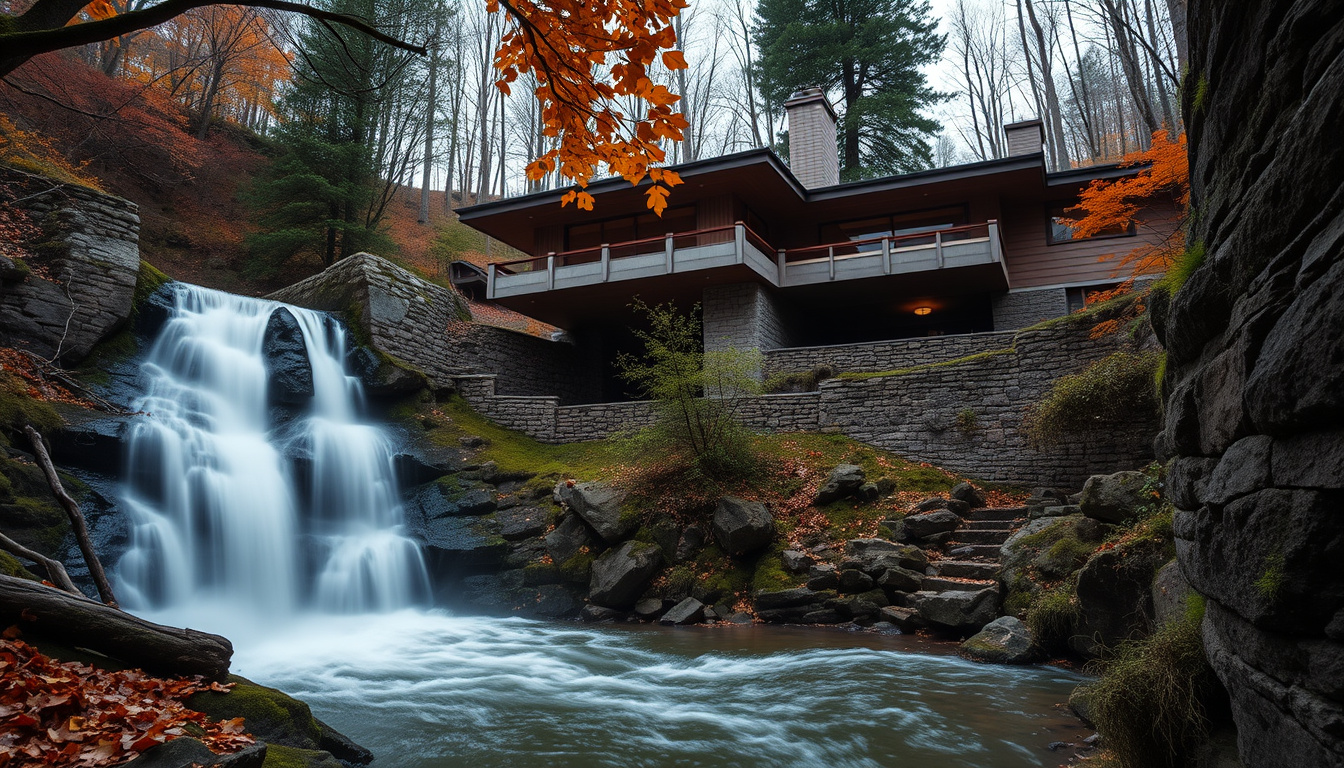
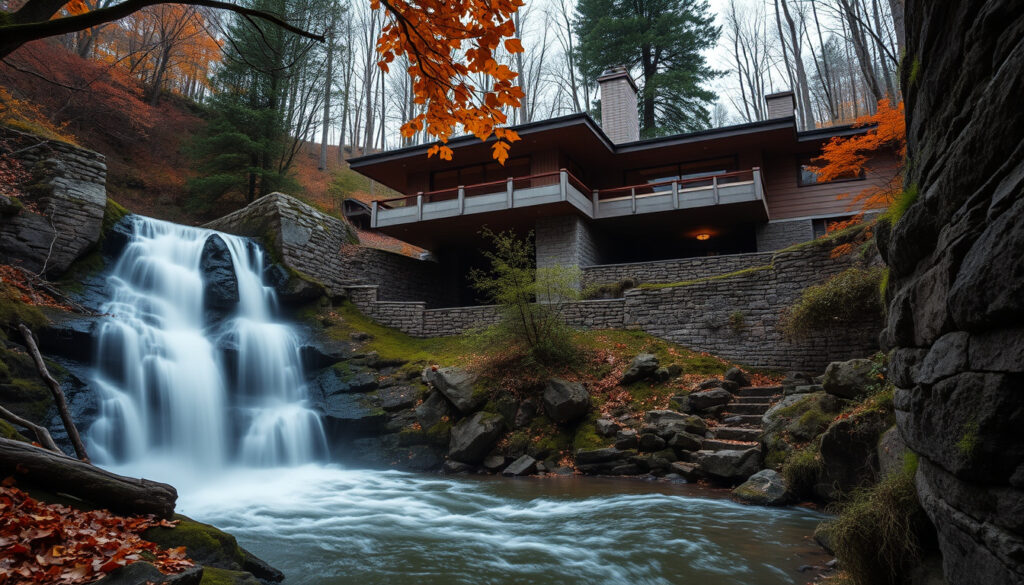
- Fallingwater is a house built over a waterfall in rural Pennsylvania for department‑store magnate Edgar J. Kaufmann and his wife Liliane (Frank Lloyd Wright Foundation).
- Completed in 1939, it features cantilevered terraces that appear to float above Bear Run Creek.
- Wright placed the main living area directly over the falls, with a stairway descending to the water’s edge (Fallingwater).
The design was so radical that Kaufmann initially hesitated — but Wright’s drawings, sketched in a single afternoon, were instantly convincing.
Why it is considered Wright’s masterpiece
- Fallingwater is a National Historic Landmark and open to the public for tours (Frank Lloyd Wright Foundation).
- The American Institute of Architects named it “the best all‑time work of American architecture” in 1991.
- UNESCO inscribed the building as part of “The 20th‑Century Architecture of Frank Lloyd Wright” World Heritage list in 2019 (Frank Lloyd Wright Foundation).
What this means: Fallingwater is the single structure that best encapsulates Wright’s organic philosophy — the building doesn’t just sit on the waterfall, it becomes part of it.
What did Frank Lloyd Wright do that was controversial?
Personal scandals
- In 1909, Wright left his first wife, Catherine Tobin, and their six children to travel to Europe with Mamah Borthwick, a client’s wife (Frank Lloyd Wright Foundation).
- The scandal made front‑page news and forced Wright to rebuild his career away from Chicago.
- In 1914, while Wright was away, a servant set fire to Taliesin (his Wisconsin home and studio), killing Mamah and six others.
Wright later married Miriam Noel (1923, separated after a year) and then Olgivanna Lazovich (1928), a Montenegrin dancer who became his companion until his death.
Professional conflicts and financial troubles
- Wright refused to join the American Institute of Architects and openly attacked its fee‑setting, ethical codes, and education standards (The Atlantic).
- He was constantly in debt, often borrowing from clients and selling art from his collection to fund his lavish lifestyle.
- His arrogance cost him commissions — several potential clients walked away after his blunt criticisms of their taste.
The implication: Wright’s personal life was as unconventional as his architecture. The same stubbornness that produced masterpieces also wrecked relationships and drained finances.
How many wives and children did Frank Lloyd Wright have?
Three marriages, seven children
- Wright married Catherine Tobin in 1889 (six children); they divorced in 1922.
- He married Miriam Noel in 1923 (separated 1924, divorced 1927).
- He married Olgivanna Lazovich in 1928; they had one daughter together and she raised his children from previous relationships (Frank Lloyd Wright Foundation).
- In total, Wright had seven children: six with Catherine and one (Loyal) with Olgivanna.
One of his sons, John Lloyd Wright, invented Lincoln Logs in 1916, inspired by the interlocking beams used in his father’s buildings.
The pattern: Wright’s family life was turbulent — he outlived three of his children and buried one wife (Mamah) who was not legally his spouse. Yet his children remained a recurring presence in his stories.
Timeline
- 1867 – Frank Lloyd Wright born in Richland Center, Wisconsin (Frank Lloyd Wright Foundation).
- 1889 – Marries Catherine Tobin; builds first home in Oak Park, Illinois.
- 1893 – Opens his own practice after leaving the office of Louis Sullivan (The Metropolitan Museum of Art).
- 1909 – Leaves family for Europe with Mamah Borthwick, sparking scandal.
- 1935 – Designs Fallingwater, his most famous residence (Frank Lloyd Wright Foundation).
- 1959 – Dies at age 91; the Guggenheim Museum opens later that year (Frank Lloyd Wright Foundation).
Confirmed facts vs. What’s unclear
Confirmed facts
- Wright was a pioneer of organic architecture (Encyclopaedia Britannica).
- Fallingwater is one of the most important buildings of the 20th century (Fallingwater).
- He had three legal marriages and seven children (Frank Lloyd Wright Foundation).
- He studied under Louis Sullivan and later broke away to form his own practice (The Metropolitan Museum of Art).
What’s unclear
- The exact number of buildings he completed varies between 380 and 532 depending on the source (Encyclopaedia Britannica).
- The full extent of Mamah Borthwick’s influence on his work is debated by scholars.
- The number of designs he authored is reported as both “about 800” and “1,114” (Frank Lloyd Wright Foundation; Encyclopaedia Britannica).
- Some details about his involvement with the Japanese government during his visits to Japan remain obscure.
Key quotes on Wright and his work
“Frank Lloyd Wright became famous as the creator and expounder of organic architecture.”
“Organic architecture is the philosophy most clearly exemplified by Fallingwater.”
“Wright is considered the greatest American architect of all time.”
— Frank Lloyd Wright Foundation
Summary
Frank Lloyd Wright’s legacy is a blend of architectural brilliance and personal turbulence. His best buildings — Fallingwater, Taliesin, the Guggenheim — continue to draw millions of visitors and their designs have influenced every subsequent generation of architects. For anyone studying architecture today, the choice is clear: emulate his commitment to integrating building and landscape, but be wary of the ego that came with it. Wright showed that innovation and rule‑breaking go hand in hand, but also that genius without discipline can destroy the very people it touches.
Related reading: Frank Lloyd Wright Foundation · Fallingwater
en.wikipedia.org, architecture-history.org, franklloydwright.org, mam.org, franklloydwright.org, modernnati.com, norskecasino.cc
Frequently asked questions
What is organic architecture?
Organic architecture is a philosophy that promotes harmony between human habitation and the natural world. Wright described it as architecture that appears to grow from its site and functions as an integrated whole.
Where did Frank Lloyd Wright study architecture?
Wright studied engineering at the University of Wisconsin for two semesters but never formally graduated. He learned architecture by working as a draftsman under Louis Sullivan in Chicago from 1888 to 1893 (The Metropolitan Museum of Art).
What materials did Wright commonly use?
Wright favored natural materials such as stone, brick, wood, and glass. He often left materials exposed to celebrate their texture and patina, a key principle of organic architecture.
How many buildings did Wright design that were actually built?
According to the Frank Lloyd Wright Foundation, 532 of his 1,114 designs were realized. Britannica reports a lower estimate of about 380 built projects. The discrepancy exists because some structures have been demolished or never fully constructed (Encyclopaedia Britannica).
Is Fallingwater open to the public?
Yes, Fallingwater is a National Historic Landmark and offers guided tours year‑round. It is managed by the Western Pennsylvania Conservancy (Fallingwater).
What is the significance of the Prairie style?
The Prairie style is the first uniquely American architectural style, developed by Wright in the early 1900s. It broke away from European revivals by emphasizing horizontal lines, open interiors, and integration with the Midwestern landscape (Encyclopaedia Britannica).
Why is Wright considered the greatest American architect?
Wright is revered for his immense creativity (over 1,000 designs), his development of organic architecture, and iconic works like Fallingwater and the Guggenheim Museum. The American Institute of Architects itself named him the greatest American architect of all time (Frank Lloyd Wright Foundation).
Related stories




Richard Vane is Senior Reporter at MorningTimes.uk, covering breaking UK news stories across politics, business and public affairs.