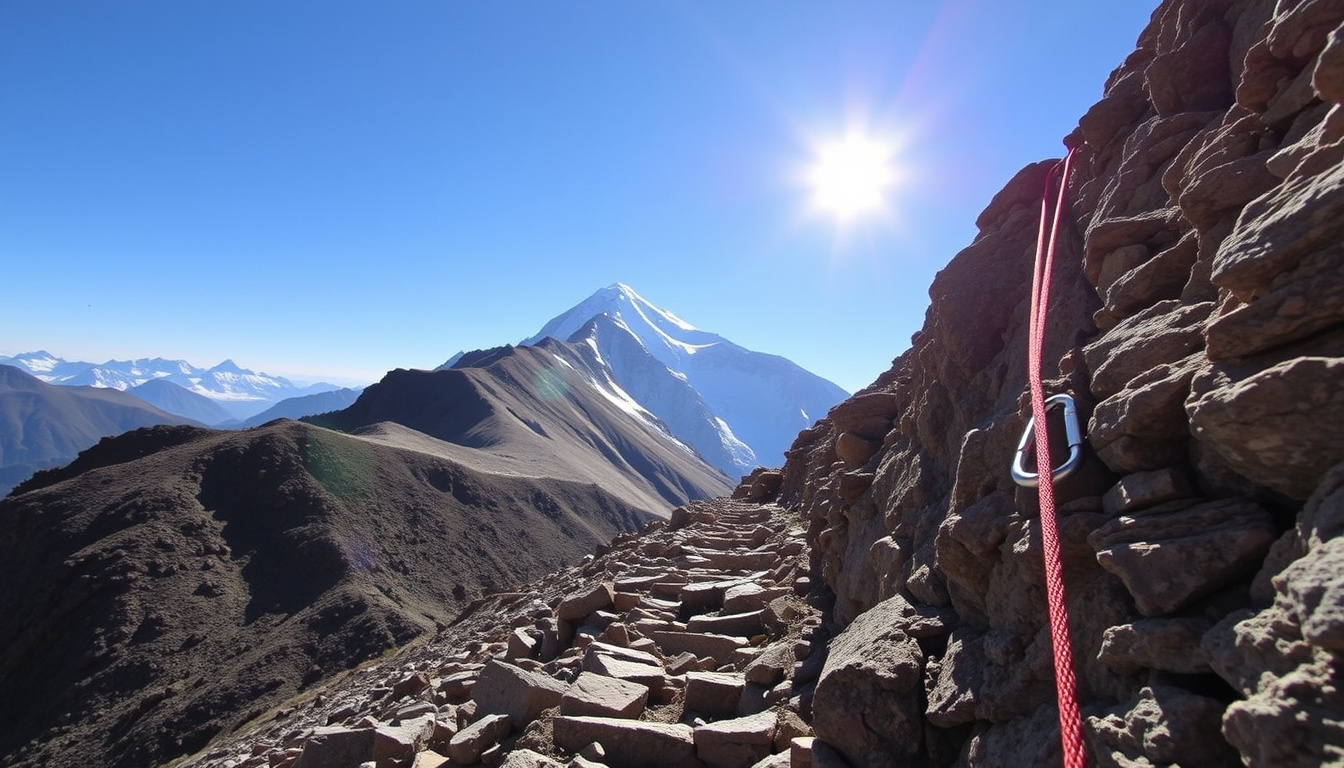
That moment when you decide to climb your first high-altitude peak — equal parts excitement and uncertainty. Mount Toubkal, North Africa’s highest summit at 4,167 meters (13,671 feet), has become the go-to answer for adventurers looking for that experience without requiring years of mountaineering training.
Height: 4,167 m (13,671 ft) ·
Location: Morocco, Atlas Mountains ·
Difficulty: Moderate, non-technical ·
Typical Duration: 2 days ·
First Ascent: 1923
Quick snapshot
- Height: 4,167 m (Wikipedia)
- Non-technical climb in summer (Call to Adventure)
- Standard route starts from Imlil village (Wikipedia)
- Overnight refuge at 3,207 m (News Ledger)
- Exact difficulty varies by individual fitness
- Trail conditions reported inconsistently
- Altitude sickness risk percentage not universally defined
- 1923: First recorded summit (Earth’s Edge)
- 2 days: Standard trek duration (Earth’s Edge)
- 5-9 hours: Daily hiking times (Earth’s Edge)
- Read our difficulty breakdown below
- Check safety and gear sections
- Compare Toubkal vs Kilimanjaro
Six key facts define this trek, one pattern: the challenge is altitude, not technical skill.
| Fact | Detail | Source |
|---|---|---|
| First summit | 1923 | Wikipedia |
| Mountain range | Atlas Mountains | Wikipedia |
| Starting point | Imlil village | Morocco Escape |
| Refuge | Neltner Refuge (3,207 m) | News Ledger |
| Best season | April to October | Morocco Escape |
| Difficulty rating | Moderate to strenuous | Call to Adventure |
How hard is Mount Toubkal to climb?
Understanding the physical demands
Mount Toubkal is widely described as a non-technical climb, but that doesn’t mean it’s easy. The standard two-day itinerary involves 5 to 7 hours of hiking on day one and 8 to 9 hours on summit day, according to Earth’s Edge, an Ireland-based trekking operator. The terrain is steep, rocky, and includes sections of scree and loose rock near the top, as noted by Wide Open Trail hiking blog.
For a fit beginner, the physical demands are manageable — but the cumulative fatigue of two long days at altitude is the real test, not steepness alone.
Technical difficulty assessment
Summer ascents require no ropes, harnesses, or glacier travel, per Call to Adventure, a UK trekking guide. Winter and spring conditions change the equation — snow and ice can make crampons necessary, according to Wikipedia. The route is well-marked in lower sections, though the upper mountain has loose rock that demands careful footing.
Fitness recommendations
- You should be comfortable walking 6-9 hours on consecutive days
- Cardiovascular endurance matters more than upper body strength
- Practice hiking on uneven terrain before your trip
- Most fit people can summit without serious altitude issues, per Wide Open Trail hiking blog
Bottom line: Mount Toubkal is a non-technical altitude challenge, not a climbing test. For fit beginners, the route is achievable with basic preparation. For experienced trekkers, this is a straightforward two-day mission at high altitude.
Do you need oxygen to climb Toubkal?
Altitude sickness explained
Altitude sickness can begin above 2,500 meters, making Toubkal’s 4,167-meter summit a meaningful risk threshold, as Wide Open Trail hiking blog explains. Symptoms include headache, nausea, and shortness of breath. The overnight stop at Neltner Refuge sits at 3,207 meters, giving trekkers roughly 12 hours of acclimatization before summit day, according to News Ledger, an outdoor travel outlet.
Oxygen needs at 4,167 meters
Supplemental oxygen is not typically required for Toubkal’s altitude. The mountain sits well below the 8,000-meter “death zone” where supplemental oxygen becomes essential. Call to Adventure emphasizes that altitude — not technical skill — is the primary challenge. Most healthy adults acclimatize adequately with proper pacing and hydration.
Prevention and preparation
- Acclimatize overnight at the refuge (3,207 m) before summiting
- Stay hydrated — aim for 3-4 liters of water per day
- Ascend slowly: “walk high, sleep low” helps adaptation
- Avoid alcohol the night before summit day
- Descend immediately if symptoms worsen
The trade-off: Toubkal’s altitude is high enough to cause problems for the unprepared but low enough that most fit trekkers manage without medical oxygen. The catch is that poor acclimatization ruins more summit attempts than lack of fitness.
How safe is it to trek Mount Toubkal?
Common risks on the trail
The primary hazards are rockfall on the upper slopes and sudden weather changes — conditions that shift faster than many first-time trekkers expect. Call to Adventure rates the route as well-established and generally safe when basic precautions are followed. The trail is clearly marked in lower sections, though the upper mountain’s loose scree demands attention.
Rockfall on the final ascent and afternoon thunderstorms in summer are the two risks that catch beginners off guard. Both are avoidable with an early start and a guide who knows the mountain’s daily weather patterns.
Safety tips for trekkers
- Start before dawn to avoid afternoon storms and loose rock on the descent
- Check weather forecasts for the High Atlas region before departing
- Carry warm layers — summit temperatures can drop near freezing even in summer
- Inform someone of your itinerary before leaving Imlil
Choosing a reliable guide
Hiring a local guide is strongly recommended. Trekking Atlas Mountains, a Morocco-based trekking operator, states that no technical skills are required but a guide is essential for safety. Guides handle route-finding, emergency communication, and logistical support. Morocco’s tourism board licenses guides through the Ministry of Tourism — verify credentials before booking.
The implication: Toubkal is safe for the prepared trekker, but the margin for error shrinks if you skip a guide or ignore weather warnings. The mountain rewards respect, not bravado.
What’s harder, Toubkal or Kilimanjaro?
Altitude and duration comparison
Kilimanjaro reaches 5,895 meters — 1,728 meters higher than Toubkal — and requires 5 to 9 days on the mountain versus Toubkal’s 2-day itinerary. Atlas Hikes, a trekking comparison resource, characterizes Toubkal as the easier high-altitude objective and Kilimanjaro as the harder one. The longer exposure to altitude on Kilimanjaro makes acute mountain sickness more likely.
Technical difficulty contrast
Both are non-technical in their standard seasons, though Kilimanjaro’s summit night involves steep scree on the Barranco Wall and a final push in darkness. Toubkal’s summer route is straightforward walking on rocky terrain. News Ledger notes that the two-day Toubkal itinerary is suitable for strong beginners or fit first-time high-altitude trekkers.
Which trek suits you better?
Five differences shape your choice: Toubkal is a weekend challenge; Kilimanjaro is a week-long expedition.
| Factor | Toubkal | Kilimanjaro |
|---|---|---|
| Height | 4,167 m | 5,895 m |
| Typical duration | 2 days | 5-9 days |
| Technical difficulty (summer) | Non-technical | Non-technical |
| Cost range | Lower ($200-$500) | Higher ($2,000-$6,000) |
| Acclimatization time | ~12 hours at refuge | Multiple days on the mountain |
Why this matters: A beginner with limited time and budget gets a genuine high-altitude experience on Toubkal without the logistics burden of Kilimanjaro. For someone testing whether high-altitude trekking is for them, Toubkal is the lower-stakes entry point.
Is Toubkal beginner friendly?
What defines a beginner-friendly climb
Earth’s Edge describes Toubkal as one of the most beginner-friendly high-altitude treks in the world, while also emphasizing that it “is still a challenge that requires preparation and a reasonable base level of fitness.” The combination of non-technical terrain, short duration, and established infrastructure makes it accessible.
Testimonials from first-time trekkers
“You don’t need any climbing experience for Toubkal — it’s a long, steep walk at altitude. What surprised me was how much the altitude affected me even at 3,500 meters. Drink water constantly and don’t rush.”
“The summit day is tough because you start before dawn and walk for 8-9 hours. But the sense of achievement when you stand on North Africa’s highest point is incredible. Take it one step at a time.”
— Ian Taylor Trekking, an experienced trekking blogger
Training tips for your first summit
- Build up to 8-10 km walks on hilly terrain 4-6 weeks before your trek
- Practice with your trekking poles to distribute load on steep terrain
- Break in your boots with at least 50 km of walking beforehand
- Do stair-climbing sessions — they simulate the repetitive ascent motion
Toubkal is beginner-friendly exactly because it doesn’t pretend to be easy. The honest physical demands attract people who want a real challenge, not a guided walk. If you train properly, you’ll earn the summit — and that’s precisely why it works as a first high-altitude trek.
Steps to plan your Toubkal trek
Step 1: Choose your season
The best window is April through October. Summer (June-August) offers stable weather and snow-free routes. Spring (April-May) has wildflowers and cooler temperatures. Winter (November-March) adds snow, ice, and potential crampon use — not recommended for beginners.
Step 2: Get to Imlil from Marrakech
Imlil is a 90-minute drive from Marrakech. Shared taxis cost around $10-$15 per person. Private transfers run $30-$50. Most treks begin from Imlil’s main square, where guides and muleteers assemble.
Step 3: Book a guide or join a group
A guided trek costs $200-$500 for the standard 2-day itinerary, including meals, accommodation at the refuge, and guide fees. Independent trekking is possible but not recommended for first-timers — route-finding above the refuge becomes tricky in poor visibility.
Step 4: Pack appropriately
Essentials include: sturdy hiking boots, trekking poles, a warm sleeping bag (rated to 0°C or lower), headlamp, sunscreen, and a first-aid kit. A Down Jacket Guide applies here — summit temperatures on Toubkal demand proper insulation.
Step 5: Plan the itinerary
- Day 1: Imlil (1,740 m) → Neltner Refuge (3,207 m) — 5-7 hours
- Day 2: Neltner Refuge → Summit (4,167 m) → Return to Imlil — 8-9 hours
- Total distance: approximately 14 km each way
Confirmed facts vs what’s unclear
Confirmed facts
- Height: 4,167 m (13,671 ft) — Wikipedia
- Location: Atlas Mountains, Morocco — Wikipedia
- Non-technical climb in summer — Call to Adventure
- Typical duration: 2 days — Earth’s Edge
- First summit: 1923 — Wikipedia
What’s unclear
- Exact difficulty for individuals varies by fitness and experience
- Current trail conditions are not consistently updated online
- Altitude sickness risk percentage lacks a universally defined figure
- Weather forecasts for the High Atlas can shift rapidly
ultimateadventuretravel.co.uk, presshive.uk, roamwithross.com, muchbetteradventures.com, przegladpunkt.pl
Before heading out, trekkers often consult a comprehensive Mount Toubkal climbing difficulty guide to prepare for the altitude and terrain.
Frequently asked questions
What is the best season to climb Toubkal?
The best season is April to October. Summer offers the most stable weather and snow-free conditions. Spring and autumn provide cooler temperatures and fewer crowds.
What fitness level is required for Toubkal?
You should be comfortable walking 6-9 hours on consecutive days over uneven terrain. Cardiovascular endurance and prior hill-walking experience are more important than raw strength.
Can I climb Toubkal without a guide?
Technically yes, but hiring a guide is strongly recommended for safety — especially for first-time visitors unfamiliar with the terrain, weather patterns, and route-finding above the refuge.
What should I pack for the Toubkal trek?
Essentials include: hiking boots, trekking poles, warm sleeping bag (rated to 0°C), headlamp, sunscreen, water bottles (3-4L capacity), first-aid kit, and layered clothing including a down jacket for summit temperatures.
How do I get to Imlil from Marrakech?
Shared taxis from Marrakech cost $10-$15 per person and take about 90 minutes. Private transfers run $30-$50. Most local trek operators include transport in their package price.
Is there accommodation on the mountain?
Neltner Refuge at 3,207m provides dormitory-style lodging, meals, and shared facilities. Booking ahead is essential during peak season (June-September). Some trekkers camp nearby with their own equipment.
Do I need travel insurance for Toubkal?
Yes. Standard travel insurance is advisable. Check that your policy covers trekking up to 4,500 meters and emergency evacuation — many standard policies exclude high-altitude activities.
Related reading
For cold-weather preparation, see our Down Jacket Guide — summit conditions on Toubkal demand proper insulation. If you’re planning broader travel, the Tokyo Skytree Guide offers a different kind of elevation experience for your travel list.

Richard Vane is Senior Reporter at MorningTimes.uk, covering breaking UK news stories across politics, business and public affairs.