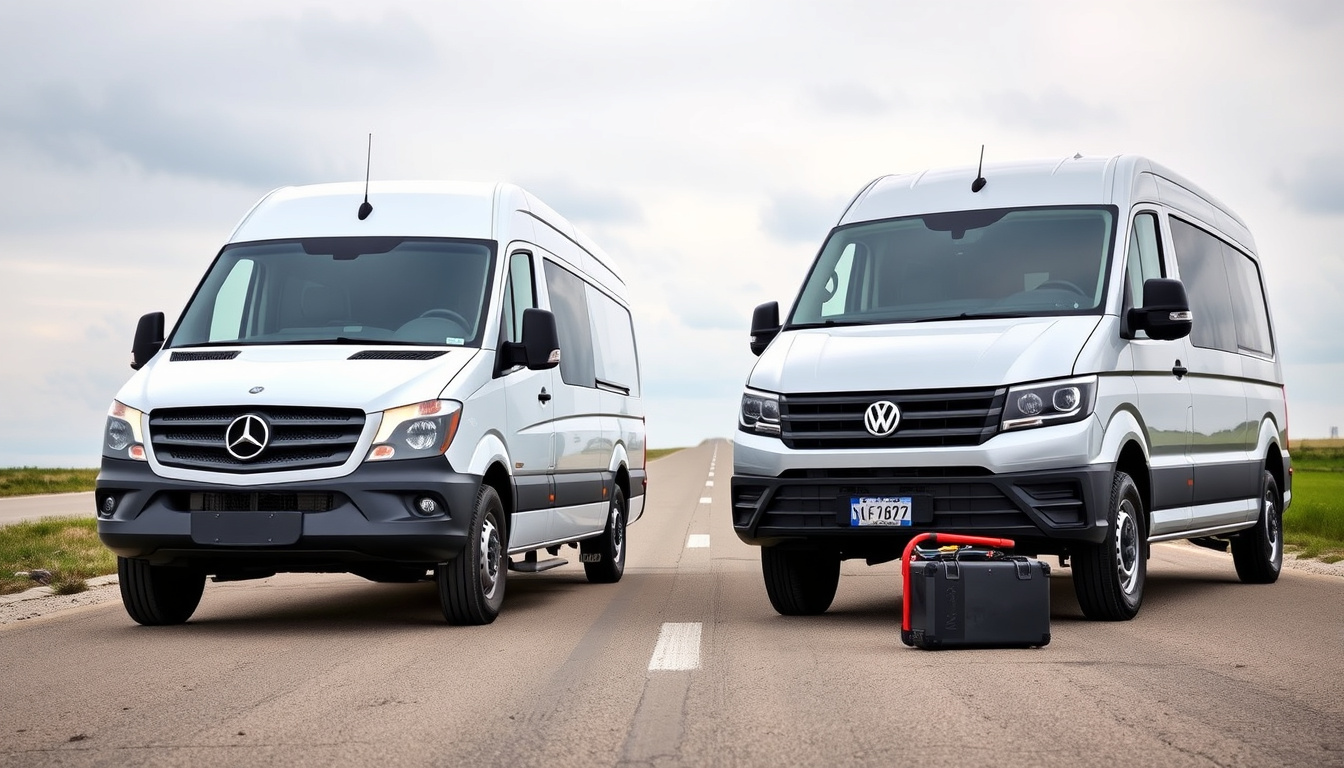
If you’re shopping for a large van, the Mercedes Sprinter probably comes up in every conversation. But the VW Crafter is a serious alternative that often raises a specific question: is it just a rebadged Sprinter with a different badge? This article compares the two on size, price, reliability, and the engine myth, using concrete data and user reports to help you decide which van fits your business.
GVW class: 3 to 5 tons · Maximum load compartment height: 2,196 mm · Sliding door opening width: 1,311 mm · Starting payload (model dependent): 735 kg · Sample used price (Ireland): €23,995
Quick snapshot
- Largest VW Commercial Vehicles van (Transit Center Ireland specialist)
- Panel van, dropside van and chassis models (Transit Center Ireland specialist)
- Size and dimensions compared (Van Guide twin test)
- Engine provenance clarified (Van Guide twin test)
- Reliability and problem signals (Van Guide twin test)
- New and used price signals
- Irish listings context
- Camper conversion potential
- Load height up to 2,196 mm
- Sliding door opening up to 1,311 mm
- Payload from 735 kg depending on model
| Specification | Value |
|---|---|
| First introduced | 2006 (Wikipedia) |
| Manufacturer | Volkswagen Commercial Vehicles |
| GVW class | 3 to 5 tons (Van Guide) |
| Maximum load compartment height | 2,196 mm |
| Sliding door opening width | 1,311 mm |
| Starting payload (model dependent) | 735 kg |
Is the Volkswagen Crafter a good van?
The Crafter is Volkswagen Commercial Vehicles’ largest three-to-five-ton van, introduced in 2006 (Wikipedia). Body styles include panel van, dropside van and chassis models. Official marketing describes it as versatile, robust and powerful, but as a buyer you want independent proof, not a brochure. The catch is that the value question depends on your ownership horizon.
What does a VW Crafter cost?
Pricing varies by spec, but a used example gives a real benchmark. A DoneDeal listing in Ireland offers a Crafter at €23,995 with a one-year warranty (DoneDeal listing). For new models, a Van Guide twin test shows the Crafter starting at £26,640 plus VAT, while a comparable Sprinter started at £24,350 plus VAT (Van Guide twin test). The gap narrows on high-roof variants: £31,515 for the Crafter versus £31,365 for the Sprinter.
The Crafter often undercuts the Sprinter on new price, but the Sprinter holds its value better thanks to its reputation and customer loyalty (Van Guide twin test).
Is the VW Crafter good for camper conversions?
The Crafter’s high roof models offer a load compartment height up to 2,196 mm and a sliding door opening width of 1,311 mm, both useful for camper builds. Both Crafter and Sprinter are popular for conversions, and all-wheel-drive systems are available as 4MOTION on the Crafter and 4MATIC on the Sprinter (Hubdub Campers campervan comparison). The AWD premium is estimated at £4,000–£6,000.
What are common VW Crafter problems?
Owner forums and reliability guides report a pattern of issues, though official failure rates are not publicly available. The most frequently mentioned problems come from a Volkswagen forum: electric window switch failures, DPF problems, seat-belt retraction issues, ignition barrel faults, relay plate non-starts, coolant-light warnings, and rust at the rear-panel and rear-corner joint above the tail lights (VW Audi Forum thread). DPF issues are reportedly worse for short, stop-start urban use such as courier work.
What do VW Crafter owners report?
Transit Center Ireland, a specialist, says the first-generation Crafter was generally dependable but developed recurring mechanical and electronic malfunctions (Transit Center Ireland reliability guide). The forum thread suggests early models (pre-2017) are more prone to these faults. No comprehensive survey data exists, so anecdotal reports should be taken as signals rather than statistics.
If you use a Crafter for urban stop-start work, pay extra attention to DPF regeneration. Owners report that short trips exacerbate the problem.
Which is bigger, a Crafter or a Sprinter?
Size comparisons depend on body style, wheelbase and roof height. The Crafter’s maximum load compartment height is 2,196 mm, and its sliding door opening is up to 1,311 mm. The Sprinter’s dimensions vary widely by variant, but in comparable long/high-roof forms the two vans are very close in length and width. A Van Guide twin test found the Crafter CR35 Trendline LWB high roof and the Sprinter 3.5t 114CDi long high roof to be nearly identical in usable space (Van Guide twin test). The implication: your decision hinges on other factors like payload config rather than sheer volume.
What are the VW Crafter dimensions?
Key dimensions cited by dealers include a load compartment height of 2,196 mm and a sliding door width of 1,311 mm. Payload starts at 735 kg and goes up depending on the model and GVW configuration. For exact measurements by variant, check the official Volkswagen Commercial Vehicles specifications.
Does a VW Crafter have a Mercedes engine?
This is a common question with a generation-specific answer. According to Parkers, up until 2017 the Volkswagen Crafter was essentially the same van as the Sprinter, developed jointly with Mercedes-Benz (Parkers Sprinter review). That means the first-generation Crafter used engines from the Mercedes parts bin, including 2.5 TDI and later 2.0 TDI units (Transit Center Ireland reliability guide). From 2017 onward, the current-generation Crafter is a Volkswagen-developed vehicle with its own engine range.
Platform sharing is not the same as engine sharing. First-generation Crafters shared the platform and some powertrains with the Sprinter; second-generation Crafters use VW’s own EA288 EVO diesel engines.
What engines are available in the VW Crafter?
First-generation models (2006–2017) offered 2.5 TDI and 2.0 TDI diesel engines, with power outputs ranging from about 88 kW to 120 kW. The current generation uses Volkswagen’s 2.0 TDI EA288 EVO engine in various states of tune, producing 102 kW to 130 kW. Both generations have manual and automatic transmission options.
Which is better, Mercedes Sprinter or VW Crafter?
There is no universal winner. The better van depends on your budget, body style requirements, and how long you plan to keep it. The following table highlights the key differences.
| Aspect | VW Crafter | Mercedes Sprinter |
|---|---|---|
| New price (entry model, inc VAT) | £26,640 (Van Guide twin test) | £24,350 |
| Long/high-roof variant price | £31,515 | £31,365 |
| Service interval | 30,000 miles | 24,000 miles (FWD) / 37,000 miles (RWD) |
| Warranty | 3 years / 100,000 miles | 3 years / unlimited mileage |
| Residual values | Lower (Van Guide twin test) | Higher |
| Reliability reputation | Good for first 3 years, then declines (Hubdub Campers campervan comparison) | Strong over 10 years |
The pattern shows a clear trade-off: lower entry price and decent early reliability versus stronger residuals and better long-term dependability.
Which is more reliable, Crafter or Sprinter?
The Sprinter has a stronger reliability reputation, often placing first in the FN50 Van Reliability Survey (Parkers Sprinter review). A campervan comparison notes that Crafters tend to need less attention in the first three years, while Sprinters tend to need less attention over the first ten years (Hubdub Campers campervan comparison). A reliability summary from a low-credibility source suggests the Sprinter outranks the Crafter for longevity and lower repair frequency in high-mileage use (Bottega del Sarto summary).
How do Crafter and Sprinter prices compare?
As shown in the table, the Crafter is slightly more expensive at entry level but nearly identical on high-roof variants. The Sprinter’s better residual values mean the total cost of ownership can be lower, especially if you sell after several years (Van Guide twin test).
How reliable is a VW Crafter?
Reliability varies by engine, model year, and maintenance history. The first-generation Crafter (2006–2017) has mixed reports: Transit Center Ireland calls it generally dependable but with recurring mechanical and electronic issues (Transit Center Ireland reliability guide). Owner forum reports list DPF, window switches, and rust as common weak points (VW Audi Forum thread). What this means: pre-purchase inspection matters more than brand reputation.
Are VW Crafter engines reliable?
The 2.5 TDI and 2.0 TDI engines in first-gen Crafters are broadly the same units used in the Sprinter, so their reliability mirrors Mercedes’ diesel engines of the era. The current 2.0 TDI EA288 EVO is a Volkswagen engine with a good track record in other VW vans. A campervan source says both vans are reliable, with the Crafter needing less attention in the first three years (Hubdub Campers campervan comparison). However, no large-scale owner survey is available to confirm specific failure rates.
If you’re buying a used Crafter, the engine’s maintenance history is more important than the model year. A well-serviced first-generation Crafter can still be a reliable workhorse, but check for DPF and rust issues.
Confirmed facts
- The Crafter is the largest three-to-five-ton van sold by Volkswagen Commercial Vehicles.
- Official/dealer data lists a sliding door opening up to 1,311 mm and load height up to 2,196 mm.
- A DoneDeal used listing in Ireland is available at €23,995 with a one-year warranty (DoneDeal listing).
- First-generation Crafter shared platform with Sprinter (Parkers Sprinter review).
What’s unclear
- Specific common-problem frequencies and failure rates.
- Which exact model years use Mercedes-sourced engines.
- A direct reliability ranking between Crafter and Sprinter with statistical confidence.
- A full, current VW Crafter price list for Ireland.
The Crafter is versatile, robust and powerful.
— Volkswagen Commercial Vehicles (Ireland) – official product page
The sliding door opening width is 1,311 mm, and the load compartment height is 2,196 mm, making it ideal for urban delivery and camper conversions.
— Donnelly Group (dealer)
A used Crafter in Ireland at €23,995 with a one-year warranty represents a strong entry point for a large van.
— DoneDeal listing
For buyers in Ireland, the decision between a Crafter and a Sprinter comes down to trade-offs: a lower initial price and decent early reliability versus stronger residuals and better long-term dependability. If you plan to keep the van for five years or more, the Sprinter is the safer bet. If you’re looking for a well-equipped large van at a competitive price and are willing to accept a few known issues, the Crafter remains a solid workhorse. The implication for Irish buyers: let your ownership timeline dictate the choice.
volkswagenmarket.com, infinityvans.com, carsurvey.org, facebook.com, bymycar.fr, pistonheads.com, signalio.nl
For the latest pricing and specifications, our 2025 VW Crafter guide offers a comprehensive overview of the current model.
Frequently Asked Questions
What is the VW Crafter’s payload capacity?
Payload starts at 735 kg and goes up depending on the model and GVW configuration. High-roof variants can carry up to around 1,200 kg.
Is the VW Crafter cheaper to maintain than a Sprinter?
Maintenance costs are similar; service intervals for the Crafter are 30,000 miles, while the Sprinter varies (24,000 miles FWD, 37,000 miles RWD). Parts availability is good for both.
Does the VW Crafter have automatic transmission options?
Yes, both first- and second-generation Crafters offer automatic transmissions. Current models use an 8-speed automatic.
How long does a VW Crafter last?
With proper maintenance, Crafters can exceed 260,000 km, according to a low-credibility source (Bottega del Sarto summary). Owner reports suggest 250,000–300,000 km is achievable.
Is the VW Crafter good for towing?
Yes, the Crafter can tow up to 2,500–3,500 kg depending on the variant and engine. Check the specific model’s towing capacity before purchase.
What is the warranty on a new VW Crafter?
New Crafters come with a 3-year / 100,000-mile warranty, while the Sprinter offers 3 years / unlimited mileage (Van Guide twin test).
Related stories





Richard Vane is Senior Reporter at MorningTimes.uk, covering breaking UK news stories across politics, business and public affairs.