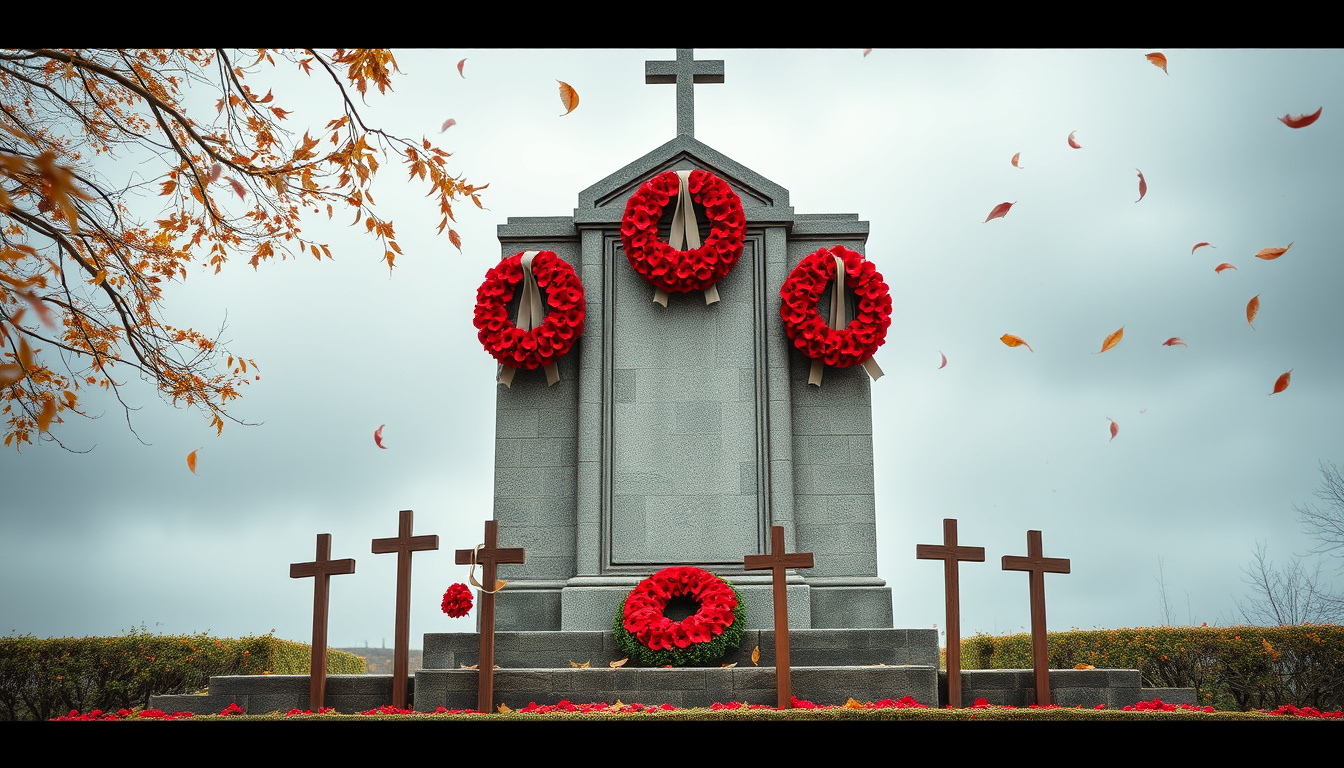

By early November, you’ll start seeing paper poppies on lapels across the UK. The tradition runs deeper than many realize — tied to a specific date, a particular silence, and a flower that once blanketed battlefields in Flanders. Understanding why the UK marks 11 November, what happens during the two-minute quiet, and why some choose not to wear the poppy reveals a more complicated story than the ritual’s simple appearance suggests.
Observed annually on: 11 November · Marks end of: World War I hostilities in 1918 · Two-minute silence at: 11 a.m. · Remembrance Sunday on: Second Sunday in November · Symbol: Poppy
Quick snapshot
- Armistice signed 11 November 1918 at 11 a.m. (History.co.uk)
- First silence observed 11 November 1919, inaugurated by King George V (Britannica)
- Royal British Legion founded 15 May 1921 (History.co.uk)
- First British Poppy Day held 11 November 1921 (Royal British Legion)
- Exact numbers of those who decline to wear poppies for political reasons
- Regional variations within UK (Scotland, Northern Ireland specifics)
- Post-1994 changes to national Armistice Day status
- 1919: First silence at Buckingham Palace
- 1921: Poppy Day established by Earl Haig
- 1956: Remembrance Sunday date fixed
- Recent years: Armistice Day revived alongside Sunday
- Remembrance Sunday 2025: 9 November (History.co.uk)
- Armistice Day 2025: 11 November (History.co.uk)
- Two-minute silence at 11:00 a.m. both dates (History.co.uk)
This table summarises the essential facts about Remembrance Day in the UK.
| Label | Value |
|---|---|
| Date | 11 November |
| Alternative name | Armistice Day (some countries) |
| Silence duration | Two minutes |
| Sunday observance | Second Sunday in November |
| Primary wars | All conflicts, originating WW1 |
Why is Remembrance Day on November 11?
The date marks the moment when the guns fell silent on the Western Front. The Armistice Agreement was signed on in Compiègne, France, ending the fighting in the First World War (History.co.uk).
The specific timing — the eleventh hour of the eleventh day of the eleventh month — became sacred in public memory. King George V requested a two-minute silence on the first Armistice Day in 1919, formalizing a ritual that railway workers had informally proposed (Britannica). He called for “all locomotion should cease, so that, in perfect stillness, the thoughts of everyone may be concentrated on reverent Remembrance of the Glorious Day” (Royal British Veterans Enterprise).
Historical origin of the date
- The signing took place in Marshal Foch’s railway carriage in the Forest of Compiègne
- Hostilities ceased at 11 a.m. Paris time, becoming the symbolic moment of peace
- The date became embedded in Commonwealth remembrance culture globally
Connection to Armistice
The Armistice ended fighting but did not conclude the war formally — the Treaty of Versailles came later in 1919. Still, November 11 became the date nations chose to mark the human cost of the conflict (History & Policy).
The Royal British Legion was formed on specifically to support those affected by the war, organizing the annual poppy sales that would become central to remembrance (History.co.uk).
Three key figures shaped the poppy tradition within two years: Lt Col John McCrae wrote the poem in 1915, Moina Michael championed the symbol in the US, and Anna Guérin brought it to Britain in 1921. On , Earl Haig announced that 11 November 1921 would be Remembrance Day and “Poppy Day” (Royal British Legion). Anna Guérin funded the first poppies herself, reimbursed only after sales proved successful (Wikipedia).
Between 1919 and 1926, the core rituals solidified: the two-minute silence, the Cenotaph ceremony, poppy wearing, and the Legion’s annual festival all emerged during this period (History & Policy). Poppies grew naturally on WWI battlefields in Flanders, their red color representing the blood spilled in the soil (History.co.uk).
The Cenotaph itself was unveiled in 1920 as the nation’s central war memorial, though notably, poppies were not central to that year’s major commemorations like the Unknown Warrior burial or Cenotaph unveiling (Imperial War Museum). The poppy’s rise as the emblem came later, through sustained campaigning.
What is Remembrance Day and what happens?
Remembrance Day commemorates military personnel who died in armed conflicts, originally focusing on those lost in the First World War. The observance has expanded to honor casualties from all wars, conflicts, and peacekeeping operations where British forces have served (History.co.uk).
Key events and ceremonies
- The National Service of Remembrance is held annually at the Cenotaph in Whitehall on Remembrance Sunday (History.co.uk)
- Approximately 10,000 veterans march past the Cenotaph, with royalty and parliamentarians in attendance
- The ceremony is broadcast live nationally and draws millions of television viewers
- Remembrance Sunday falls within the Church of England liturgical period of Allsaintstide (Wikipedia)
Two-minute silence details
The silence begins at 11:00 a.m., marking the exact moment the Armistice took effect. King George V inaugurated the practice on 11 November 1919 at Buckingham Palace, calling for a nationwide pause “so that, in perfect stillness, the thoughts of everyone may be concentrated on reverent Remembrance of the Glorious Day” (Royal British Veterans Enterprise).
After World War II, the UK government shifted emphasis from Armistice Day to Remembrance Sunday to honor casualties from both world wars (Britannica). During the Second World War, main national commemorations on 11 November were cancelled entirely (History & Policy).
“All locomotion should cease, so that, in perfect stillness, the thoughts of everyone may be concentrated on reverent Remembrance of the Glorious Day.”
— King George V, Monarch (Royal British Veterans Enterprise)
In recent years, Armistice Day has been revived alongside Remembrance Sunday, restoring the 11th November to national significance (Britannica). By 1926, poppy production had moved to Richmond, London, churning out around 36 million poppies yearly (Discover Britain).
The ritual has evolved substantially since 1919. Originally a single day, commemoration fragmented into Remembrance Sunday focus after WWII, then partially reassembled Armistice Day back into national practice in recent decades — meaning modern observers have two formal moments rather than one.
Is Remembrance Sunday before or after the 11th?
Remembrance Sunday falls on the second Sunday in November — the nearest Sunday to 11 November. This means it can occur either before or after the 11th, depending on the calendar (Britannica).
Date of Remembrance Sunday
- In 2025, Remembrance Sunday falls on (History.co.uk)
- In some years, the second Sunday falls after the 11th
- The date was officially fixed as the second Sunday in November in (Britannica)
Difference from 11 November
Armistice Day on 11 November carries the original silence at 11 a.m. — the fixed moment of the Western Front ceasefire. Remembrance Sunday brings the full national ceremony at the Cenotaph in Whitehall with veterans’ march past and wreath-laying (History.co.uk).
From 1946 to 1994, national focus was on Remembrance Sunday with local Armistice Day observance only (History & Policy). In recent years, Armistice Day has been revived with its own silence alongside Remembrance Sunday (Britannica).
The implication: the calendar determines which date gets the full national ceremony, but the 11th carries the symbolic moment — making both dates meaningful in different ways.
Why might someone not wear a poppy for Remembrance Day?
The poppy tradition has become increasingly contentious in modern Britain, with several distinct reasons people choose not to participate.
Catholic perspectives
Some members of the Catholic community have traditionally declined to wear poppies, viewing the symbol as connected to British militarism and political positions they find incompatible with their faith. This view has persisted alongside the tradition rather than fading away.
Political controversies
In the 1920s and 1930s, remembrance events became politicised, with opinions divided between anti-war sentiment and honoring military service (Wikipedia). That tension never fully resolved.
Some people refuse to wear poppies because they associate it with causes they oppose — viewing it as a political symbol rather than purely commemorative. Others object to the expectation that everyone should wear one, arguing that commemoration can take other forms.
The Royal British Legion states explicitly: “The poppy is not a symbol of death, or a sign that you support war, or a symbol of blood, or a political or religious symbol” (Discover Britain). Their position holds that the poppy represents remembrance of those who served, without endorsing particular conflicts or political positions.
Yet this official framing does not resolve the underlying tension. For some, the poppy represents only the British military tradition, and they find that framing too narrow for commemoration of all war dead. Others with Irish or Scottish heritage may view the poppy as associated primarily with English national identity rather than a universal act of remembrance.
Royal family and multiple poppies
Some royal family members, including Kate Middleton, have been observed wearing multiple poppies at remembrance events. The practice carries no official significance but attracts public commentary whenever noticed.
The tradition of wearing poppies starts in November after Halloween and continues until after Remembrance Sunday, though some choose to continue wearing theirs longer — particularly those with personal family connections to military service.
What time is the 2 minute silence today?
The two-minute silence begins at 11:00 a.m. on 11 November each year. The timing reflects the Armistice signing — “the eleventh hour of the eleventh day of the eleventh month” in 1918 (History.co.uk).
Standard timing
- Observances begin at 11:00 a.m. sharp
- The silence lasts exactly two minutes
- Broadcast nationally on television and radio
- Observances also occur at Remembrance Sunday ceremonies at 11:00 a.m.
Why two minutes?
King George V formally established the two-minute silence in 1919, though the idea originated informally among railway workers. His proclamation called for all “locomotion to cease” during the pause (Britannica).
The length was not based on any specific calculation of mourning or military significance — it emerged as a practical duration that allowed for meaningful pause without disruption to daily routines.
The pattern: the silence works as a national trigger, beginning at the same moment across the country — in schools, workplaces, public spaces, and homes — creating a shared experience of pause that marks the anniversary without requiring attendance at any specific ceremony.
The two-minute silence works precisely because it requires nothing from participants except pause — making it simultaneously the most accessible and most demanding of remembrance rituals. Anyone can observe it anywhere at 11:00 a.m. on 11 November.
Timeline signal
This timeline tracks the key milestones in the evolution of UK remembrance traditions.
| Date | Event |
|---|---|
| Armistice signed, WWI hostilities end | |
| First two-minute silence, King George V at Buckingham Palace | |
| Royal British Legion founded | |
| Earl Haig announces Poppy Day | |
| First British Remembrance/Poppy Day | |
| Remembrance Sunday date officially fixed |
Confirmed facts
- Armistice signed 11 November 1918 at 11:00 a.m.
- First silence held 11 November 1919 at Buckingham Palace
- Royal British Legion founded 15 May 1921
- First Poppy Day 11 May 1921
- Remembrance Sunday fixed as second Sunday in November in 1956
- Two-minute silence originates from King George V’s 1919 proclamation
What remains unclear
- Exact modern participation numbers beyond the historical 10,000 veterans figure
- Specific regional variations within Scotland and Northern Ireland
- Contemporary political controversies around poppy wearing
What people say
“All locomotion should cease, so that, in perfect stillness, the thoughts of everyone may be concentrated on reverent Remembrance of the Glorious Day.”
— King George V, Monarch (Royal British Veterans Enterprise)
“Earl Haig announced that he wished 11 November 1921 to be known as Remembrance Day and that it would be a ‘Poppy Day’.”
— Royal British Legion (Royal British Legion)
“The poppy is neither a symbol of death nor a sign of support for war… it should reflect no religious or political bias.”
— Royal British Legion, Official Statement (Discover Britain)
The two-minute silence at 11 a.m. on 11 November remains the ritual’s beating heart — a moment that asks nothing except pause, observed simultaneously across the country without requiring attendance at any ceremony. Yet beneath that simplicity lies a tradition that has shifted substantially over a century: from the first national silence in 1919 to the post-WWII shift toward Remembrance Sunday, and back to renewed emphasis on the 11th in recent years.
The poppy’s story mirrors this evolution. Anna Guérin funded the first British poppies herself in 1921, only reimbursed after sales proved successful — a grassroots origin that contrasts with the institutional weight the symbol carries today. Roughly 36 million poppies are distributed annually through the Royal British Legion’s appeal, raising funds for veterans and their families (Discover Britain).
The tradition shows no signs of fading. The Cenotaph ceremony draws approximately 10,000 veterans each year for the march past, with the national broadcast drawing millions of viewers. Commonwealth countries share the commemoration, spreading the poppy tradition globally through the network that Anna Guérin helped establish in 1921 (Wikipedia).
Is Remembrance Day for WW1 or WW2?
Remembrance Day originated to commemorate those who died in World War I. After World War II, the observance expanded to honor casualties from all conflicts, including WW2 and subsequent wars. The shift to emphasizing Remembrance Sunday after WWII reflected this expanded scope, allowing the ceremony to honor those lost in both world wars and beyond.
Why do Catholics not wear poppies?
Some Catholics have traditionally declined to wear poppies due to associations with British militarism and political positions they find incompatible with their faith. The view holds that the poppy has been used as a symbol of support for causes some find objectionable, rather than purely commemorating the war dead. This perspective persists alongside the tradition rather than having replaced it.
Why does Kate Middleton wear three poppies?
Kate Middleton, now Catherine, Princess of Wales, has been observed wearing multiple poppies at remembrance events. The practice carries no official significance or meaning — it is not an established tradition with documented rules. The choice appears personal, though it attracts public commentary whenever noticed. Other members of the royal family have also been seen wearing multiple poppies.
Do Germans remember their war dead?
Germany observes Volkstrauertag (National Day of Mourning) on the Sunday before Totensonntag, typically in November. This observance commemorates victims of war and tyranny without focusing on specific conflicts. Germany’s approach to remembrance differs from the UK tradition, shaped by different historical experiences and contemporary sensitivities. The German observance operates on a separate calendar and carries different cultural weight than the Commonwealth’s Remembrance tradition.
Why 2 minutes silence and not 1?
King George V established the two-minute silence on 11 November 1919, though the idea originated informally among railway workers. The duration was not based on specific mourning or military significance — it emerged as a practical length that allowed for meaningful pause without excessive disruption to daily activities. The silence has remained two minutes ever since.
How is Remembrance Day celebrated?
The observance includes the two-minute silence at 11 a.m. on 11 November, the national Cenotaph ceremony on Remembrance Sunday, wearing poppies throughout November, wreath-laying ceremonies, remembrance services in churches and public spaces, and veteran marches past memorials. Schools, workplaces, and public buildings typically observe the silence. The national broadcast of the Cenotaph ceremony draws millions of viewers.
When did Remembrance Day start?
The first national observance was on 11 November 1919, one year after the Armistice. King George V inaugurated the first two-minute silence at Buckingham Palace. The Royal British Legion was formed on 15 May 1921, and the first formal Poppy Day occurred on 11 May 1921. The tradition has evolved continuously since then.
What time is Remembrance Day?
The two-minute silence occurs at 11:00 a.m. on 11 November and again at 11:00 a.m. on Remembrance Sunday. The Cenotaph ceremony begins earlier on Remembrance Sunday morning, with the march past and wreath-laying proceeding through the morning. The 11 a.m. silence is the day’s symbolic anchor point, observed nationally across the UK.
Related reading: When is Super Bowl 2025
englandspuzzle.com, swissbritishexchange.com, legacytree.com
Related stories





Marcus Bell covers UK politics, public policy and government for MorningTimes.uk.