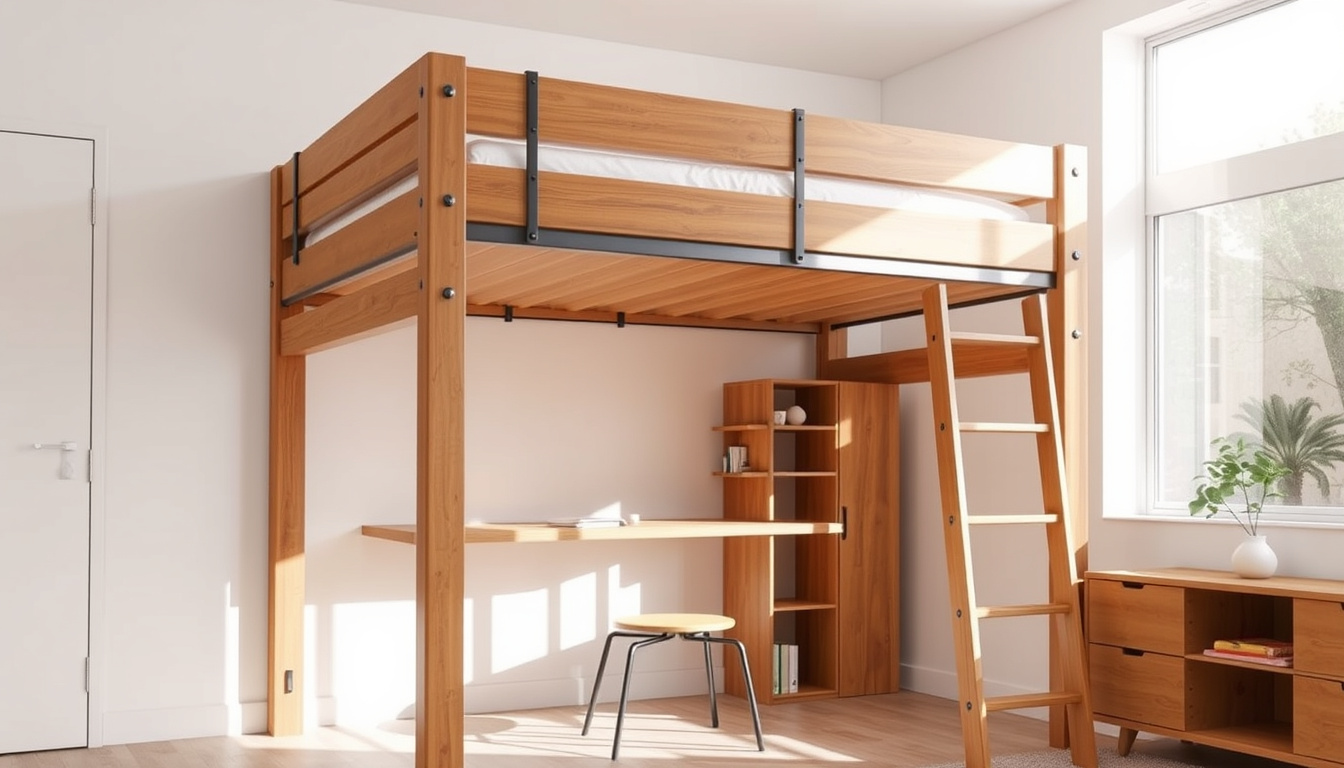
Anyone who has tried working, sleeping, and storing a season’s worth of clothes in one room has at some point looked up and wondered whether moving the bed upward is the answer. Loft beds lift the mattress off the floor and free the space underneath for a desk, sofa, or wardrobe — and IKEA sells wooden and steel versions aimed at adults as well as teenagers. The details that make or break them are less obvious: stability, ceiling height, mattress thickness, and weight rating matter more than the photo suggests.
UK price range: £319–£460 for basic models ·
STORÅ under-bed clearance: 67 in ·
Clearance above mattress: 30 in minimum ·
Guardrail rule: 5 in above mattress top
Quick snapshot
- IKEA markets its US loft beds to older children, teens, and adults (IKEA’s official US loft bed category)
- The STORÅ frame is solid pine (IKEA’s STORÅ product page)
- The VITVAL frame is powder-coated steel (IKEA’s VITVAL product page)
- Adult weight limits are model-specific, so the printed rating is the only reliable answer (Loft Beds NYC)
- IKEA’s adult loft bed lineup changes by season and differs by country (IKEA’s Greek loft bed range)
- Whether a double loft bed fits depends on ceiling height and room size (Loft Beds NYC)
- Wobble problems typically show up after assembly, not at the store (The Fine Bed)
- Night-time ladder use is the main long-term risk; the standard safeguards are a non-slip ladder and a night light (The Fine Bed)
- Measure ceiling height and floor footprint before shopping (Loft Beds NYC’s safety guidance)
- Confirm the weight limit sits above the sleeper’s combined weight (Loft Beds NYC’s safety guidance)
- Choose wood or metal based on look, weight, and budget (IKEA’s wood-vs-metal buying guidance)
Eight numbers, one pattern: the raised sleeping surface moves every other decision upward too.
| Label | Value |
|---|---|
| Definition | A raised bed with open floor space underneath for furniture or activity |
| Main frame materials | Steel, solid pine, and engineered wood |
| Typical UK price range | Roughly £319–£460 for basic models |
| Common under-bed uses | Desk, sofa bed, wardrobe, and storage |
| Adult options | Single, double, and higher-weight-capacity models |
| Under-bed clearance (STORÅ) | 67 in, according to Mattress Nerd’s loft bed review |
| Clearance above mattress | At least 30 in recommended (Mattress Nut’s guide) |
| Guardrail rule | Top of guardrail at least 5 in above the mattress top (Eat Healthy 365’s loft bed checklist) |
What are the downsides of a loft bed?
The selling point of a loft bed is vertical space. The catch is that everything else in the room has to work around it. Low beams, ceiling fans, and sloped ceilings all become clearance problems once the mattress is raised, and a ceiling fan that is fine beside a standard bed can sit dangerously close to a lofted one. Loft Beds NYC (a loft bed specialist retailer) warns that a room needs enough headroom to sit up comfortably without hitting the ceiling.
Climbing into a raised bed is the detail many buyers overlook. A sleeping surface set 5 ft off the floor suits a teenager but demands more from older adults or anyone with knee or mobility issues. The Fine Bed (a loft bed retailer’s safety guide) notes that adult loft bed use often hinges on nighttime ladder use, so the ladder needs to be genuinely secure.
A loft bed only works if the ceiling cooperates. With less than 30 in between the mattress and the ceiling, sitting up becomes a daily negotiation rather than a simple comfort check.
Can bed bugs live in metal bunk beds?
- Hiding spots: frame joints, seam gaps, and underside corners
- Material myth: metal does not repel or prevent bed bugs
- Real protection: regular inspection and keeping the bed away from walls
Can bed bugs live in metal bunk beds? Yes — they hide in frame joints and crevices, and nothing about metal makes it inhospitable. Since retailers such as IKEA offer both metal and solid-wood models, the material choice should never be treated as a pest-control strategy (IKEA’s Greek loft and bunk bed range).
Can an adult sleep in a loft bed?
Yes, adults can sleep in a loft bed — provided the frame’s weight rating matches the sleeper and the room has enough ceiling height. Adult-friendly models exist across price points: reviewers single out IKEA’s STORÅ as a full-size frame that works for grown-ups (Mattress Nerd’s best loft beds guide).
What age is a loft bed suitable for?
- Age guidance is manufacturer-specific, not a fixed legal cutoff
- Key factors: guardrail height, ladder access, mattress thickness, and comfort climbing at night
- Adult-specific frames are sold in full and double sizes
There is no universal age. A young child often struggles with the ladder, while a teenager or adult can be perfectly fine in the same frame. What matters is whether the guardrail sits high enough relative to the mattress and whether the sleeper is comfortable going up and down, especially in the dark.
Is a loft bed childish?
- “Loft bed” describes the raised design, not a child’s product
- Full-size and double models target adult bedrooms
- The look depends on the frame material and the room around it
The word “loft bed” refers to the raised sleeping platform, not the intended user. Adult-targeted models in double sizes are common, and with a solid-pine frame like IKEA’s STORÅ the look is closer to a studio-flat space solution than a child’s bunk bed.
What this means: adult suitability is not about the furniture’s personality — it is about whether the frame’s rating, the guardrail height, and the ceiling clearance match the person who will climb in every night.
Do IKEA loft beds require a special mattress?
IKEA loft beds ship with a slatted bed base, not a mattress. That makes the mattress a separate purchase, and the product manual sets a maximum recommended thickness so the sleeping surface stays below the guardrail line.
Does IKEA offer loft beds for adults?
- STORÅ: full-size adult frame, cited by reviewers as adult-friendly (Mattress Nerd)
- VITVAL: steel frame with an integrated desk top
- Models vary by country and season, so the local catalogue is the source of truth
Yes, IKEA does offer adult loft beds. The US STORÅ is a full-size frame, and the VITVAL pairs a steel loft bed with a desk underneath. The catch: the adult models vary by country and season, so checking the local IKEA site before ordering is the only reliable way to see what is actually in stock.
Loft bed IKEA: what to know before you order
- Mattress is sold separately on a slatted base
- Maximum mattress thickness is set by the frame’s guardrail height
- Wall anchoring is part of the setup where the manual provides fittings
Ordering an IKEA loft bed means planning for three extras: a mattress within the stated thickness limit, tools and time for assembly, and wall anchoring if the manual calls for it. IKEA loft beds take standard UK single and double mattress sizes, so the non-negotiable spec is the maximum height in the manual — go thicker and the sleeper sits above the guardrail line.
The trade-off: IKEA loft beds are well documented and affordable, but the manual does the safety work — skip the thickness limit or the wall anchor and the frame stops being compliant.
How stable are IKEA loft beds?
IKEA loft beds are stable when assembled the way the manual dictates. That caveat does a lot of work: Engineer Fix (a UK engineering advice site) traces wobble in loft beds to missing brackets, uneven floors, or loose fixings rather than a defective frame.
Are loft beds usually wobbly?
A wobbly loft bed at sleeping height is a fall risk, not a cosmetic issue — and the fix is almost always an installation step that was skipped.
Loft beds have a higher centre of gravity than standard beds, so small amounts of play in the joints are easier to notice. Tightening every bolt, using the supplied brackets, and levelling the frame on the floor removes most of the movement. Metal IKEA loft beds are lighter than wood ones, but they are still stable when assembled as directed. Wall anchoring is an additional safeguard that many loft bed manuals include, and it matters most in rooms with floorboards that flex underfoot.
The implication: if it wobbles, re-tighten, re-level, and anchor before assuming the frame is faulty — most stability problems are fixed with a spanner, not a replacement.
Are wooden or metal loft beds better?
The wood-versus-metal decision comes down to what the bed should feel like and how often it will move. IKEA’s own buying guidance describes wood loft beds as warmer and more style-flexible, while metal frames read as more modern and are easier to clean.
Choose metal if you move often; choose wood if you want the bed to age quietly and hide the dents of daily life.
Who makes the best loft beds?
- IKEA: broad range, clear manuals, adult-friendly full-size models
- Specialist UK retailers: heavier-duty wood frames and wardrobe combos
- Amazon marketplace: wide price spread, with customer reviews that often discuss wobble and mattress fit
No single maker dominates the category. IKEA is the reference point for documented, affordable frames; specialist retailers sell heavier or more custom layouts; Amazon adds variety but with inconsistent product information. The best maker for a given buyer is the one whose listing answers the weight-limit and ceiling-height questions clearly.
The takeaway: let the room’s style and your move frequency pick the material — then verify the frame’s rating before paying.
Where is the best place to buy loft beds?
In the UK, the practical shortlist is IKEA for straightforward frames, Amazon for breadth, and specialist furniture retailers for wardrobe-integrated or double-size builds. Basic single loft beds start around £300.
Loft bed UK
- IKEA UK: seasonal adult loft bed selection — check the current local catalogue
- Amazon: single and double loft beds across a wide budget range
- Specialists: wardrobe-combination and heavy-duty wood models
UK buyers have a strong choice of retailers. The trade-off is that IKEA’s adult loft bed assortment changes by season, so a model seen online today can disappear from the catalogue when the range rotates. Amazon and specialist stores fill the gaps with more permanent lines, which makes them the safer bet if you are planning around a specific room layout.
Loft bed with wardrobe and double loft bed options
- Wardrobe combos use the space under the bed for storage instead of leaving it empty
- Double loft beds suit adults who need more sleeping width
- Under-bed clearance determines whether a wardrobe, sofa, or desk actually fits
Loft beds with wardrobes or storage units underneath turn empty floor space into usable square footage — the same reason studio flats and small bedrooms are the category’s natural habitat. Double loft beds exist for adults who want more sleeping width, but they demand proportionally more ceiling height and floor footprint.
The catch: the cheapest option is rarely the one with the right weight limit and ceiling clearance, so compare specs before comparing prices.
Wood vs metal loft beds: side-by-side comparison
Four differences, one pattern: the frame material shapes the bed’s weight, its look, and how much wear it hides.
| Factor | Wood frames | Metal frames |
|---|---|---|
| Visual style | Warmer look and more flexible with different décor (IKEA’s wood-vs-metal buying guidance) | More modern and streamlined; easier to clean |
| Weight and moving | Heavier; harder to move between rooms | Lighter; easier to reposition |
| Dent resistance | Hides dents and daily wear better | Scratches and dents show more easily |
| Best for | Rental flats wanting a calm, warmer finish | Frequent movers and tighter budgets |
The trade-off: wood wins on warmth and dent-masking; metal wins on weight and cleaning. If the bed will move more than once every couple of years, metal is the lower-effort choice.
Key specifications to verify before you buy
Eight specs, one rule: the manual is the only source that matters for fit and safety.
| Spec | What to check | Why it matters |
|---|---|---|
| Max mattress thickness | Listed in the frame manual | Keeps the mattress below the guardrail line (Eat Healthy 365’s loft bed checklist) |
| Mattress size | Standard UK single or double | Prevents gaps or overhang at the frame edges |
| Weight limit | Rated above the sleeper’s combined weight | The safe target is comfortably above the limit, not at it |
| Ceiling height | At least 30 in between mattress top and ceiling | Allows sitting up without hitting beams or fans (Mattress Nut’s guide) |
| Guardrail height | At least 5 in above the mattress top | Fall prevention for adult sleepers |
| Under-bed clearance | Height of desk, wardrobe, or sofa | Determines what fits underneath after assembly |
| Ladder fixing | Securely fixed to the frame | Reduces the risk of slips during night-time use |
| Wall anchoring | Supplied brackets and instructions | Limits side-to-side movement of the raised frame |
The implication: if a listing cannot show these eight numbers, it is not ready to buy — missing data does not appear after delivery.
Loft bed pros and cons for adult buyers
Upsides
- Frees floor space for a desk, sofa, or wardrobe
- Adult-rated frames are available in double sizes
- Under-bed storage combos make small bedrooms feel larger
Downsides
- Needs higher ceilings and careful clearance planning
- Climbing in and out is harder for adults with mobility issues
- Wobble risk if assembly or anchoring is rushed
The pattern: the pros are about space, the cons are about fit — which is why measurements decide most loft bed purchases.
How to choose and install a loft bed safely
- Measure the room. Record ceiling height, floor footprint, and the height of any ceiling fan or beam before you look at frames.
- Set a weight budget. The frame’s printed limit must sit above the combined weight of sleeper and mattress — a rating exactly at the limit is not a rating that leaves any margin.
- Choose the frame material. Wood reads warmer and hides dents; metal is lighter and easier to clean. Let your move frequency and room style settle the rest.
- Check the mattress limit. Verify the maximum mattress thickness in the manual so the sleeping surface stays below the guardrail line.
- Assemble with care. Use the supplied brackets, tighten every bolt fully, and level the frame on the floor before loading it.
- Anchor the frame. Where the manual includes wall-anchor fittings, attach the frame to a wall stud — this is the step that removes most side-to-side movement.
- Do a wobble test. Press the top rail from the side. If the frame flexes, find the loose connection before you use the bed for the first time.
Measure first — a beautiful frame that does not fit the room is a return, not a solution.
What we know vs what’s still unclear
Confirmed facts
- IKEA sells loft beds in both wood and steel, with the mix varying by market (IKEA’s Greek loft bed range)
- Guardrails should sit at least 5 in above the mattress top (Eat Healthy 365’s loft bed checklist)
- Loft bed safety guidance recommends roughly 30 in of clearance between the mattress top and the ceiling (Mattress Nut’s guide)
What’s unclear
- Exact adult weight limits vary by model and are rarely shown in retailer snippets
- IKEA’s UK adult loft bed lineup changes by season
- Whether metal or wood changes bed bug risk is open — the material is not a pest barrier
- Whether a double loft bed makes sense depends on ceiling height, room width, and the sleeper’s habits
Why this matters: the confirmed column is where safety decisions belong; the unclear column is what to ask the retailer before you pay.
What product pages and reviewers say
Two independent guides land on the same practical note: the parts you cannot see in the product photo decide whether the bed works.
“Solid hardwoods such as oak or maple are generally stronger than particleboard, while high-grade steel or aluminum can achieve very high weight ratings.”
“Adult loft bed use often hinges on nighttime ladder use, so a non-slip ladder and a night light at the base are especially important.”
The Fine Bed (loft bed retailer safety guide)
The common thread: every source lands on the same conclusion — the frame’s rating and the room’s dimensions decide safety, not the styling.
For anyone renting a small flat in the UK, the loft bed decision comes down to three numbers: the frame’s weight limit, the ceiling clearance, and the maximum mattress thickness. Buyers who measure the room and check the manual before ordering get a space-saving bed that works for years. Buyers who skip those checks get a wobbly, too-high, or non-compliant frame — and the return process for a full-size loft bed is exactly as awkward as it sounds.
Frequently asked questions
What is the weight limit for a loft bed?
There is no universal weight limit. Each model lists a maximum rated weight, and the safe target is a frame rated comfortably above the combined weight of the sleeper and the mattress. If the listing does not show a printed rating, treat that as a warning sign.
Do I need to anchor a loft bed to the wall?
In most cases, yes. A loft bed has a raised centre of gravity, and wall anchoring limits side-to-side movement. IKEA’s assembly instructions include wall-anchor fittings where the frame design requires them, so follow the manual for the specific model.
What is the best mattress for a loft bed?
The best mattress is one that fits the frame’s maximum thickness limit. If the mattress is thicker than the guardrail line, the sleeper sits above the protective rail; if it is too thin, the rail sits too high relative to the sleeper. Check the manual’s maximum mattress height before buying.
Can a loft bed fit in a room with low ceilings?
Only if the room keeps enough clearance above the mattress. A common rule of thumb is at least 30 in between the mattress top and the ceiling, so the sleeper can sit up without hitting beams, fans, or sloped ceilings.
Are loft beds safe for adults?
Yes, when three conditions are met: the frame is rated for the sleeper’s weight, the guardrail sits at least 5 in above the mattress, and the ladder is secure. Night-time ladder use is the main risk, so a non-slip ladder and a night light are worth adding (The Fine Bed).
How much does a loft bed cost in the UK?
Basic single loft beds start at roughly £300. Solid-pine adult models are typically in the £319–£460 range, and double-size or wardrobe-combination frames cost more depending on material and build.
Related reading
More evergreen guides from Morning Times:
IKEA product ranges, prices, and availability change by market and season. The safety figures in this article come from the IKEA product pages and independent loft bed guides cited above.
Related stories





Richard Vane is Senior Reporter at MorningTimes.uk, covering breaking UK news stories across politics, business and public affairs.