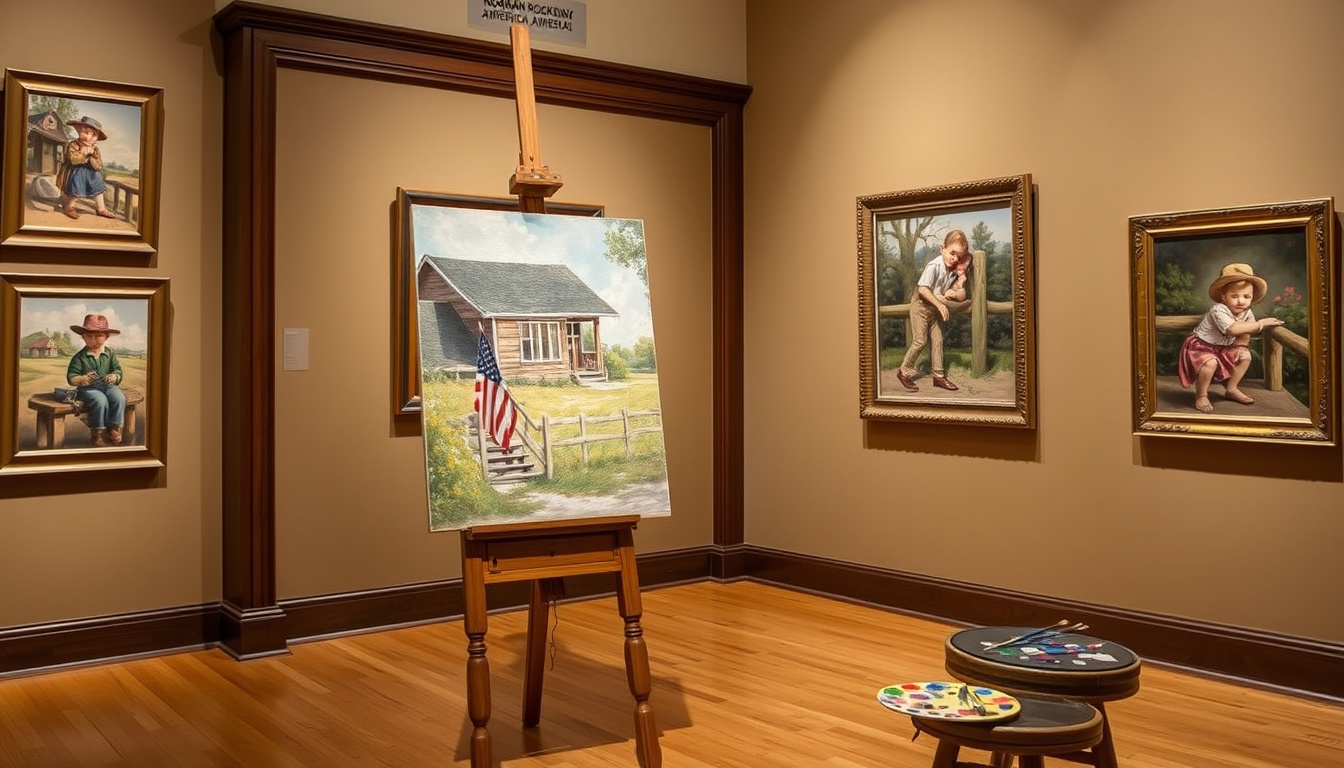
Few American artists are as easy to recognize and as hard to pin down as Norman Rockwell. He painted his first cover for The Saturday Evening Post in 1916 (Norman Rockwell Museum (the artist’s official archive)) and spent the next six decades turning everyday American life into a national mirror — until the mirror started reflecting civil rights, not just nostalgia, with the full arc from cheerful Christmas covers to a school-desegregation painting marking the distance that is the real story.
Born: February 3, 1894, New York City · Died: November 8, 1978, Stockbridge, Massachusetts · Post covers: Over 300 · Most famous work: The Problem We All Live With (1964) · Museum: Stockbridge, Massachusetts · Medium: Oil on canvas, illustration
Quick snapshot
- More than 300 covers for The Saturday Evening Post (Smithsonian American Art Museum (U.S. national collection))
- The Problem We All Live With, painted in 1963 amid school desegregation, shows Ruby Bridges escorted by U.S. marshals (Google Arts & Culture (Norman Rockwell Museum’s digital archive))
- Painted his first Saturday Evening Post cover in 1916 (Norman Rockwell Museum)
- Cover totals vary by source: 321 in one specialist count, 324 in another (Burchfield Penney Art Center (museum archive))
- Why his early work omitted Black Americans — interpretations differ (TheCollector (art history publication))
- 1943: the Four Freedoms series appears (Smithsonian American Art Museum)
- January 14, 1964: The Problem We All Live With on the cover of Look (Burchfield Penney Art Center)
- The Stockbridge museum stewards the largest public collection of his work (Norman Rockwell Museum)
- The 1960s civil rights paintings now anchor the legacy debate (TheCollector)
Seven biographical markers, one pattern: a New York City childhood that turned into a small-town New England career.
| Attribute | Detail |
|---|---|
| Full Name | Norman Percevel Rockwell |
| Born | February 3, 1894, New York City |
| Died | November 8, 1978, Stockbridge, Massachusetts |
| Nationality | American |
| Known For | Painting, illustration, magazine covers |
| Notable Works | Four Freedoms; The Problem We All Live With; Golden Rule |
| Museum | Norman Rockwell Museum, Stockbridge, Massachusetts |
The pattern is geographic as well as artistic: the city kid became a small-town painter, and the town where he died now holds the record of his life.
Who is Norman Rockwell?
Norman Rockwell was one of the most visible American artists of the twentieth century, even though he worked in a medium — magazine illustration — that critics often treated as low art. The distance between his popular fame and his critical reputation is part of the story.
Early life and training
- Born in New York City on February 3, 1894 (Smithsonian American Art Museum (U.S. national collection))
- Began formal art training at the Chase School of Fine and Applied Art at age 14 and served as art director of Boys’ Life as a teenager (Norman Rockwell Museum (the artist’s official archive))
- Left high school in 1910 to study at the National Academy of Design, later transferring to the Art Students League (Smithsonian American Art Museum (U.S. national collection))
His first commercial commission, a set of Christmas cards, came before his sixteenth birthday (Norman Rockwell Museum (the artist’s official archive)). The pattern was set early: Rockwell was a commercial artist by instinct, trained in the fastest, most practical way available, and he treated illustration as a serious craft decades before critics agreed.
That craft is why the later work holds up: when he turned to civil rights subjects, he had the technical skill to make a political image as compelling as any cover.
Career at the Saturday Evening Post
- Painted his first Post cover in 1916 (Norman Rockwell Museum (the artist’s official archive)) — the start of a run that made him a household name
- Produced more than 300 covers, according to the Smithsonian’s count (Smithsonian American Art Museum (U.S. national collection))
- Built a body of work so commercially successful that the Post became synonymous with his style
The Post covers made Rockwell a household name. His compositions were so readable that the magazine became the place where Americans saw themselves reflected — sometimes as they were, sometimes as they wished to be. The wishful half of that equation is what later critics held against him.
Even so, the output is the biographical fact that matters: no other American painter penetrated the culture at that volume.
Later years and legacy
- Moved with his family to Arlington, Vermont, in 1939 (Norman Rockwell Museum (the artist’s official archive))
- Died in Stockbridge, Massachusetts, on November 8, 1978 (Smithsonian American Art Museum (U.S. national collection))
The last chapter was the least nostalgic. Rockwell spent his final decades working for Look, and his subject matter shifted from small-town scenes to school desegregation and civil rights — the themes that now define his late reputation (Google Arts & Culture (Norman Rockwell Museum’s digital archive)).
The implication: his biography is usually told as a rise and a decline. The sharper arc is a rise, a long plateau, and a turn — and that turn is what the museum now treats as the heart of his legacy.
The pattern: Rockwell’s career was a two-act story that changed the way America saw itself.
Where is the Norman Rockwell Museum located?
The Norman Rockwell Museum sits in Stockbridge, Massachusetts, the town in the western part of the state where Rockwell died in 1978. The museum is the institutional center of everything written about him since.
Museum address and hours
- Located in Stockbridge, Massachusetts (Norman Rockwell Museum (the artist’s official archive))
- Hours vary by season; the museum’s official site is the reliable place to check current times
Stockbridge is a day-trip town: most visitors arrive by car, and the museum operates as the centerpiece of a longer regional visit. The galleries feel more personal than a big-city museum — fewer rooms, deeper context, and an emphasis on the artist’s working process rather than a sweeping survey of American art.
What this means for planning: give the museum a real block of time. The collection rewards close reading, and the interpretive galleries are not built for a quick walk-through.
Exhibits and collection
- Holds the largest public collection of Rockwell’s work, including original paintings, sketches, and personal artifacts (Norman Rockwell Museum (the artist’s official archive))
- Rotating special exhibitions add context around the permanent collection
The permanent display makes the artist’s range visible in one place: the small-town covers, the Four Freedoms, the Golden Rule, and the civil rights paintings. Seeing them together is the closest thing to watching Rockwell’s politics change in real time.
The pattern: the museum is less a shrine than an evidence locker. It can show you exactly when and how the work changed, which is why serious writing about Rockwell keeps coming back to it.
What is Rockwell famous for?
Two images anchor his reputation: the Four Freedoms, a wartime series about American ideals, and The Problem We All Live With, a civil rights painting that changed how later generations read everything he made before it.
The Problem We All Live With
Rockwell’s most famous painting is also his least nostalgic one — a work about desegregation, not a 1940s daydream.
Painted in 1963 against the backdrop of school desegregation, it shows Ruby Bridges walking to school under the protection of U.S. marshals (Google Arts & Culture (Norman Rockwell Museum’s digital archive)). Look magazine put it on its cover on January 14, 1964 (Burchfield Penney Art Center (museum archive)). The painting reframed Rockwell overnight, and it has been the hinge of his legacy ever since.
What this means: the same public that knew him for warm holiday covers watched him make a political image about race — and the shift was unmistakable because the style was unchanged. The hand was the same; the subject had finally caught up with the country.
The Four Freedoms series
- Created in 1943; the Smithsonian identifies it as Rockwell’s best-known series (Smithsonian American Art Museum (U.S. national collection))
- Inspired by President Franklin D. Roosevelt’s 1941 address to Congress (Burchfield Penney Art Center (museum archive))
- Four subjects: Freedom of Speech, Freedom of Worship, Freedom from Want, Freedom from Fear (Burchfield Penney Art Center (museum archive))
The series ran during World War II and gave Rockwell his most durable cultural footprint. He made freedom feel domestic — a neighbor at a town meeting, a family at table — and that translation of political philosophy into everyday life was exactly what made it powerful.
The pattern: the Four Freedoms were political art in wartime packaging. They claimed that ordinary American life was the thing worth defending, and that claim is why they outlived the war that produced them.
Other iconic works
- Triple Self-Portrait, the famous image of the artist painting himself
- Golden Rule, created as a United Nations poster in 1961, covered in the next section
- New Kids in the Neighborhood, a 1960s painting about integration (TheCollector (art history publication))
Collectively, these works show a through-line: Rockwell was always interested in belonging — who gets a seat at the table, who is inside the frame, and who is left out. Early on, the frame was narrow. By the 1960s, he was deliberately widening it.
The trade-off: the later works are the reason his reputation survived the collapse of the magazine market. Had he only painted covers, he would be remembered as a craftsman of nostalgia; the civil rights paintings turned him into something closer to a moral historian.
The pattern: Rockwell’s most famous works mark the pivot from nostalgia to conscience.
What is controversial about Norman Rockwell?
The controversy is not about technique. It is about what Rockwell left out of his America for the first four decades of his career.
Early work and racial omission
- His early commercial work largely omitted African American subjects (TheCollector (art history publication))
- Critics argue he avoided racial issues until the civil rights movement pushed the subject into his work (TheCollector (art history publication))
- The online claim that he was “not allowed” to paint Black people is not backed by any verified record of a formal ban
The question “Why was Norman Rockwell not allowed to paint black people?” keeps surfacing in search results, and the honest answer is that the documented record shows omission, not prohibition. His magazine covers — the most powerful visual platform in the country — almost never featured Black Americans before the 1960s. Scholars have offered different explanations, from editorial caution to the commercial logic of a readership that was overwhelmingly white (TheCollector (art history publication)).
The warmth that made Rockwell beloved also produced a vision of America that was overwhelmingly white. That absence is visible in the archive itself, not invented by modern critics.
What this means: the early silence on race is part of his biography, and it is the reason the 1960s paintings matter. You cannot understand their force without first understanding what they broke from.
The 1960s shift to civil rights
- The Problem We All Live With ran on the cover of Look on January 14, 1964 (Burchfield Penney Art Center (museum archive))
- Southern Justice and New Kids in the Neighborhood are the other major civil-rights paintings of the decade (TheCollector (art history publication))
By the mid-1960s, Rockwell was making explicitly political pictures for Look, using the same illustrative skill he had once applied to holiday covers. The paintings from this period are not gentle: they show violence, isolation, and the uncomfortable gap between the American ideal and American reality.
What is Rockwell’s golden rule?
The Golden Rule painting meaning
- Shows people of many faiths and ethnicities standing together under the phrase “Do unto others as you would have them do unto you” — created for a United Nations poster in 1961 (Google Arts & Culture (Norman Rockwell Museum’s digital archive))
- Two years later, Rockwell would apply the same moral clarity to school desegregation in The Problem We All Live With
Rockwell’s Golden Rule rearranges the world. Instead of one small town, the painting lines up dozens of faces — different religions, races, and generations — under a single moral sentence. It was the clearest public statement of where his politics had landed in 1961.
The Golden Rule is the bridge between Rockwell’s two careers: it keeps the warm, inclusive style of the Post years while pointing straight at the civil rights themes of the 1960s.
The implication: the painting that looks like Rockwell’s most universal statement was also his most political one — a mainstream endorsement of human equality at a moment when large parts of the country were still fighting against it.
Rockwell’s inspiration
- Commissioned as a United Nations poster, the image was designed to translate a moral phrase into a human scene
- It followed a decade of growing engagement with themes of tolerance and justice
The inspiration is best read in context. Rockwell’s work had been moving toward moral argument for years, and the Golden Rule gave that argument a single, memorable image. It also prepared the ground for the civil rights paintings — The Problem We All Live With, Southern Justice, and New Kids in the Neighborhood — that now define his late period.
Was Norman Rockwell a good person?
The question cannot be answered from paintings alone, but the record of his late career gives a clear direction of travel.
Civil rights and activism
- Supported civil rights causes in his final decades (TheCollector (art history publication))
- Used his position as a mainstream illustrator to address desegregation and racial injustice (TheCollector (art history publication))
The 1960s paintings did not fit the nostalgic formula, and they surprised parts of his audience. Rockwell made them anyway. That is the strongest biographical evidence on the “good person” side of the ledger: he risked his established brand to make political art about race at a time when much of the country did not want to look.
The contradiction is part of the story: the man who had painted an all-white small-town America was the same man confronting integration, and he knew it.
Critics of the sentimental view
- Some critics found his idealized America too neat and too white (TheCollector (art history publication))
- Others see the late civil rights paintings as a correction of that same vision
The strongest criticism of Rockwell was never that he was dishonest. It was that his early America airbrushed away conflict — economic, racial, and political. His defenders can point to the late paintings as evidence that he eventually saw the gap and tried to close it.
The pattern: “good person” is too small a category for an artist, but Rockwell’s late turn suggests a man who used his fame to say something true, even when it broke with the work that made him famous.
Is the Norman Rockwell Museum Worth Visiting?
The short answer: yes, with the right expectations. The museum is the one place where the full arc — commercial illustrator to civil rights painter — is actually visible.
Upsides
- The largest public collection of Rockwell’s work anywhere
- Original paintings, studies, and personal artifacts show the working process behind the covers
- Rotating exhibitions keep the collection fresh for repeat visitors
Downsides
- Stockbridge is a small town in western Massachusetts — most visitors will need a car and a full day
- The collection leans biographical; casual visitors expecting only “greatest hits” should budget time for the contextual galleries
- Seasonal hours mean planning matters more than at a city museum
The upshot: for anyone deciding how to spend a day in the Berkshires, the museum is the clearest possible introduction to Rockwell’s double legacy — nostalgia first, conscience second.
Norman Rockwell Timeline: Six Dates That Matter
Six entries, one line of work: Rockwell spent six decades describing America to itself. The timeline below draws on the Smithsonian American Art Museum and the Norman Rockwell Museum.
| Date | Event |
|---|---|
| 1894 | Born February 3 in New York City |
| 1908–1912 | Studies at the Chase School, the National Academy of Design, and the Art Students League |
| 1916 | First cover for The Saturday Evening Post |
| 1943 | Publishes the Four Freedoms series |
| 1963–1964 | Paints The Problem We All Live With; it runs on Look’s cover on January 14, 1964 |
| 1978 | Dies November 8 in Stockbridge |
The pattern: the last two entries frame the entire shift — from wartime unity paintings to a civil rights image that reframed his legacy.
What’s Confirmed and What’s Still Unclear
Here is where the archival record is solid and where it splits.
Confirmed facts
- Born February 3, 1894, in New York City; died November 8, 1978, in Stockbridge (Smithsonian American Art Museum)
- Painted his first Saturday Evening Post cover in 1916 (Google Arts & Culture)
- The Problem We All Live With ran on Look’s cover on January 14, 1964 (Burchfield Penney Art Center)
What’s unclear
- Why his early work omitted Black Americans — interpretations differ (TheCollector (art history publication))
- Total Post covers: 321 by one specialist count, 324 by the Smithsonian’s (Burchfield Penney Art Center (museum archive))
- The full painting count is not fixed in public records; roughly 4,000 is often cited, but the counting method varies
The pattern: the dates are settled; the explanations are not. Treating the explanations as settled facts is where most Rockwell writing goes wrong.
Norman Rockwell in His Own Words
Two quotes — one from the artist, one from the president whose speech set the Four Freedoms in motion — frame how Rockwell saw his work.
“I don’t want to be remembered as an artist. I want to be remembered as a person who tried to be a good citizen.”
— Norman Rockwell · Smithsonian American Art Museum (U.S. national collection)
“In the future days, which we seek to make secure, we look forward to a world founded upon four essential human freedoms.”
— Franklin D. Roosevelt, 1941 State of the Union address · Norman Rockwell Museum (the artist’s official archive)
The connection is the point: Rockwell painted Roosevelt’s speech as a set of domestic scenes, then spent the 1960s testing whether America actually lived up to them.
The Takeaway
Rockwell’s reputation has done something unusual: it survived the collapse of the magazine culture that made him. The museum in Stockbridge owns the full record — the cheerful covers and the civil rights paintings — and it is the only place where the whole arc is visible at once. For first-time visitors to Stockbridge, the choice is clear: read the late paintings before you stand in front of them, or you risk mistaking a deliberate political statement for another sentimental cover.
Frequently asked questions
How many paintings did Norman Rockwell create?
Around 4,000, though the exact count depends on whether sketches, studies, and unfinished works are included. No single public catalog fixes the total.
What medium did Rockwell primarily use?
Oil on canvas. He also produced studies and preliminary drawings in other media, but his finished works are overwhelmingly oils.
Why was Norman Rockwell not allowed to paint black people?
There is no verified record of a formal ban. What the record shows is that his early commercial work almost never included Black Americans, and critics have debated why. In the 1960s, he directly addressed integration with paintings such as The Problem We All Live With.
Did Norman Rockwell have children?
Yes, three sons.
Who influenced Norman Rockwell’s style?
Howard Pyle and J.C. Leyendecker are the two names most often cited. Pyle shaped narrative illustration; Leyendecker defined the modern magazine-cover style before Rockwell.
Are Norman Rockwell prints valuable?
Yes, some prints and limited editions fetch high prices at auction, especially signed examples. Condition and provenance drive the value.
Was Norman Rockwell ever honored with a stamp?
Yes. The U.S. Postal Service issued a Norman Rockwell stamp in 1994.
The pattern: these questions address the gaps that still surround Rockwell’s life and work.
Related reading
Related stories




Richard Vane is Senior Reporter at MorningTimes.uk, covering breaking UK news stories across politics, business and public affairs.