The first time Wales’ patron saint appears in the record, he arrives through a medieval storyteller rather than a formal biography. That’s typical for St David (Dewi Sant): his 1 March feast day is firmly documented, but the man himself lives between history and legend, and this guide separates fact from fiction while clearing up the confusion between the Welsh saint and the biblical King David.
Patron saint of: Wales ·
Feast day: 1 March ·
Born: c. 500 AD ·
Died: 589 AD ·
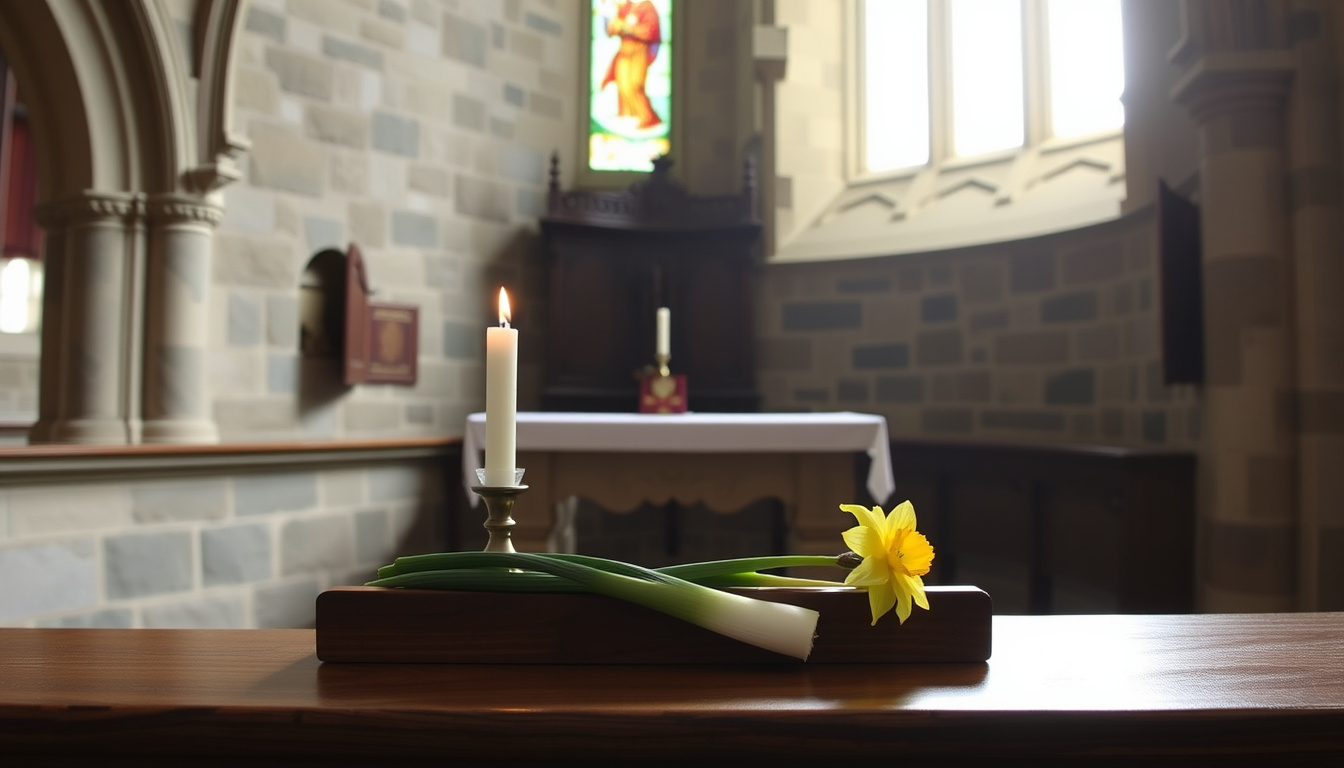
Traditional symbol: Daffodil and leek ·
Known miracle: Sermon of the Little Bird
Quick snapshot
- St David is the patron saint of Wales (BBC News)
- His feast day falls on 1 March, the day he died (Museum Wales)
- He has held the role since the 12th century (BBC History)
- The exact birth and death years are not fixed — Britannica gives circa 520 for his birth and circa 600 for his death (Britannica)
- The dragon-slaying story is a later folk tale, absent from early hagiographies (Britannica)
- Died on 1 March 589 — the date Wales keeps as his feast day (BBC History)
- St Davids Cathedral stands on his monastery site and dates back to 1181 (Wales.com)
- A 1120 canonization is traditionally claimed for Pope Calixtus II, though Britannica calls it unproven (Britannica)
- St David’s Day returns every 1 March with events across Wales (Visit Wales)
- The feast is called Dydd Gŵyl Dewi Sant in Welsh (Visit Wales)
- The next step for many readers: separating the Welsh saint from the biblical King David — covered below (Visit Wales)
Six facts, one pattern: David’s public identity is built on feast-day practice and hagiography, not on a documentary biography.
| Fact | Detail |
|---|---|
| Feast Day | March 1 |
| Born | c. 500 AD |
| Died | 589 AD |
| Patron of | Wales |
| Symbol | Daffodil & Leek |
| Known for | Sermon of the Little Bird |
What is Saint David known for?
St David — Dewi Sant in Welsh — is the man Wales has been named after for nine centuries, and the shortest account of his life reads like a medieval church roster: monk, bishop, founder, teacher.
- He is the patron saint of Wales (BBC News)
- His Welsh name, Dewi Sant, is the one used in Welsh-language observances (Wales.com)
In practice, his reputation rests on the monastery he founded at St Davids in southwest Pembrokeshire — the cathedral site that anchors his legacy to this day. The location fits the tradition of austerity attached to his name, the same simplicity people still invoke when they ask for his intercession. Pilgrims came for centuries, and the site still functions as the spiritual heart of the diocese.
The popular “dragon-slayer” version of St David is the exception, not the rule. His documented identity is monastic, and his status was built by cathedral, clergy, and centuries of feast-day practice — not by a battlefield win.
The pattern: David’s fame is institutional. A cathedral, a monastery, and a 12th-century tradition of patronage did more for his name than any single miracle.
What miracle did St David do?
- The Sermon of the Little Bird — the miracle most often attached to David’s name in medieval tradition.
- Raising a dead child — also part of the miracle tradition around him.
Both enter the written record through the Life of St David by Rhygyfarch, an 11th-century hagiography that remains the main source for the miracles.
The catch: hagiography is written to inspire devotion, not to satisfy historians. These stories tell us how medieval monks wanted David remembered, not what eyewitnesses recorded.
Did St David slay a dragon?
- The legend: David killed a dragon — a story that circulates widely online.
- The record: no early hagiography mentions dragon-slaying; the tale appears to be a later folk addition.
That puts the story closer to the Welsh national myth of the red dragon than to David’s own biography. It is a lively legend, but it is not early history.
What do you pray to St David for?
People who pray to St David typically ask for intercession, guidance, protection, and the plain faithfulness he was known for.
- Intercession — David prays with you and for you.
- Guidance — for everyday decisions and steady faith.
- Protection — over family, community, and homeland.
The traditional Prayer of St David emphasizes following God’s will and living simply. That matches the historical portrait: a monk-bishop whose teaching was remembered as plain rather than spectacular.
The pattern: David’s prayer appeal is humility, not spectacle. He is invoked as a companion in ordinary faithfulness — which is why his name now shows up on everything from parish prayer cards to devotional websites. That plainness is also why the feast has never needed a grand narrative: it survives on daffodils, parades, and quiet pride.
What flower represents St. David’s Day?
Two answers are correct, and both belong to 1 March.
- Daffodil — the flower most widely worn on St David’s Day and the national flower of Wales.
- Leek — the older traditional emblem, linked in folk tradition to a battle story involving St David (Wales.com).
Both appear on the feast: the daffodil on lapels, the leek in older ceremonial badges. The daffodil dominates modern parades; the leek carries the older memory.
The trade-off: a monk remembered for plainness now fronts a festival of bright flowers. The symbols are Welsh identity markers, not biography.
What was David’s powerful prayer?
Here is where the two Davids collide. Ask the question in a Welsh context and the answer is Psalm 51; ask it in a devotional search and you may land on St David instead.
The prayer most often identified as King David’s “powerful prayer” is Psalm 51 — known by its Latin title, the Miserere — a psalm of repentance, traditionally connected to the prophet Nathan’s confrontation. Christians have used it for centuries as a penitential prayer, and it is the psalm most associated with Lent in Western Christian practice.
Prayers to St David and prayers of King David are two different traditions. The Welsh saint is asked for intercession and guidance; the biblical king’s prayers live in the Psalms. Popular searches have blended them for years.
What three things did God promise to David?
- An everlasting kingdom — David’s throne would not end.
- A lasting dynasty — his descendants would keep ruling.
- A son to build the temple — the promise recorded in 2 Samuel 7.
Together, these three promises are what theologians call the Davidic Covenant.
What does Jehovah Rohi mean?
- Jehovah Rohi — also written Yahweh Rohi — means “The Lord is my Shepherd”.
- The title comes from Psalm 23, the psalm of trust in God’s care.
Here David speaks as the shepherd who became king, and the name pictures God as the one who leads, feeds, and protects. It is a prayer of trust, not a plea for spectacle.
The pattern: two Davids, two spiritual legacies — one in the Psalms, one in the parish church. The search mix-up is understandable, but the traditions are distinct.
What are the three strongest prayers?
This question belongs to folk Catholic devotion, and the answer shifts depending on who you ask. The most commonly cited trio is the Our Father, the Hail Mary, and the Glory Be.
- Our Father — the prayer Jesus taught his disciples.
- Hail Mary — the central prayer of Marian devotion.
- Glory Be — the short doxology of praise.
That list varies by tradition, which is the point: there is no single official ranking of “strongest” prayers. Devotion is built on habit and love, not on a leaderboard.
What are the three forbidden times to pray?
- There is no universal Christian teaching about three forbidden times to pray.
- The idea appears to come from folk belief or local custom, not from scripture, catechism, or church law.
If a search result tells you to avoid praying at certain hours, it is folklore presented as doctrine. The New Testament’s repeated instruction runs the other way: pray at all times.
What is a miracle prayer that never fails?
- The phrase “miracle prayer that never fails” is not an official Catholic prayer.
- Devotions such as the Chaplet of Divine Mercy are sometimes shared under that label.
The Chaplet is a real, beloved devotion. But “never fails” is a human promise, not a church guarantee. The phrase usually appears on prayer cards and social media, where it works as a sharing hook more than a liturgical label. Faithful prayer opens a relationship; it does not run on a guarantee.
Why do Catholics not say the last line of the Lord’s prayer?
- Catholics do say the line “deliver us from evil” — it is part of the standard Our Father.
- What some traditions add is the longer doxology: “For thine is the kingdom, and the power, and the glory, forever.”
That doxology is common in Protestant usage; Catholics keep it separate, which is why the Lord’s Prayer in a Catholic setting appears to end one line earlier.
The trade-off: devotional formulas that promise “never fails” spread because they feel certain, but no official Catholic text makes that promise. Treat certainty as comfort, not contract.
The pattern: devotional formulas promising certainty reflect a human desire for guarantees, not church teaching.
Confirmed facts vs. what’s unclear
Confirmed facts
- St David died on 1 March — the date now kept as his feast day (Museum Wales)
- He has been recognised as the patron saint of Wales since the 12th century (BBC News)
What’s unclear
- The dragon-slaying story is a later folk tale, absent from early hagiographies
- His birth year is approximate — around 500 by tradition, circa 520 by Britannica’s estimate
- Details of some miracles may be legendary, preserved through 11th-century hagiography rather than contemporary records
The balance tips toward caution: the confirmed list is short, the unclear list longer — exactly what you would expect for a 6th-century figure whose earliest biography was written centuries later.
What the record says about St David
Three voices sum up the gap between devotion and documentation.
David’s miracles — the Sermon of the Little Bird, the raising of a dead child — enter the written record in the Life of St David by Rhygyfarch, an 11th-century hagiography.
Rhygyfarch — medieval hagiographer, The Life of St David
The canonization of St David by Pope Calixtus II around 1120 is unproven.
— Britannica, historical assessment of St David’s canonization
St David’s Day is promoted across Wales as a national, annual celebration on 1 March.
— Visit Wales, on the scale of the feast
The implication: devotion built St David’s fame, and documentation sets its limits. Both can be held at once — the confusion only starts when legend is presented as record.
What to remember
St David is both a historical figure and a national symbol: a 6th-century monk-bishop who became Wales’ patron saint in the 12th century, remembered through a cathedral, a feast day, and a tradition of simple faith. The dragon story is legend, and the biblical David’s prayers belong to a different tradition entirely. For anyone preparing a St David’s Day school assembly, a parish talk, or a family celebration, the choice is clear: teach the documented saint and name the legends as legends — or hand the next generation a medieval fantasy dressed as history.
bbc.com, wales.com, en.wikipedia.org, museum.wales, bbc.co.uk, franciscanmedia.org
Frequently asked questions
Why is St David the patron saint of Wales?
St David’s status grew from his monastic foundation at St Davids and his reputation as a teacher and bishop. By the 12th century he was recognised as Wales’ patron saint, a role that has stayed with him ever since.
What is the connection between St David and daffodils?
The daffodil is the national flower of Wales and the flower most often worn on St David’s Day. The leek is the older emblem, linked in folk tradition to a battle story involving St David.
Is St David’s Day a public holiday in Wales?
St David’s Day on 1 March is a national day of celebration in Wales, marked with parades, school events, and cultural activities. Visit Wales promotes it as a national, annual, holiday-focused occasion on 1 March.
What is the Sermon of the Little Bird?
The Sermon of the Little Bird is the miracle most often attached to St David in medieval tradition. Along with the raising of a dead child, it comes to us through the 11th-century Life of St David by Rhygyfarch, the main hagiographical source for his miracles.
Can anyone pray to St David for intercession?
Yes. In Christian practice, saints are asked to intercede — to pray with and for the person making the request. St David is typically invoked for guidance, protection, humility, and simplicity of life.
How did St David become a saint?
St David’s canonization is traditionally credited to Pope Calixtus II around 1120, though Britannica notes that the canonization is unproven from the historical record. His status was cemented by medieval devotion, his monastery, and widespread church dedications.
What is the significance of the leek on St David’s Day?
The leek is a traditional emblem of Wales and of St David’s Day. Folk tradition links it to a battle story involving St David.
Related reading
- For a modern example of Welsh identity on screen, see Welsh Roots.
- For another landmark that blends faith and monument, see Christ Redeemer Brazil.
Related stories





Richard Vane is Senior Reporter at MorningTimes.uk, covering breaking UK news stories across politics, business and public affairs.