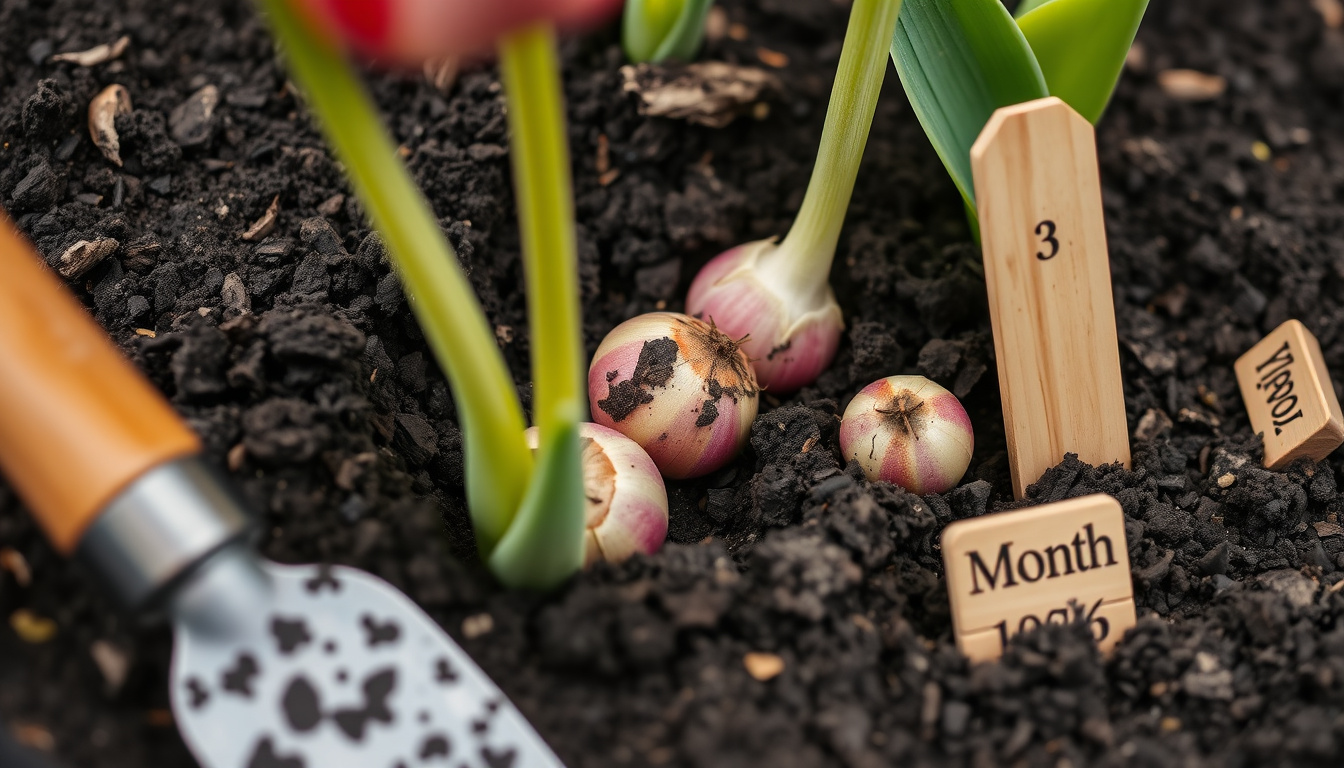
There’s a moment in autumn when the soil cools enough that tulip bulbs know it’s safe to root — plant too early and they may rot, too late and they won’t establish before frost. In the UK, that sweet spot lands in November when ground temperatures dip below 10°C (50°F), and this guide walks through the exact timing, depth, and container strategies that give your tulips the best shot at a spectacular show.
Ideal planting window in temperate zones: mid-September to November · Typical bulb depth: 3 times bulb height (approx. 6 inches/15 cm) · Recommended spacing between bulbs: 4-6 inches (10-15 cm) · Number of bulbs per container (10-inch pot): 5-8 bulbs · Chilling period required for proper root growth: 12-16 weeks of soil temperature below 50°F (10°C)
Quick snapshot
- Tulips need 12–16 weeks with soil temperature below 50°F (10°C) to bloom (ADR Bulbs).
- Plant at a depth of three times bulb height (Three Acre Farm).
- November is the ideal planting window for the UK and Ireland (Sarah Raven).
- Effectiveness of vodka in extending tulip vase life lacks rigorous peer-reviewed evidence.
- Optimal number of bulbs per hole for naturalized drifts depends on bulb size and variety.
- Ideal planting depth varies by source — three times bulb height vs. shallower 8 cm (3 in) recommendations.
- Whether tulips treated as annuals or perennials depends on variety and soil conditions — no universal rule guarantees reblooming.
- September–October: early planting in colder zones or for potted bulbs.
- November: ideal traditional planting window for UK and Ireland.
- December: late planting acceptable in mild winters.
- Monitor soil temperature — wait until it stays below 55°F (13°C).
- Prepare pots or beds with good drainage before planting.
- Water once after planting, then leave bulbs to root in cool soil.
Here are the core metrics every gardener needs before they start digging.
| Metric | Value |
|---|---|
| Best month to plant in UK | November (Sarah Raven) |
| Best month to plant in Ireland | Late November (Sarah Raven) |
| Standard planting depth | 6 inches (15 cm) — three times bulb height (Three Acre Farm) |
| Bulbs per 10-inch pot | 5–8 (Sarah Raven) |
| Days from planting to bloom | approx. 120–150 days |
What month is best to plant tulips?
Soil temperature guidelines
- Wait until soil temperature drops below 55°F (13°C) for proper root development (ADR Bulbs).
- A commonly cited trigger is soil below 60°F (16°C) as a starting cue (Three Acre Farm).
- Tulips need a prolonged cold period of about 10 to 12 weeks at 35°F to 45°F (or cooler) to bloom properly (Three Acre Farm).
The pattern: soil temperature — not the calendar — is the real cue. A warm October means wait; a cool September means start early.
Regional variations for UK and Ireland
- In the UK, Sarah Raven recommends planting in late October, November, or December (Sarah Raven).
- For Ireland, the Royal Horticultural Society of Ireland advises waiting until late November.
- In USDA zones 6 and 7, the optimal window is mid-October to early November (ADR Bulbs).
What this means: gardeners in milder coastal areas can push planting into December, while colder inland spots should aim for late October or November.
Can I plant tulips in pots in October?
Benefits of early pot planting
- October planting in pots allows bulbs to establish roots before deep cold sets in (Sarah Raven).
- Containers warm up faster than ground soil in spring, which can lead to earlier blooms.
- Pots also let you control drainage and soil quality more precisely.
The trade-off: pots need winter protection in very cold zones, but the head start on root growth is real.
Pot size and drainage requirements
- Use pots with drainage holes and at least 10 inches depth — 12+ inches for taller varieties (Sarah Raven).
- Sarah Raven recommends good peat-free compost and ensuring the pot has proper drainage (Sarah Raven).
- Water once after planting, then leave in a cool, dark location until shoots appear.
October pot-planting works well for UK gardeners who want earlier blooms and can provide a cool, protected spot for their containers over winter.
The implication: if you time it right, pots give you a head start on spring colour that in-ground planting can’t match.
Do tulips do better in pots or in the ground?
Ground planting advantages
- In-ground tulips naturalize more easily and require less frequent watering (Three Acre Farm).
- Ground soil provides more stable temperatures, reducing risk of freeze-thaw damage.
- Spacing in the ground: 4–6 inches apart (Sarah Raven).
Container growing considerations
- Pots offer better drainage and soil control but need winter protection in very cold climates (ADR Bulbs).
- For containers, Sarah Raven recommends bulbs about 2 to 3 cm apart for a dense display (Sarah Raven).
- Containers allow layering — plant deep bulbs first, cover with compost, then add a second layer for continuous blooms.
Five key differences, one pattern: ground planting favours naturalisation and low maintenance, while pots give you control over soil and placement but demand more winter care.
| Factor | Ground | Pots |
|---|---|---|
| Naturalisation | Excellent — bulbs multiply over years (Three Acre Farm) | Limited — bulbs rarely naturalise well |
| Drainage control | Depends on native soil (ADR Bulbs) | Full control with compost choice |
| Winter protection needed | Minimal in most UK/Ireland zones | Yes — move to sheltered spot or wrap pot |
| Spacing | 4–6 inches apart (Sarah Raven) | 2–3 cm apart for density |
| Bloom timing | Standard spring | Can flower 1–2 weeks earlier |
Upsides
- Ground planting allows bulbs to naturalise and return year after year.
- Pots offer perfect drainage and soil control, ideal for heavy clay gardens.
- Container tulips can be moved to prime display spots when in bloom.
- Layering bulbs in pots extends the flowering season from a single container.
Downsides
- In-ground bulbs may rot in heavy, waterlogged soil (ADR Bulbs).
- Pots need winter protection — freezing can damage bulbs in containers.
- Container bulbs rarely naturalise and may need replacing each season.
- Potted tulips require more frequent watering and feeding during growth.
Can I leave tulip bulbs in the ground all year?
Perennial behavior of tulips
- In well-drained soil, many tulip varieties can remain in ground year-round (Three Acre Farm).
- Species tulips (e.g., Tulipa sylvestris) are more perennial than hybrid types and often return reliably.
- Hybrid tulips may produce smaller blooms in subsequent years and are often treated as annuals.
Lifting and storing guidance
- In heavy clay or wet soil, bulbs are better lifted after foliage dies back (ADR Bulbs).
- ADR Bulbs warns that all bulbs are harmed by ‘wet feet’ and should never be planted where water pools (ADR Bulbs).
- If lifting: dry bulbs in a shaded spot, store in a cool, dark place, and replant in autumn.
Gardeners on heavy clay face a clear choice: improve drainage with organic matter or lift bulbs annually — stale, wet soil is the fastest way to lose your tulips to rot.
The pattern: your soil type determines whether tulips are a permanent fixture or an annual replanting project.
Why can’t you put tulips and daffodils together?
Allelopathic effects of daffodils
- Daffodils release lycorine, a chemical that can shorten tulip vase life if stems share water.
- In the garden, they can be planted together; conflicting advice mainly concerns cut flowers in a vase.
- In mixed pots, both can coexist as long as daffodil bulbs are not overcrowded.
Water condition compatibility
- The mucilage from cut daffodil stems affects water quality for tulips in a vase.
- For garden beds, soil chemistry differences are negligible — the real issue is competition for space.
- If planting together in a pot, allow adequate spacing so daffodil bulbs don’t crowd tulip roots.
What this means: the don’t-plant-together rule is mostly about cut-flower arrangements, not your garden bed.
How deep to plant tulips in pots?
Depth calculation
- General rule: plant at depth equal to 3 times bulb height — about 6 inches (15 cm) for most tulips (Three Acre Farm).
- Sarah Raven says many books recommend about 8 cm (3 in) for most tulips, but she prefers deeper planting (Sarah Raven).
- In pots, allow 1 inch (2.5 cm) between bulb top and rim for watering.
Layering bulbs in containers
- Sarah Raven suggests the first layer in a layered container can go 28 to 30 cm (11 to 12 in) deep, then covered with 5 cm (2 in) of compost before the next layer (Sarah Raven).
- Use shallow pots for small bulbs; deeper pots (12+ inches) for taller varieties.
- Water once after planting, then leave in a cool, dark location until shoots appear.
The catch: deeper planting in pots gives better insulation and room for layering, but you must leave enough space at the top for watering.
Can I plant tulips in March or April?
Late planting risks
- Spring-planted bulbs may not bloom the same year; they require a cold period to flower (Three Acre Farm).
- Tulips need 12 to 16 weeks with sustained soil temperature below 50°F (10°C) to bloom properly (ADR Bulbs).
- By April it is generally too late for natural spring flowering — bulbs may flower the following year.
Forced bulbs as alternative
- In mild climates, March planting with pre-chilled bulbs (6-8 weeks in a fridge) might produce late blooms.
- Pre-chilled bulbs are a workaround but success rates are lower than autumn-planted bulbs.
- For gardeners who missed autumn planting, buying pre-grown potted tulips in spring is a more reliable option.
The implication: March and April planting is a gamble — pre-chilled bulbs are your only shot, and even then, don’t expect a full show.
Timeline for planting tulip bulbs
- September–October: Early planting in colder zones (USDA 3-5) or for potted bulbs. Soil temperatures begin to cool.
- November: Ideal traditional planting window for UK and Ireland (Sarah Raven).
- December: Late planting acceptable in mild winters or if ground is not frozen. Gardener’s World notes this is acceptable in warmer areas.
- January–February: Plant only pre-chilled bulbs in regions with mild winters; low success rate for spring blooms.
- March–April: Generally too late for spring blooms; bulbs may flower next year if they get a cold period later.
What we know vs. what’s still debated
Confirmed facts
- Tulip bulbs require a cold period (12–16 weeks below 10°C) to initiate flowering (ADR Bulbs).
- Planting depth should be 3 times the bulb height (Three Acre Farm).
- November is the recommended planting month in the UK and Ireland (Sarah Raven).
What’s unclear
- Effectiveness of vodka in extending tulip vase life lacks rigorous peer-reviewed evidence.
- Optimal number of bulbs per hole for naturalized drifts depends on bulb size and variety — no universal rule exists.
- Ideal planting depth varies by source — three times bulb height vs. shallower 8 cm (3 in) recommendations.
- Whether tulips treated as annuals or perennials depends on variety and soil conditions — no universal guarantee of reblooming.
- Tulips need well-draining soil and may rot in heavy, wet soils (Three Acre Farm).
Expert perspectives on tulip planting
“Plant tulip bulbs in late October, November, or December in the UK.”
— Sarah Raven, gardening expert and author (Sarah Raven)
“Wait until soil temperature has cooled to below 60°F (about 16°C) before planting.”
— Three Acre Farm, bulb-growing guide (Three Acre Farm)
“All bulbs are harmed by ‘wet feet’ and should never be planted where water pools.”
— ADR Bulbs, bulb supplier and growing resource (ADR Bulbs)
Getting the timing right for tulips means reading your soil temperature, not just the calendar. For UK and Irish gardeners, the window runs from late October through December, with November as the sweet spot. Container planting adds flexibility and earlier blooms but demands winter protection. Flowers Next Day Delivery Ireland offers a practical option for those who miss the planting window and still want spring colour, while the Outdoor Toys for Kids guide provides ideas for keeping little ones engaged in the garden while you work. The choice for every gardener is clear: check your soil temperature, prepare your beds or pots by mid-autumn, and give those bulbs the cold period they evolved to need — or accept that spring blooms are a year away.
Once you know the ideal window for planting, consult a step-by-step planting guide that covers both pot and ground methods to ensure success.
Frequently asked questions
How long do tulip blooms last in the garden?
Most tulip blooms last 1–2 weeks in the garden, depending on temperature and variety. Cooler weather extends the display; hot sun shortens it.
Should I fertilize tulip bulbs at planting time?
A light application of balanced bulb fertiliser (low in nitrogen) at planting time can help root development. Avoid high-nitrogen feeds that encourage leafy growth at the expense of flowers.
What soil type is best for tulips?
Tulips need well-draining soil. Sandy loam is ideal. In heavy clay, improve drainage by adding grit, compost, or planting in raised beds (ADR Bulbs).
Can tulips be grown in full shade?
Tulips do best in full sun but can tolerate partial shade (Three Acre Farm). In heavy shade, flowering is reduced.
Why do my tulip bulbs rot in the ground?
Bulbs rot in waterlogged soil. Ensure planting sites drain well — if your garden has heavy clay, improve drainage with organic matter or plant in pots (ADR Bulbs).
How deep should I plant tulips in clay soil?
In clay soil, plant slightly shallower — about 4–5 inches (10–12 cm) — to reduce the risk of rot. ADR Bulbs recommends loosening heavy clay to 10 inches deep before planting (ADR Bulbs).
Do squirrels dig up tulip bulbs? How to protect them?
Yes, squirrels may dig up tulip bulbs. Protect them by covering the soil with chicken wire or mesh after planting, or by adding a layer of sharp grit on top of the soil.
Related stories




James Holloway covers culture, lifestyle and society for MorningTimes.uk.