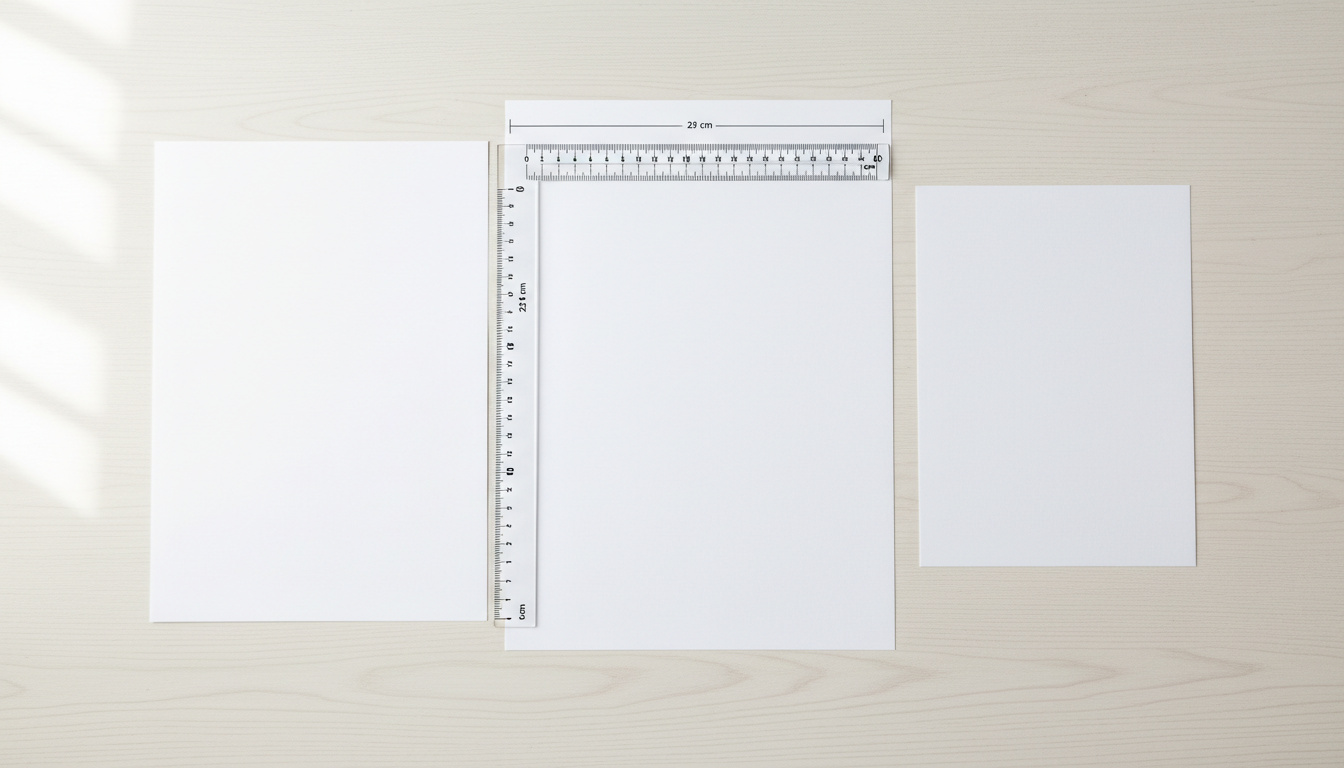

A4 paper measures exactly 21.0 centimetres by 29.7 centimetres. This dimension, defined by the ISO 216 international standard, represents the most widely used paper size for business, education, and publishing worldwide.
The specifications translate to 210 millimetres in width and 297 millimetres in height, maintaining a precise aspect ratio of 1 to the square root of 2 (approximately 1.414:1). Industry sources confirm these measurements allow the sheet to be cut in half repeatedly while preserving identical proportions.
While dominant across Europe, Asia, and Oceania, the format faces regional competition from the US Letter size, which remains standard in North America. Documentation from paper size archives indicates A4 adoption correlates closely with metric system usage.
What Is the Exact Size of A4 Paper in CM?
- Exact dimensions: 21.0 cm × 29.7 cm (210 mm × 297 mm)
- Aspect ratio of 1:√2 (~1.414:1) ensures scalable halving
- Total surface area equals 1/16 of a square metre
- Manufacturing tolerances allow ±2 mm deviation
- Recognized as the international default for office documents
| Size | Width (cm) | Height (cm) | Notes |
|---|---|---|---|
| A4 | 21.0 | 29.7 | ISO 216 international standard |
| A3 | 29.7 | 42.0 | Double the area of A4 |
| A5 | 14.8 | 21.0 | Half the area of A4 |
| US Letter | 21.59 | 27.94 | North American standard (ANSI) |
| Legal | 21.59 | 35.56 | North American legal documents |
| A0 | 84.1 | 118.9 | 1 m² surface area |
A4 Dimensions in MM and Other Units
What Is A4 Size in Millimeters?
The ISO 216 specification defines A4 as 210 mm wide by 297 mm tall. International size standards show these millimetre measurements provide the precision required for manufacturing consistency across global supply chains.
What Is A4 Size in Inches?
Conversion yields approximately 8.27 inches in width and 11.69 inches in height. Some references round this to 8¼ by 11¾ inches for practical purposes, though the exact decimal conversion remains 8.27 × 11.69 inches.
A4 Paper Dimensions for Printing
Digital workflows require pixel translations that depend on resolution density. At 300 dots per inch (DPI), the standard for professional printing, A4 translates to roughly 2480 pixels by 3508 pixels. Screen viewing at 72 or 96 DPI produces significantly smaller pixel dimensions.
At 300 DPI, A4 equals 2480 × 3508 pixels. At 150 DPI, this halves to 1240 × 1754 pixels. ISO 216 governs physical dimensions only; pixel counts vary by output device.
How Does A4 Compare to Letter and Other Sizes?
Is A4 the Same as Letter Size?
US Letter measures 215.9 mm by 279.4 mm (21.59 cm × 27.94 cm), making it slightly wider but noticeably shorter than A4. ANSI standards documentation confirms this divergence creates compatibility issues when printing documents across regions. The aspect ratios differ fundamentally: A4 maintains 1:√2 while Letter uses approximately 1:1.294.
How Big Is A4 Compared to A3?
A3 dimensions of 297 mm × 420 mm (29.7 cm × 42 cm) make it exactly twice the surface area of A4. Two A4 sheets placed side-by-side along their longer edges match one A3 sheet perfectly, illustrating the mathematical efficiency of the ISO system.
North American printers often default to Letter size. When feeding A4 paper into these devices, automatic scaling may reduce content by approximately 5% to fit the shorter page length.
A4 Paper Under ISO 216 Standard
What Is ISO 216 Standard?
ISO 216 establishes the A, B, and C series of paper sizes based on a single coherent mathematical principle. Technical documentation traces the standard’s origins to German DIN 476, formalized internationally in 1975. The A-series begins with A0, occupying exactly one square metre (841 mm × 1189 mm), with each subsequent size halving the area.
Why Is A4 Size 210×297 mm?
These specific millimetres emerge from the geometric requirement to maintain √2 proportions while halving area. Cutting an A0 sheet (841 × 1189 mm) in half produces A1 (594 × 841 mm). Continuing this division through A2 (420 × 594 mm), A3 (297 × 420 mm), and finally A4 yields 210 × 297 mm. The numbers round to nearest millimetres for manufacturing practicality.
What Is the Aspect Ratio of A4?
The ratio of height to width equals the square root of 2 (approximately 1.414 to 1). This irrational number ensures that when the sheet is divided in half parallel to its shorter side, the resulting halves retain identical proportions. Comparative analysis shows this scalability contrasts sharply with US Letter’s incompatible ratio.
ISO 216 permits dimensional deviations: ±1.5 mm for sizes up to 150 mm, ±2 mm for dimensions between 150 mm and 600 mm, and ±3 mm above 600 mm. Some national standards like DIN 476 enforce tighter tolerances of ±1–2 mm.
When Did A4 Become the International Standard?
- : European countries adopt A-series formats based on metric principles, predating formal ISO standardization.
- : Germany codifies the system under DIN 476, establishing the foundation for future international standards.
- : ISO publishes ISO 216, formally defining A4 as 210 × 297 mm with √2 aspect ratio. Subsequent 2007 editions refined technical specifications.
- : Global adoption accelerates outside North America, driven by metric system integration and efficient scaling requirements.
What Is Definitively Known About A4 Measurements?
| Established Facts | Uncertainties/Variations |
|---|---|
| Fixed at 210 × 297 mm per ISO 216 | Exact adoption dates vary by national standards bodies |
| Aspect ratio of 1:√2 (~1.414:1) | Regional tolerance enforcement variations (DIN vs ISO) |
| Area of 623.7 cm² (1/16 m²) | Transitional periods in former imperial-measurement countries |
| Global standard outside North America | Specific manufacturer deviations within tolerance ranges |
Why Did A4 Become the Global Standard?
The format’s dominance stems from its mathematical elegance. The √2 ratio enables photocopiers and printers to scale documents between sizes (A3 to A4, A4 to A5) without distorting images or text. Industry analyses note this scalability reduces waste and simplifies logistics.
Metric system alignment further propelled adoption. Countries transitioning from imperial measurements found the decimal-based A-series compatible with existing measurement infrastructures. Educational and governmental institutions drove standardization through bulk purchasing power.
By the late 1970s, most nations outside North America had adopted ISO 216 as the default for official documentation, creating network effects that reinforced A4’s market position. Similar precision appears in specialized industries, as detailed in What Is Wagyu Beef – Origins, Breeds and Kobe Differences.
Where Do A4 Dimensions Originate?
The mathematical foundation traces to German engineer Walter Porstmann, who formalized the A-series in 1922 under DIN 476. His system derived from earlier 19th-century French proposals to rationalize paper production through metric geometry. The Cambridge University Computer Laboratory maintains technical archives showing how the √2 principle solved scaling problems that plagued arbitrary historical sizes.
The A series is based on area √2 ratio, allowing repeated halving without proportion change.
— ISO 216 Technical Specification
Standardization efforts accelerated after World War II as international trade expanded. Chelsea FC vs FC Barcelona Standings – Full Head-to-Head Record demonstrates how international standards facilitate cross-border consistency, whether in sports documentation or paper sizing.
How to Apply A4 Dimensions in Practice
Designers and procurement officers should verify printer compatibility when working across regions. Software settings must specify A4 explicitly to prevent automatic Letter resizing, which can alter document layouts. For digital design, implementing profiles at 300 DPI ensures print-ready output at 2480 × 3508 pixels. Organizations managing international documentation should verify envelope compatibility; A4 folds to fit C5 (162 × 229 mm) or DL (110 × 220 mm) formats.
Frequently Asked Questions
What is A4 size in pixels at 300 DPI?
At 300 DPI, A4 equals approximately 2480 pixels by 3508 pixels. This derives from converting 210 mm and 297 mm to inches (8.27 × 11.69), then multiplying by 300.
Why is A4 exactly 210 × 297 mm?
These dimensions result from halving an A0 sheet (1 m² at 841 × 1189 mm) four times while maintaining the √2 aspect ratio. Each halving rounds to the nearest millimetre.
What envelope size fits A4 paper?
A4 folds to fit C5 envelopes (162 × 229 mm) or DL envelopes (110 × 220 mm) for mailing.
Is A4 the same as 8.5 × 11 inches?
No. US Letter is 8.5 × 11 inches (215.9 × 279.4 mm), while A4 is 8.27 × 11.69 inches (210 × 297 mm). A4 is taller and slightly narrower.
Can I print A4 documents on US Letter paper?
Yes, but the document requires scaling or margin adjustment. Letter paper is 6.35 mm shorter than A4, which may truncate footers or page numbers.
Related stories





Priya Sharma covers the economy, business and consumer affairs for MorningTimes.uk.