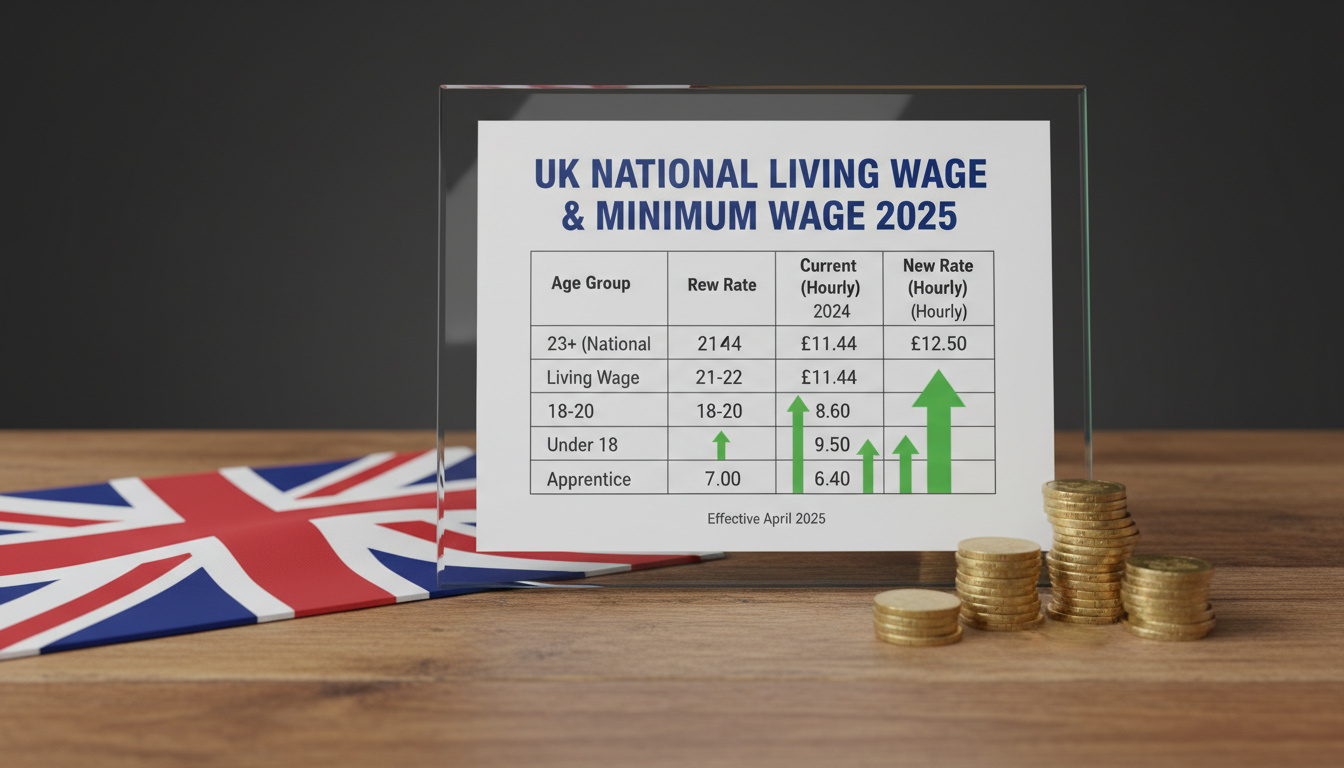
From 1 April 2025, UK workers aged 21 and over are entitled to £12.21 per hour under the National Living Wage, marking a 6.7% increase from the previous year. Younger workers and apprentices see substantially larger percentage rises, with rates for 18-to-20-year-olds jumping 16.3% to £10.00 per hour.
The Low Pay Commission recommended these adjustments to narrow historical pay gaps between age groups while maintaining employment levels. All rates apply uniformly across England, Scotland, Wales and Northern Ireland, with no exemptions for employer size or sector.
The complete rate structure, implementation timeline, and calculation methods detailed below are based on official government sources and independent advisory reports.
What are the UK minimum wage rates for 2025?
The 2025 minimum wage structure divides workers into four distinct categories based on age and apprenticeship status. Each band receives a different hourly rate reflecting the government’s phased approach to equalising pay levels across age groups.
Key developments for 2025:
- The NLW threshold dropped from age 23 to 21 in 2024, and remains at 21 for 2025
- The 16.3% increase for 18-20 year olds represents the largest ever rise for this age group
- Under-18s receive an 18.0% increase, the second-highest historical rise after 2004
- Apprentice rates align with under-18 rates at £7.55, up from £6.40
- Minimum wage obligations apply from school leaving age, typically 16
- Northern Ireland maintains identical base rates to Great Britain
| Age/Apprentice Status | April 2025 Rate | April 2024 Rate | Hourly Increase | Percentage Increase |
|---|---|---|---|---|
| 21 and over (NLW) | £12.21 | £11.44 | £0.77 | 6.7% |
| 18-20 years | £10.00 | £8.60 | £1.40 | 16.3% |
| Under 18 years | £7.55 | £6.40 | £1.15 | 18.0% |
| Apprentice (qualifying) | £7.55 | £6.40 | £1.15 | 18.0% |
Source: GOV.UK National Minimum Wage rates and Low Pay Commission 2025 Uprating Report.
What is the minimum wage by age group in the UK for 2025?
Age remains the primary determinant of minimum hourly pay in UK law, though the gap between adult and youth rates continues to narrow under current policy. The system recognises four distinct age bands, each with specific entitlements and exceptions.
Workers aged 21 and over
Workers in this category qualify for the National Living Wage, set at £12.21 per hour from April 2025. This rate applies regardless of whether the worker is 21 or 65, creating a single adult minimum standard. The 6.7% increase adds approximately £0.77 per hour compared to 2024 levels.
Workers aged 18 to 20
This band receives £10.00 per hour, a historic increase of 16.3%. The Low Pay Commission specifically targeted this group to reverse the widening gap that emerged between youth and adult rates in previous years. Employers hiring workers in this age bracket face significantly higher wage costs compared to 2024.
Workers under 18
School leavers and younger workers aged 16-17 are entitled to £7.55 per hour, rising 18.0% from £6.40. This rate applies from the last Friday in June of the school year in which the worker turns 16. The substantial percentage increase reflects policy efforts to establish fairer starting wages for entry-level positions.
Apprenticeship rates
Apprentices qualify for the £7.55 rate only if they are aged under 19, or aged 19 and over but in their first year of apprenticeship. Beyond the first year, apprentices aged 19+ must receive the age-appropriate rate for their category—meaning a 21-year-old apprentice in year two receives £12.21, not £7.55.
A 21-year-old starting an apprenticeship in April 2025 receives £7.55 for the first 12 months. Upon entering year two, the employer must increase pay to £12.21 to comply with NLW requirements. Source: Check Your Pay campaign.
When does the UK minimum wage increase in 2025?
The 2025 rates took effect on 1 April 2025, following the annual cycle established under the National Minimum Wage Act 1998. This date aligns with the start of the tax year and applies to pay reference periods beginning on or after this date.
Annual review cycle
The Low Pay Commission reviews rates annually, typically submitting recommendations to the government in the autumn preceding the April implementation. For 2025, the Commission recommended the current rates based on economic forecasts and labour market conditions, with the government accepting the proposals in full.
Future adjustments
Rates for April 2026 have been announced in advance: £12.71 for workers aged 21+, £10.85 for 18-20 year olds, and £8.00 for under-18s and apprentices. These figures remain subject to parliamentary approval but provide employers with planning certainty.
How does the 2025 UK minimum wage compare to 2024?
The 2025 uprating represents the most significant restructuring of youth rates in the National Minimum Wage’s history. While the adult NLW increase of 6.7% tracks roughly with inflation, youth rates substantially outpace cost-of-living adjustments.
In absolute terms, an 18-year-old working 35 hours per week earns £350.00 weekly under 2025 rates, compared to £301.00 in 2024—a weekly increase of £49.00 before deductions. This compression of the age-related pay scale reduces the incentive for employers to hire younger workers purely based on wage cost differentials.
The 16.3% increase for 18-20 year olds and 18.0% rise for under-18s represent the highest and second-highest increases ever recorded for these groups. Employers with high concentrations of young staff face the steepest wage bill increases. Source: Low Pay Commission 2025 Report.
Successive governments have directed the Low Pay Commission to narrow the gap between youth and adult rates. The 2025 adjustments continue this trend, though a £2.21 hourly difference remains between 20-year-olds and 21-year-olds.
How to calculate UK minimum wage monthly or yearly for 2025?
Converting hourly rates to longer periods requires multiplying the hourly figure by contracted hours, then scaling to monthly or annual figures. Standard calculations assume a 37.5-hour week or 40-hour week, though actual contracts vary.
For a full-time worker aged 21+ earning £12.21 per hour and working 37.5 hours weekly: weekly earnings equal £457.88, monthly earnings approximate £1,984.13 (weekly × 52 ÷ 12), and annual salary reaches approximately £23,809.50 before tax and National Insurance.
Workers aged 18-20 at £10.00 per hour working identical hours earn £375.00 weekly, roughly £1,625.00 monthly, and £19,500.00 annually. Those requiring precise calculations for Change Driving Licence Address – Free DVLA Update Guide budgeting should use the exact weeks worked per year, as holiday entitlements affect total hours.
How have UK minimum wage rates evolved over time?
- April 2024: Previous rates established with NLW at £11.44 for workers aged 21+.
- Autumn 2024: Low Pay Commission submitted recommendations to government for 2025 uprating.
- 1 April 2025: Current rates implemented across all UK jurisdictions.
- October 2025: Workers planning annual leave around school holidays should note that October Half Term 2025 UK – Dates for England, Scotland, Wales & NI vary by region.
- April 2026 (projected): NLW scheduled to rise to £12.71, with youth rates increasing to £10.85 (18-20) and £8.00 (under-18/apprentice).
Source: GOV.UK historical rates and UNISON minimum wage guidance. Workers planning annual leave around school holidays should note that October Half Term 2025 UK – Dates for England, Scotland, Wales & NI vary by region, and for those interested in major sporting events, Чемпіонат світу з футболу 2025 дати provides further details.
What is confirmed about the 2025 minimum wage and what remains unclear?
| Established Facts | Uncertain or Misunderstood |
|---|---|
| Rates effective 1 April 2025 | August/September 2025 increases (no official changes scheduled; likely confusion with tax code adjustments or other benefit changes) |
| NLW applies to workers aged 21+ | Exact 2026 rates (figures announced but subject to parliamentary approval) |
| Apprentice rules: £7.55 for under-19 or first-year only | Whether youth rates will equalise with NLW by 2026-2027 (policy direction unclear) |
| Northern Ireland matches GB rates | Impact on employment levels for 16-20 year olds following record increases |
What is the policy background for the 2025 minimum wage changes?
The National Living Wage differs from the National Minimum Wage primarily in age threshold and rate level, though both are legally enforceable. Introduced in 2016 for workers aged 25+, the NLW threshold dropped to 23 in 2021 and 21 in 2024, expanding coverage to younger adults.
The Low Pay Commission operates as an independent body advising on rate settings, balancing worker protection against employment risks. Their 2025 recommendations noted that workers under 21 incur lower National Insurance costs for employers, partially offsetting the wage increases.
Northern Ireland follows UK-wide rates set by Westminster, though nidirect.gov.uk notes additional sector-specific grades in agriculture that do not affect the core NMW structure.
Where do the 2025 minimum wage figures originate?
From 1 April 2025, the National Living Wage applies to workers aged 21 and over at £12.21 per hour.
— GOV.UK National Minimum Wage guidance
The 16.3 per cent increase for 18-20 year olds is the highest ever for that group, and the 18 per cent increase for under-18s is the second-highest historically.
— Low Pay Commission 2025 Uprating Report
Additional verification comes from British Business Bank guidance for employers and trade union monitoring through UNISON’s minimum wage resources.
What should workers and employers remember about the 2025 minimum wage?
All workers aged 21 and above now receive at least £12.21 per hour, with younger workers and apprentices seeing record-breaking percentage increases. Employers must apply these rates from 1 April 2025, with no exemptions for business size or sector. Workers concerned about underpayment should consult official GOV.UK guidance or contact ACAS for confidential advice on enforcement rights.
Frequently asked questions
Where can I find official government confirmation of the 2025 rates?
GOV.UK publishes the authoritative National Minimum Wage rates at gov.uk/national-minimum-wage-rates, including historical data and enforcement guidance.
What will the minimum wage be in 2026?
From April 2026, rates are scheduled to rise to £12.71 (21+), £10.85 (18-20), and £8.00 (under-18/apprentice), subject to parliamentary approval. Source: Check Your Pay campaign.
How much do apprentices earn in 2025?
Qualifying apprentices receive £7.55 per hour. This applies to apprentices under 19, or those 19+ in their first year. Second-year apprentices aged 19+ receive age-appropriate rates.
Is the minimum wage increasing in August 2025?
No. The 2025 increase took effect on 1 April 2025. There are no scheduled minimum wage changes for August or September 2025.
Will the minimum wage rise in September 2025?
No official increases are scheduled for September 2025. Searches for September increases likely confuse the minimum wage with tax code changes or student finance adjustments occurring in that month.
What is the minimum wage for someone aged 25 or over?
Workers aged 25 and over fall into the 21+ category, receiving £12.21 per hour. The NLW threshold was reduced from 23 to 21 in 2024, so those aged 21-24 receive the same rate as older workers.
Related stories





Marcus Bell covers UK politics, public policy and government for MorningTimes.uk.