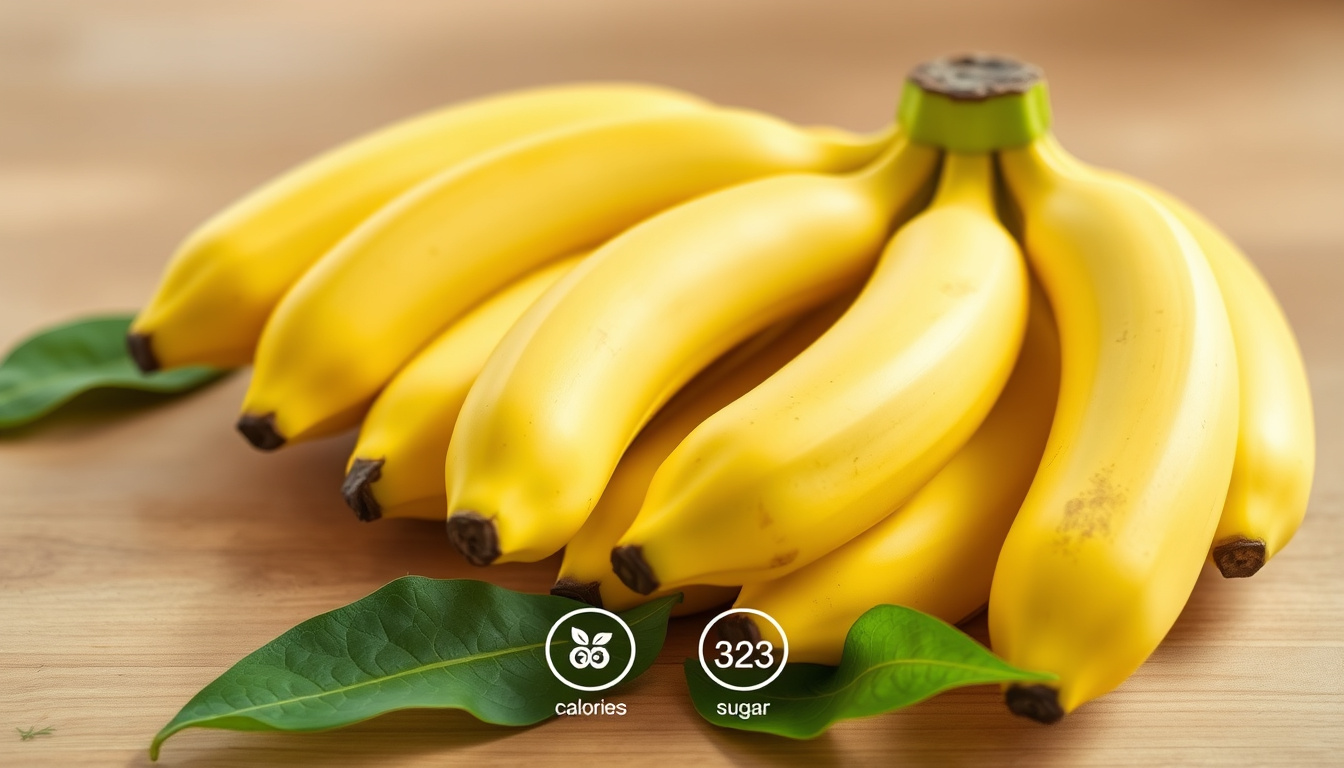
If you’ve ever stood in the kitchen wondering whether a banana is sabotaging your diet, you’re not alone. This curved yellow fruit sits in a strange spot—often praised by fitness fans but eyed suspiciously by anyone counting carbs. The good news is that banana nutrition facts are straightforward once you cut through the noise, and a medium banana lands right around 105 calories with a decent fiber kick to keep you satisfied.
Calories (medium banana): 105 ·
Carbs: 27g ·
Sugar: 14g ·
Fiber: 3g ·
Protein: 1g
Quick snapshot
- Extra-small (6in): 72 cal (Noom)
- Small (6-7in): 90 cal (Noom)
- Medium (7-8in): 105 cal (Women’s Health Magazine)
- Large (8-9in): 121 cal (Noom)
- Potassium: 450mg (Harvard T.H. Chan School of Public Health)
- Vitamin B6: 25% Daily Value (Healthline)
- Fiber: 3g (Harvard T.H. Chan School of Public Health)
- Low glycemic load when paired with fiber (Noom)
- 93% of calories from carbs (Dr. Axe)
- Satisfying fiber curbs overeating (Noom)
- 14-15g natural sugar in medium banana (Women’s Health Magazine)
- Balanced by fiber—no insulin crash (Noom)
- Entirely naturally occurring, not added sugar (Harvard T.H. Chan School of Public Health)
The table below breaks down the core macronutrients for a single medium banana (118g), the standard reference size used across nutrition databases.
| Nutrient | Amount (medium banana) |
|---|---|
| Calories | 105 |
| Total Carbohydrates | 27g |
| Dietary Fiber | 3g |
| Sugars | 14g |
| Protein | 1g |
| Fat | 0g |
How many calories are in 1 average banana?
Bananas generally contain between 72 and 135 calories depending on their size (Noom), and the standard reference used by nutritionists is the medium banana at 118 grams delivering 105 calories (Women’s Health Magazine). One medium ripe banana provides about 110 calories, 28 grams of carbohydrate, 15 grams of sugar, and 3 grams of fiber (Harvard T.H. Chan School of Public Health). This puts the banana squarely in the “moderate calorie” category for fruits.
Calories by banana size
Size drives calorie count predictably—each bump in length adds roughly 15 calories. The table below shows how weight translates to energy across the standard size range.
| Size | Weight | Calories |
|---|---|---|
| Extra-small | 81g | 72 |
| Small | 101g | 90 |
| Medium (reference) | 118g | 105 |
| Large | 136g | 121 |
| Extra-large | 152g | 135 |
An extra-small banana under 6 inches has 72 calories while a large banana at 8 to 8-7/8 inches long contains 121.04 calories (University Hospitals). The extra-large variety exceeding 9 inches would contain around 135 calories (Chiquita). Most of the calories in a banana come from carbohydrates—around 93 percent—with only about 4 percent from protein and 3 percent from fat (Dr. Axe).
If you’re watching portions, pick bananas on the smaller end: a small banana saves you 15 calories compared to a medium, and over a week of daily snacking that difference adds up to 105 calories cut from your total intake.
Calories in a banana slice
When you cut a banana up, portion size shifts quickly. A cup of banana slices (about 150 grams) will provide around 134 calories, while a cup of mashed banana weighing 225 grams contains around 200 calories (Chiquita). This matters for recipes like smoothies or overnight oats where you might assume “one banana” but end up with double the calories if it’s large and well-mashed.
Do bananas really have too much sugar?
A medium banana contains approximately 14 grams of sugar (Women’s Health Magazine), and while that might sound alarming if you’re watching carbs, the context matters. The sugar in bananas occurs naturally in the form of fructose—a simple sugar that the body digests rapidly (Women’s Health Magazine), but this is fundamentally different from the added sugars in candy, soda, or baked goods. Bananas are a source of Vitamin B6, Fiber, Potassium, Magnesium, Vitamin C, and Manganese (Harvard T.H. Chan School of Public Health), nutrients that come packaged with that sugar.
Sugar content in bananas
A large banana (8 to 8-7/8 inches long) contains 16.63 grams of total sugars (University Hospitals), which is slightly higher than a medium because of the size difference. The natural sugars in bananas are balanced by fiber, making it an excellent, nutrient-dense snack rather than a sugar bomb (Noom). The fiber slows digestion and prevents the sharp blood sugar spikes that come from equivalent amounts of refined sugar.
Dietitians distinguish between naturally occurring fruit sugars and added sugars: the fiber, vitamins, and minerals in a banana make it nutritionally distinct from a candy bar with the same sugar count, even if the raw sugar numbers look similar.
Is 1 banana a day too much sugar?
For most people, one medium banana a day fits comfortably within dietary guidelines. The American Heart Association recommends no more than 36 grams of added sugar daily for men and 25 grams for women—far above what a single banana delivers. One medium banana contains 12% of the Daily Value for Potassium, which supports blood pressure regulation and muscle function (Healthline), and delivers 3 grams of fiber that aids digestion and satiety.
Are bananas good for dieting?
Bananas are high in fiber, which promotes satiety and reduces overall calorie intake (Noom). The combination of fiber and moderate calories makes a banana a filling snack that won’t derail your deficit. Bananas make an excellent, healthy, and low calorie snack (Healthline) that provides sustained energy from its carbohydrate content without the processed additives found in many diet foods.
Bananas for weight loss
Bananas are packed with potassium, vitamin B6, and antioxidants that support muscle function and metabolism while aiding weight management (Noom). The majority of banana’s calories come from carbohydrates, with a little from protein, and bananas contain between 2-4 grams of fiber each (Chiquita). This fiber content helps you feel full longer, potentially reducing the urge to snack on higher-calorie alternatives.
Dieters who eat bananas pre-workout often find they sustain energy longer, but those eating bananas as an evening snack without accounting for the 105 calories may stall their progress—the timing and context of banana consumption matters as much as the fruit itself.
Are bananas ok for losing weight?
An average-sized banana contains about 100 calories and 25 grams of carbs (Healthline), which fits easily into a calorie-conscious eating plan. The key is treating a banana as a structured snack rather than an invisible addition to meals you’re already eating. Pairing a banana with a protein source like Greek yogurt or nut butter creates a more complete snack that balances the carbs and extends satiety.
Which fruit has the lowest calories?
When ranked against other common fruits, bananas sit in the middle-to-higher calorie range. Lemons and watermelon generally offer fewer calories per serving, while berries like strawberries often provide more fiber and fewer carbs for the same weight. Bananas contain plenty of carbohydrates, more than an orange, but also contain fiber and starch (Dr. Axe) that add nutritional value beyond simple calorie counts.
Lowest calorie fruits
Water-heavy fruits dominate the low-calorie rankings, while denser options like bananas trade water content for energy density. The comparison below shows how bananas stack up against common alternatives.
| Fruit | Calories per 100g | Notes |
|---|---|---|
| Watermelon | 30 | High water content |
| Strawberries | 32 | High fiber, low sugar |
| Grapefruit | 42 | Popular in diet plans |
| Orange | 47 | More fiber than bananas |
| Apple | 52 | Similar calorie density |
| Banana | 89 | Higher calories but more potassium |
The pattern is clear: fruits with high water content tend to be lower in calories, while denser fruits like bananas pack more energy per gram. This doesn’t make watermelons “better” than bananas—each delivers different nutrients—but if your goal is pure calorie minimization, watermelon and berries outperform bananas significantly.
Despite higher calories, bananas often outperform low-calorie fruits for sustained energy during exercise or physical activity, because their natural sugars and potassium support muscle function in ways that watery fruits cannot match.
Banana vs other fruits
Comparing nutrient density reveals a trade-off: bananas deliver substantially more potassium (450mg vs. oranges at around 180mg) and provide quick-digesting carbohydrates ideal for athletes (Harvard T.H. Chan School of Public Health), but fruits like berries offer more antioxidants and lower sugar impact for those focused on weight loss.
What fruit is best for losing weight?
No single fruit holds a universal crown for weight loss—different fruits serve different roles in a diet plan. Berries, apples, and grapefruits often rank higher in “best fruit for weight loss” articles because of their lower calorie density and higher fiber-to-sugar ratios, but bananas provide sustained energy that can power workouts essential for weight loss (Noom). A large banana contains 486.88 mg of potassium (University Hospitals), which supports muscle recovery and electrolyte balance during exercise.
Top weight loss fruits
The fruits most consistently recommended for weight loss include strawberries, blueberries, grapefruit, and apples—but bananas remain a practical choice for active individuals. One medium banana contains 25% of the Daily Value for Vitamin B6, supporting metabolic function (Healthline), which plays a role in how your body converts food to energy rather than stored fat.
The ranking for “healthiest fruit” varies depending on which nutrient you prioritize: potassium for athletes (bananas win), antioxidants for anti-aging (berries win), fiber for gut health (apples win). Don’t follow a one-size-fits-all ranking—match the fruit to your specific goals.
Bananas in weight loss rankings
Bananas typically rank around 7-10 in weight-loss fruit lists, hampered by their higher sugar and calorie content compared to berries. However, their satiety score often exceeds their ranking suggests—people feel more satisfied after a banana than after eating an equivalent calorie portion of berries, which means bananas may actually support adherence to a diet better than lower-calorie alternatives.
Upsides
- 105 calories is modest for the satisfaction level
- 3g fiber supports gut health and satiety
- 450mg potassium aids muscle function
- Quick pre-workout energy source
- Naturally portable and affordable
Downsides
- Higher in sugar than berries or melons
- Carb-heavy for low-carb dieters
- Sugar spikes more if eaten alone without protein
- Less fiber than apples or pears
- Not ideal for very calorie-restricted diets
“One medium ripe banana provides about 110 calories, 0 gram fat, 1 gram protein, 28 grams carbohydrate, 15 grams sugar, 3 grams fiber, and 450 mg potassium.”
— Harvard T.H. Chan School of Public Health (The Nutrition Source)
“Bananas generally contain between 72 and 135 calories depending on their size.”
— Noom (behavioral nutrition platform)
Related reading: 1/2 Cup in Grams – Butter, Flour, Sugar Conversions
calory.app, pmc.ncbi.nlm.nih.gov, snaped.fns.usda.gov, nutrition.umd.edu
Beyond calories and carbs, a medium banana supplies about 420 mg of potassium, essential for heart health as covered in our guide to banana potassium content.
Frequently asked questions
How many calories in 2 bananas?
Two medium bananas contain approximately 210 calories total. This assumes both are medium-sized (118g each). If one is large, the total could reach 226 calories. The calorie difference seems minor, but it matters if you’re tracking daily intake precisely.
Calories in a banana with peanut butter?
A medium banana (105 calories) plus a tablespoon of peanut butter (about 90 calories) totals roughly 195 calories. The combination makes an excellent post-workout snack because the protein and fat in peanut butter slow digestion, delivering sustained energy alongside the banana’s quick carbohydrates.
Protein in a banana?
A medium banana contains about 1 gram of protein—minimal, but present. While bananas shouldn’t be your primary protein source, pairing them with Greek yogurt, eggs, or nut butter creates a balanced snack that covers multiple macronutrient needs.
How many calories in an apple?
A medium apple contains roughly 95 calories—slightly fewer than a medium banana at 105 calories. Apples have marginally more fiber (4g vs. 3g) but less potassium. Both make healthy snack choices; the “better” option depends on whether you prioritize fiber or potassium.
Is 1200 calories a day healthy?
Eating 1200 calories a day is generally considered the minimum safe intake for most adults and should only be done under medical supervision. A single banana at 105 calories represents about 8.75% of a 1200-calorie daily budget, which means fitting three bananas into a very low-calorie diet leaves limited room for the nutrients your body needs from other foods.
What is the no. 1 healthiest fruit?
No single fruit earns the “number one healthiest” title—the answer depends entirely on which nutrients you prioritize. Blueberries rank high for antioxidants, bananas win for potassium, and avocados lead for healthy fats. The most nutritious fruit is the one that fills the gap in your specific diet.
Why do some doctors say not to eat bananas?
Some doctors caution against bananas for specific patients: those on potassium-sparing medications, people with fructose intolerance, or diabetics managing blood sugar carefully. For the general population without these conditions, bananas are not only safe but beneficial. Always follow personalized medical advice over generic recommendations.
How many calories in a banana slice?
A cup of banana slices (about 150 grams) provides around 134 calories. Slicing a banana increases perceived portion size, which can help with mindful eating, but if you’re adding banana slices to cereal or oatmeal, measure the portion to avoid accidentally doubling your carb intake.
For anyone tracking macros, bananas fit comfortably into a balanced diet when treated as a carb source rather than a “free” snack. The fiber keeps blood sugar stable, the potassium supports muscle function, and at 105 calories for a medium fruit, the cost is reasonable. The trade-off is sugar content—but context matters: a banana’s sugar comes wrapped in nutrients that candy bars simply don’t offer.
Related stories





James Holloway covers culture, lifestyle and society for MorningTimes.uk.