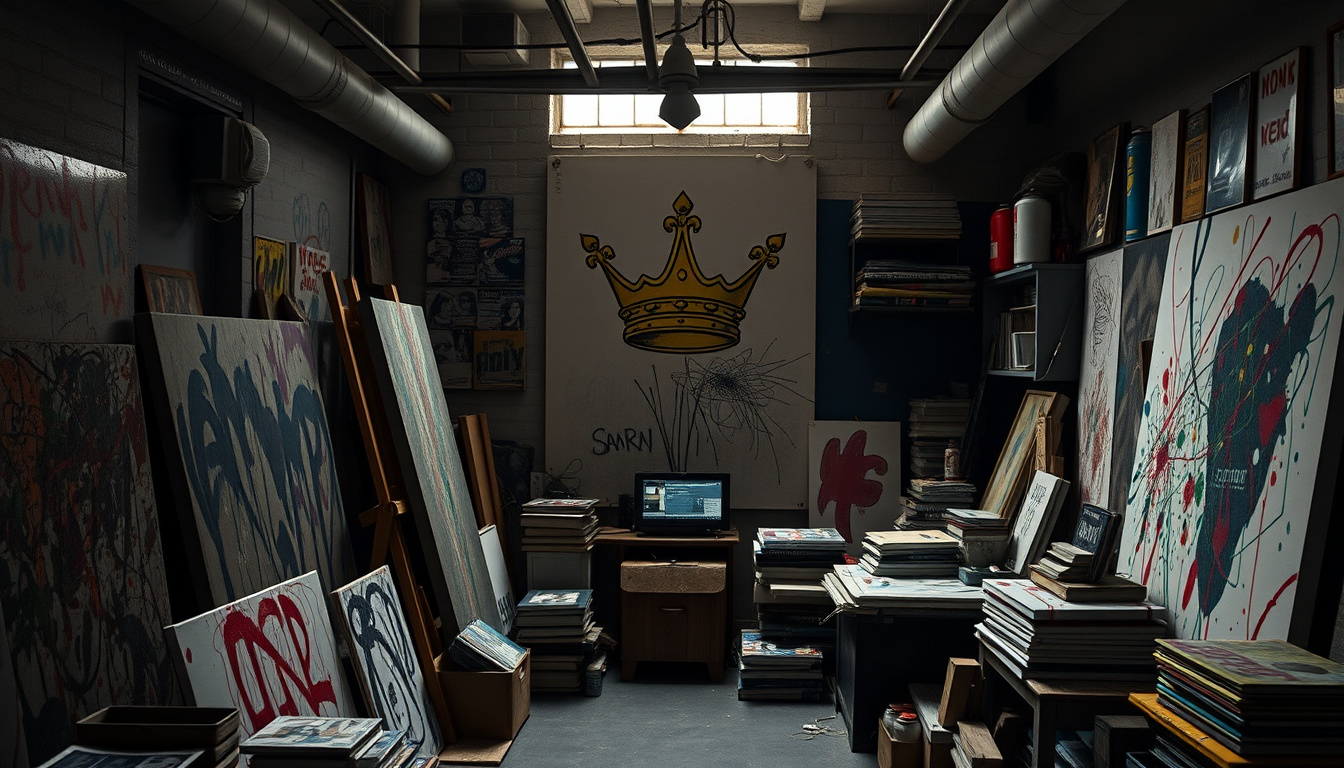
Few artists have left a mark as indelible as Jean-Michel Basquiat, whose crown motifs and raw canvases still command attention decades after his death. But beyond the iconic imagery lies a story of financial complexity—an estate that went from a modest probate valuation to hundreds of millions in art sales, all while tangled in tax disputes and inheritance questions.
Age at death: 27 ·
IRS estate valuation (2013): $138 million ·
Adjusted estate value (2013): $72 million ·
Paintings and drawings catalogued: Over 1,000 ·
First major solo show: 1982 (Annina Nosei Gallery)
Quick snapshot
- Born December 22, 1960, Brooklyn, New York (TrustLaw, inheritance law firm)
- Died of heroin overdose at age 27 (TrustLaw, inheritance law firm)
- Neo-expressionist painter known for crowns and text (TrustLaw, inheritance law firm)
- Exact net worth at death—estimates range from $3.2M to over $100M
- Whether Basquiat had a diagnosed learning disability
- Full list of celebrity-owned works (many private sales)
- 1982: Breakthrough solo exhibition at Annina Nosei Gallery (Richards Esq., legal blog)
- 1988: Died intestate (Richards Esq., legal blog)
- 2017: Posthumous auction record for an American artist (Richards Esq., legal blog)
- Estate continues licensing and exhibition deals
- Ongoing tax litigation over blockage discounts
- Potential for new auction records as demand grows
The key facts below anchor the discussion that follows.
| Attribute | Detail |
|---|---|
| Full name | Jean-Michel Basquiat |
| Born | December 22, 1960, Brooklyn, New York |
| Died | August 12, 1988, Manhattan, New York |
| Nationality | American |
| Movement | Neo-expressionism, street art |
| Known for | Crowns, skeletons, text, social commentary |
Why is Basquiat so famous?
Basquiat exploded out of the New York graffiti scene under the tag SAMO, a collaboration with friend Al Diaz. His raw, text-heavy canvases tackled race, wealth, and power with a visual language that felt both urgent and timeless. By 1982, he was the youngest artist ever to show at Documenta, and his partnership with Andy Warhol sealed his place in pop culture history (Wikipedia, crowd-sourced encyclopedia).
What made Basquiat’s art unique?
- Fused street art with neo-expressionist painting
- Repeated motifs: three-pointed crowns, skulls, and anatomical diagrams
- Addressed systemic racism, colonialism, and the art market itself
The implication: Basquiat’s fame is not just about his meteoric rise—it’s sustained by the way his work continues to speak directly to contemporary social debates.
How much is Jean-Michel Basquiat’s art worth?
After his death, the value of Basquiat’s work skyrocketed. A Christie’s appraisal of his surviving studio inventory counted 917 drawings, 25 sketchbooks, 85 prints, and 171 paintings (Richards Esq. citing Phoebe Hoban, biography author). The IRS later valued the estate’s artwork at $131 million, leading to a protracted tax dispute (DNAinfo, local New York news outlet).
How much did Jay Z pay for his Basquiat?
Reports indicate that Jay Z paid $4.5 million for a Basquiat painting in 2013, though the specific work and exact price have not been officially confirmed (DNAinfo, local New York news outlet).
Does Leo DiCaprio own a Basquiat?
Leonardo DiCaprio is known to own Basquiat’s Red Joy (1982), a work valued at over $10 million based on comparable sales, though the purchase price has not been publicly disclosed (Wikipedia, crowd-sourced encyclopedia).
The catch: Celebrity ownership has amplified Basquiat’s market, but it also makes pricing opaque—many transactions are private, and the estate itself does not release appraisal data (Basquiat Estate, official site FAQ).
Who inherited Basquiat’s money?
Because Basquiat died intestate (without a will), New York law directed his assets to his parents, Gerard and Matilde Basquiat (Richards Esq., legal blog). Gerard Basquiat served as estate administrator until his death in 2013 (Wikipedia, crowd-sourced encyclopedia). Since then, control has passed to Basquiat’s sisters, Lisane and Jeanine.
What happened to Basquiat’s estate?
In 2013, the family challenged the IRS’s $138 million valuation, arguing that a “blockage discount” of 70% should apply because flooding the market with Basquiat’s works would depress prices (YouTube interview with Doug Woodham, art market expert). The adjusted estate value was set at $72 million (DNAinfo, local New York news outlet).
The blockage discount saved the Basquiat estate tens of millions in taxes, but it also set a precedent that affects how entire artist estates are valued by the IRS.
Bottom line: Basquiat’s inheritance went to his parents, then his sisters, but the estate’s real value was determined not by the artist’s wishes but by a legal fight over market timing.
How rich was Basquiat when he died?
At the time of his death, Basquiat’s estate was initially appraised at $3.2 million for tax purposes (YouTube interview with Doug Woodham, art market expert). However, the IRS later pegged the estate’s total value at $138 million (DNAinfo, local New York news outlet).
What was Basquiat’s net worth at death?
Estimates vary widely. Sotheby’s initially appraised the estate at $36 million (Center for Art Law, legal resource for artists). The family argued the art alone was worth $127 million (DNAinfo, local New York news outlet). What is clear: Basquiat left no liquid wealth comparable to today’s market; his fortune was entirely in unsold work.
The difference between $3.2 million and $138 million isn’t just a number—it determines how much tax the estate owes, and public museum donors often use these valuations for tax deductions.
Did Basquiat have children?
Basquiat had no known children and never married, though he had high-profile relationships with Madonna and others (Wikipedia, crowd-sourced encyclopedia).
Did Basquiat ever marry?
No. He was never married, which, combined with his intestate death, left his estate to his parents rather than a spouse.
Did Basquiat have a disability?
Basquiat struggled with depression and heroin addiction, which contributed to his death at 27 (Wikipedia, crowd-sourced encyclopedia). There is no definitive diagnosis of a learning disability, though some biographers have speculated he may have had dyslexia.
What health issues did Basquiat face?
- Depression and substance abuse
- No confirmed learning disability
- Died from a heroin overdose (1988)
The pattern: While Basquiat’s art often referenced physical and mental states, there is no authoritative medical record confirming a disability. The speculation remains just that.
Timeline of Basquiat’s life and estate
- 1960 — Born in Brooklyn, New York
- 1977 — Begins graffiti as SAMO with Al Diaz
- 1980 — First group exhibition “The Times Square Show”
- 1982 — First solo show at Annina Nosei Gallery; becomes art world star
- 1985 — Appears on cover of The New York Times Magazine
- 1988 — Dies of heroin overdose at age 27; no will (Richards Esq., legal blog)
- 2013 — IRS values estate at $138 million; family challenges with blockage discount (DNAinfo, local New York news outlet)
What we know and what remains unclear
Confirmed facts
- Basquiat died from a heroin overdose (official medical examiner)
- He died without a will, so his estate went to his parents
- Gerard Basquiat served as estate administrator until 2013 (Wikipedia, crowd-sourced encyclopedia)
- No living children
What’s unclear
- Exact net worth at death – estimates range from $5M to $10M (no official figure)
- Whether Basquiat had a diagnosed learning disability (no medical records released)
- Full list of celebrity-owned works – many transactions are private
Quotes on Basquiat’s legacy
“He became an icon, and the prices just kept going up.”
— Jeffrey Deitch, art dealer and curator (The Guardian, British news publication)
“He was very driven, but also very fragile. The work consumed him.”
— Suzanne Mallouk, former partner (documentary Basquiat: A Quick Killing in Art)
For collectors and estates, the Basquiat story is a cautionary tale: without a will, a fortune in art becomes a legal battlefield. The tax dispute over blockage discounts will influence how every major artist estate plans for the future. For the Basquiat heirs, the choice is clear: keep the estate private and manage the market carefully, or risk another IRS confrontation that could reset valuation rules for generations.
taxnotes.com, news.artnet.com, fr.wikipedia.org, freemansauction.com, halmstadfronten.se
For a deeper look at Basquiat’s artistic journey and record sales, see Basquiats artistic journey and record sales.
Frequently asked questions
What was Jean-Michel Basquiat’s real name?
His full name was Jean-Michel Basquiat; he was born December 22, 1960, in Brooklyn, New York.
Where did Basquiat start his graffiti career?
He began as part of the graffiti duo SAMO, painting cryptic messages on walls in Lower Manhattan in the late 1970s.
What does the three-point crown in Basquiat’s art symbolize?
The crown became a signature motif representing royalty, sainthood, and a challenge to traditional art hierarchies—often used on figures of Black history and contemporary icons.
How many paintings did Basquiat create?
A Christie’s appraisal after his death catalogued 917 drawings, 25 sketchbooks, 85 prints, and 171 paintings, though he likely created more that were sold during his lifetime or remain uncounted.
What was Basquiat’s relationship with Andy Warhol?
Basquiat and Warhol collaborated on several paintings in the mid-1980s and were close friends. Warhol’s support significantly boosted Basquiat’s visibility in the art world.
Are Basquiat’s paintings still owned by his family?
Yes, the Basquiat Estate—managed by his sisters Lisane and Jeanine Basquiat—still retains a significant portion of his work, though many pieces have been sold at auction and through galleries.
What is the Basquiat Estate’s net worth today?
The estate’s value is not publicly disclosed, but given auction totals exceeding $500 million in the past decade and a large inventory, it is estimated to be worth several hundred million dollars.
Related stories





Richard Vane is Senior Reporter at MorningTimes.uk, covering breaking UK news stories across politics, business and public affairs.