
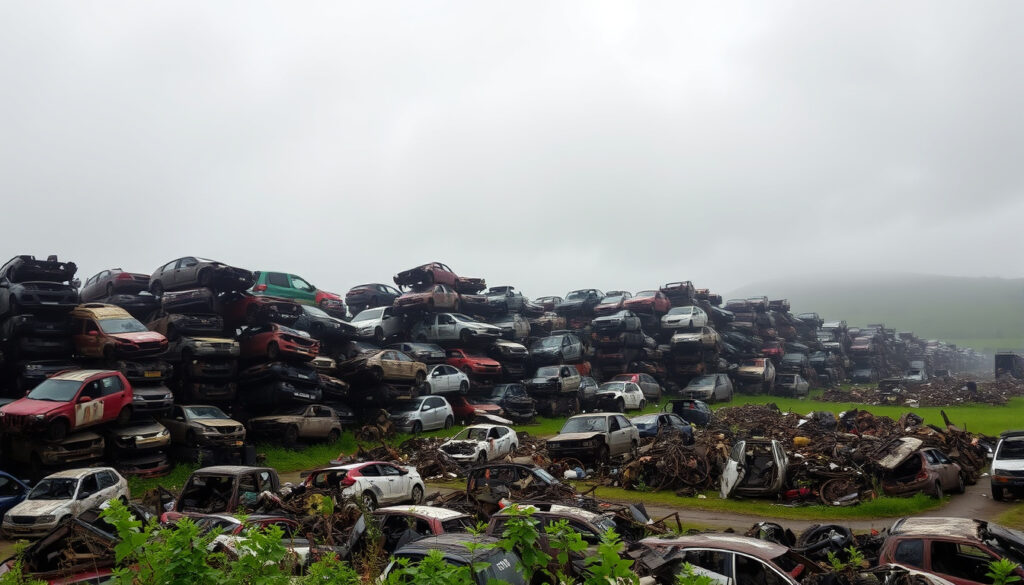
Thousands of Irish drivers face end-of-life vehicle decisions every year. Ireland’s licensed car dismantlers offer a practical solution — they’ll take your old vehicle off your hands and often pay you for it. Whether you’re after a few euros for a banger or hunting for a specific used part to keep another car running, knowing where to go makes all the difference. This guide walks you through how scrap yards work in Ireland, what you’ll actually get paid, and how to source parts without leaving home.
Largest vehicle dismantler: Kilcock Car Dismantlers (est. 1989) · Car breakers directory: FindAPart.ie (Ireland map) · Licensed service: Relihan Dismantlers (Tralee) · VAG parts specialists: DCAutospares
Quick snapshot
- FindAPart.ie lists licensed dismantlers across Ireland
- Kilcock Car Dismantlers stocks 2,500+ vehicles on 20 acres
- DCAutospares holds 34,844 parts in stock since 2004
- Get an online quote before visiting
- Check for valuable parts first — catalytic converters, alloy wheels (Get an online quote)
- Compare scrap value against selling privately (Get an online quote)
- Partfinder.ie uses VIN for exact-match parts
- FindAPart.ie or Partfinder.ie search Ireland-wide
- Specialists cover VAG, Ford, BMW — regional options exist (Partfinder.ie)
- Licensed dismantlers issue Certificates of Destruction
- Many operate as ATFs (Authorised Treatment Facilities)
- Family-run businesses span 30–40+ years experience
Established in 1989, Kilcock Car Dismantlers Recycling Centre is now one of the largest car dismantling and recycling facilities in Ireland, with over 2,500 vehicles stocked at any time.
Four categories of dismantlers serve Irish drivers: large-scale vehicle stockpilers, family-run breakers with decades of trade experience, Authorised Treatment Facilities handling end-of-life vehicles, and specialist part-finders serving specific makes.
| Provider | Type | Key detail |
|---|---|---|
| FindAPart.ie | Directory | Ireland-wide map of licensed dismantlers |
| Kilcock Car Dismantlers | Large facility | Est. 1989, 20 acres, 2,500+ vehicles |
| Relihan Dismantlers | Family business | 40+ years, licensed, Kerry-based |
| DCAutospares | Parts specialist | Est. 2004, 34,844 parts in stock |
| Oristown Autorecyclers | ATF facility | Early waste permit holder, nationwide service |
| Keohane Car Parts | Family business | 30+ years, Cork-based, nationwide delivery |
The table above shows the major licensed operators in Ireland, ranging from large-scale facilities near Dublin to family-run businesses in Munster.
How much do you get for scrapping a car in Ireland?
Scrap car prices in Ireland fluctuate based on the vehicle’s weight, condition, and current scrap metal rates. In early 2025, CarTakeBack IE recorded price ranges that reflect the market at that time — though exact quotes require knowing your car’s specifics. The rule of thumb: most standard saloons fetch between €100 and €400, while 4x4s, vans, and vehicles with valuable components can command higher offers.
Factors affecting scrap car prices
Three things drive what dismantlers will pay: weight, age, and what’s still fitted. Heavier vehicles — SUVs, vans, commercials — contain more steel and often score higher. Vehicles that have lost major components (missing engines, gearboxes) may see offers reduced. Conversely, cars with intact catalytic converters, alloy wheels, or electronic modules can push the price up, since those parts resell well.
A 2010 Ford Mondeo in driveable condition with alloys intact might fetch €250–€350. Strip the alloys or miss a service, and that drops to €150–€200. Knowing what’s valuable before you call saves you from accepting a lowball offer.
Current price ranges from providers
webuyanycar and similar online valuation tools give instant quotes by entering your registration. These tools pull live market data and typically offer collection included. For comparison, calling a local dismantler directly can sometimes yield a better price if the car has usable parts — but you’ll need to deliver it yourself.
With over 40 years experience in vehicle dismantling, Relihans Dismantlers is a family business based in Co. Kerry that offers fully licensed services with nationwide delivery.
Online buyers offer convenience and certainty. Local dismantlers may offer more if your car has valuable salvageable parts — but the process takes more legwork. Weigh the time against the euros.
What’s the best way to scrap your car?
The cleanest route runs through three steps: get a quote online first, prepare the vehicle, then hand it over to a licensed operator. Online valuation tools from platforms like webuyanycar take under 30 seconds and give you a baseline figure. From there, you decide whether to pursue that offer or check local dismantlers for a better deal.
Steps to scrap safely
- Get an online quote first. Enter your reg at webuyanycar or a similar tool to establish a market floor.
- Remove personal belongings. Check the glovebox, boot, and under seats. Cars often sit for weeks before dismantling.
- Cancel your insurance and tax. Notify your insurer; unused road tax is refundable.
- Check for valuable parts. Alloys, batteries, sat-navs, and catalytic converters add value.
- Visit a licensed dismantler. Ask for their waste permit or ATF status. Licensed operators issue a Certificate of Destruction.
A Certificate of Destruction (COD) isn’t paperwork — it’s proof your vehicle has been deregistered with the DVLA (Northern Ireland) or NDCRT (Republic). Without it, you remain the registered owner, which matters if the car is later involved in an incident or abandoned.
Online valuation tools
webuyanycar’s tool asks for your registration and mileage, returning a quote within seconds. The value holds for a set period (usually 5–7 days). If you’re not in a rush, this gives you leverage when negotiating with local yards — you already know what the car is worth on the open market.
Is it better to scrap or sell my old car?
The answer depends on your car’s condition and how much effort you want to invest. A running car with valid NCT (National Car Test) will always fetch more privately than to a dismantler — private buyers pay for utility, not scrap weight. But when repairs outweigh the car’s value, scrapping wins. There’s also the middle ground: selling to a breaker who wants it for parts.
Pros and cons comparison
Upsides
- Certainty — licensed dismantlers pay on the spot
- COD issued — you’re legally covered
- No viewings, no tyre-kickers, no haggling
- Catalytic converter and battery add-ons boost price
Downsides
- Private sale typically yields more for running cars
- You may need to deliver the vehicle
- Scrap price drops if major parts are missing
- Some yards offer collection only for higher-value cars
When scrapping makes sense
Scrapping becomes the obvious choice when the car has failed its NCT and repairs would cost more than the car’s market value, when it’s been written off by an insurer, or when you need a quick, certain transaction. Keohane Car Parts in Cork, for example, buys damaged vehicles for dismantling and issues CODs on the spot. Relihan Dismantlers in Kerry does the same, collecting from across Munster.
What is the most expensive part of a scrap car?
The catalytic converter tops the list of valuable components in most scrapped vehicles. Why? Because it contains platinum, palladium, and rhodium — precious metals that recyclers extract and resell. WA Car Removals notes that a single catalytic converter can fetch €50–€300 depending on the vehicle and the metals inside it. Alloys, electronic control units (ECUs), and sat-nav systems follow.
Valuable components list
- Catalytic converters: €50–€300 depending on precious metal content and vehicle make
- Alloy wheels: €20–€80 each; alloys without tyres fetch less
- ECUs and electronic modules: €30–€150 for engine or transmission control units
- Batteries: €10–€25; scrap yards accept these separately
- Airbag modules: €20–€60; must be deactivated before resale
- Air conditioning compressors: €15–€40 if intact
Not every yard pays equally for valuable parts. Some offer a flat rate that bakes in the catalytic converter value; others pay separately for each component. Before agreeing to a quote, ask whether the yard deducts for missing parts — if your converter’s already been removed, the offer should reflect that.
Highest paying metals
Okon Recycling identifies catalytic converters as currently the highest-paying scrap metal in the vehicle recycling space. Copper and brass components (radiator cores, wiring looms) also command premium rates. Steel body panels pay by weight, which means heavier vehicles — commercials and 4x4s — yield more per kilo. Aluminium parts (radiator end-tanks, engine covers) fetch roughly three times the steel rate.
How do I find a part number for my van?
Finding the right part hinges on one thing: your vehicle’s VIN (Vehicle Identification Number). Every car manufactured since 1981 carries a 17-character VIN etched into the chassis — that number unlocks the exact original equipment part numbers from the manufacturer’s catalog. Partfinder.ie lets you search by registration or VIN, returning matches from dismantlers across Ireland and Northern Ireland.
Locating VIN and chassis numbers
- VIN plate: Check the driver’s side door jamb or the dashboard near the windscreen.
- V5C / logbook: The VIN appears on the registration certificate.
- Under the bonnet: Stamped into the chassis rail or firewall on older vehicles.
- Online tools: Partfinder.ie accepts reg numbers and cross-references against DVLA records.
If you’re searching for a part for a van rather than a car, check whether the platform covers commercial vehicles. Partfinder.ie covers vans, but some directories focus on passenger cars only — confirm before creating an account.
Using part finder tools
Partfinder.ie works by entering your vehicle registration or manually selecting the make, model, and year. The platform then searches a network of dismantler stocks across Ireland and Northern Ireland, returning part numbers, condition grades, and pricing. Microsoft Store also hosts PartFinder software for Windows, which some professional mechanics prefer for offline searches.
For German marques (VW, Audi, Seat, Skoda), DCAutospares stocks 34,844 parts with same-day dispatch to the UK and Europe. McLaughlin Car Parts in Donegal specializes in VAG parts specifically. If you’re after a Ford or Vauxhall part, Kilcock Car Dismantlers’ 2,500-vehicle stock is worth checking — they’re one of Ireland’s biggest breakers, located 25 minutes from Dublin.
Ireland’s licensed dismantlers, much like those in the Scrap Yard Near Me guide, offer scrap prices from €100-€400 alongside quality used parts.
Frequently asked questions
How to find scrap yards near Dublin?
Kilcock Car Dismantlers is the closest major facility to Dublin — it’s in Co. Kildare, about 25 minutes from the M50. FindAPart.ie also lets you search by county, showing licensed dismantlers on a map across Leinster. Kelly’s Car Dismantlers in Enfield covers Dublin, Kildare, and Meath.
What are car dismantlers?
Car dismantlers (also called car breakers, scrap yards, or auto recyclers) disassemble end-of-life vehicles and resell usable components. Licensed operators in Ireland operate as Authorised Treatment Facilities (ATFs) and issue Certificates of Destruction when a vehicle is recycled.
Where to buy used car parts in Ireland?
Three main routes: search Partfinder.ie by reg or VIN for Ireland-wide dismantler stock; use FindAPart.ie to locate yards near you; or contact a specialist directly. DCAutospares covers VAG parts; Keohane Car Parts in Cork serves Munster; Relihan Dismantlers covers Kerry.
Are scrap yards cheap in Ireland?
Used parts from dismantlers typically cost 40–70% less than new OEM parts. The tradeoff is condition variation — most yards grade parts (new, Grade A, Grade B), and prices reflect that. Warranties are rare outside of professional rebuilders, so check return policies before buying.
What is a scrap yard in Ireland?
A licensed scrap yard in Ireland is an Authorised Treatment Facility that accepts end-of-life vehicles (ELVs), removes hazardous materials, dismantles reusable components, and issues a Certificate of Destruction. They differ from scrap metal dealers who crush vehicles for raw steel.
How to scrap a car in Kilkenny?
The most direct route: get an online quote (webuyanycar), call a licensed dismantler in Kilkenny or the surrounding counties, and confirm their offer. If the car runs and you can deliver it, you may negotiate a better price. For non-running vehicles, ask about collection options before accepting an offer.
What documents do I need for scrapping a car?
Bring your V5C registration certificate (logbook), photo ID, and if the car is financed, a settlement letter from your finance company. The dismantler needs these to issue a COD and deregister the vehicle. Without a V5C, expect a longer process and potentially a lower offer.
Related reading
Related stories





Priya Sharma covers the economy, business and consumer affairs for MorningTimes.uk.