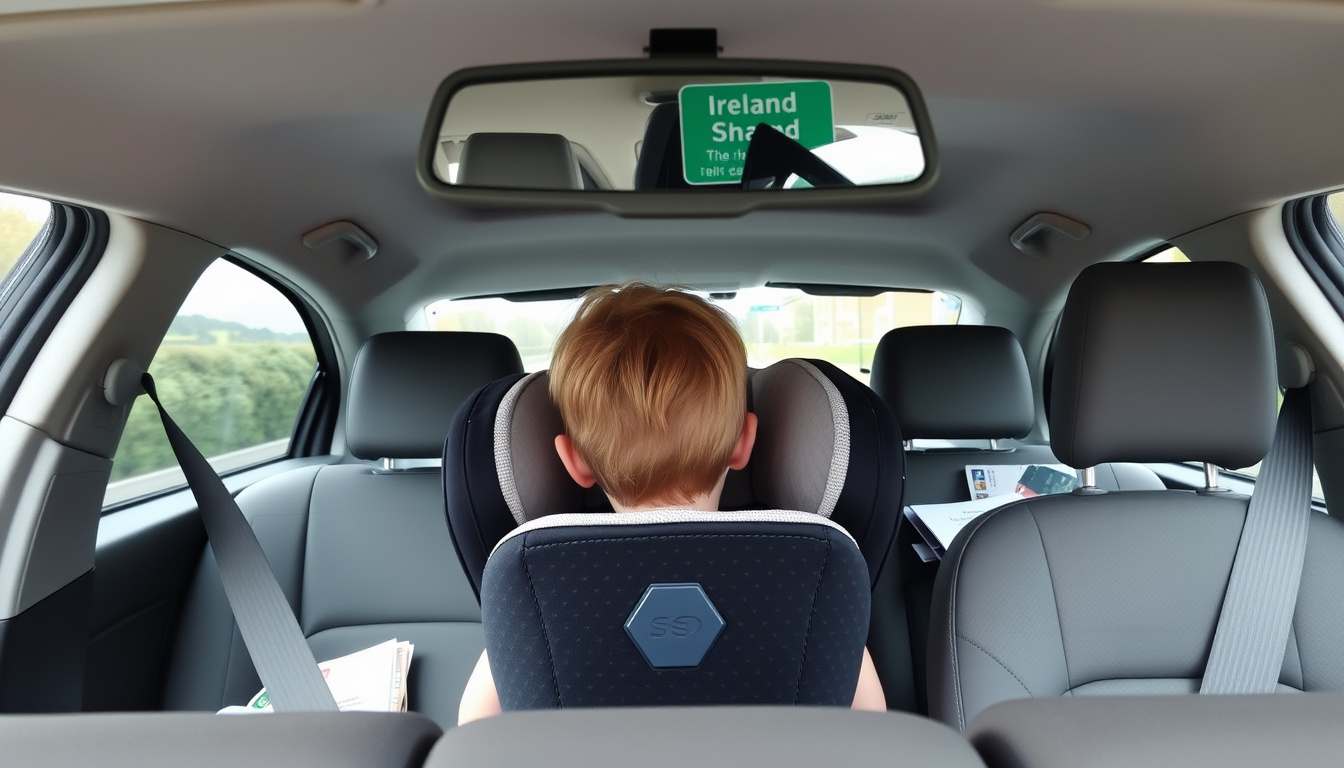
If you’re a parent in Ireland trying to figure out when your child can move to a booster seat, you’re not alone. The rules are based on height and weight rather than a specific age, which can be confusing.
Minimum age for booster seat: 4 years ·
Legal requirement in Ireland: Until 150 cm or 36 kg ·
Backless booster minimum height: 125 cm (approx. 22 kg) ·
Forward-facing harness weight range: 9 to 18 kg
Quick snapshot
- Ireland requires booster seat until 150 cm or 36 kg (RSA)
- Backless booster legal from 125 cm (Halfords Ireland)
- Forward-facing harness used 9–18 kg (HSE)
- Exact age of transition varies by individual growth
- Optimal booster type depends on vehicle and child anatomy
- Check child’s height and weight regularly
- Consider high-back booster for longer use
Several key facts underpin booster seat decisions in Ireland. Here’s a quick reference:
| Fact | Value |
|---|---|
| Minimum age for booster seat | 4 years (recommended) (RSA) |
| Minimum weight for booster seat | 15 kg (Ireland legal) (Halfords Ireland) |
| Minimum height for backless booster | 125 cm (Halfords Ireland) |
| Legal requirement in Ireland | Until 150 cm or 36 kg (RSA) |
| Forward-facing harness weight limit | 18 kg (HSE) |
The implication: Age is a rough guide; height and weight are the legal benchmarks. Parents should measure their child regularly, not just rely on birthday milestones.
What age should a child be on a booster seat?
Minimum age and weight requirements
Most children are ready for a booster seat around age 4, but the legal trigger in Ireland is weight: 15 kg, according to the RSA (Ireland’s road safety regulator). Before that, children should use a forward-facing harness seat (9–18 kg). The HSE (Health Service Executive) confirms that a child must use the correct seat until they are 150 cm tall or weigh 36 kg – which can be around age 12.
- Forward-facing harness: 9–18 kg (HSE)
- Booster seat (high-back): from 15 kg (RSA)
- Backless booster: from 22 kg (Halfords Ireland)
A 4-year-old who weighs 14 kg is still too small for a booster seat – staying in a harness seat is safer. The legal minimum is 15 kg, but the RSA recommends using a high-back booster for as long as possible.
Height-based guidelines
Height is the more reliable measure. The Citizens Information (official public service) states that all children under 150 cm must use a child restraint. The NHTSA (U.S. National Highway Traffic Safety Administration) recommends a booster until the child is 4’9″ (145 cm) – a close match to Ireland’s 150 cm rule.
The pattern: height thresholds are more consistent than age across countries. Ireland’s 150 cm rule aligns with best practice, though it’s slightly taller than the U.S. benchmark.
What are the rules for booster seats in Ireland?
RSA guidelines
The RSA (Road Safety Authority) provides the definitive guidance: children must use a booster seat from 15 kg until they reach 150 cm or 36 kg. The RSA advises older children to use a high-back booster seat for as long as possible, rather than a booster cushion alone. The Tusla (Child and Family Agency) guidance echoes this, noting that children aged 3+ under 150 cm and 36 kg must use the correct restraint.
- Booster seat mandatory from 15 kg to 36 kg / 150 cm (RSA)
- High-back booster preferred over backless cushion (RSA)
- Taxi exemption: children may travel without a booster in a taxi (Citizens Information)
The taxi exemption means some children may travel without a booster in a licensed taxi – but it’s not a safety recommendation, just a legal exception. The RSA still advises using a booster if possible.
Penalties for non-compliance
Failing to use a proper child restraint can result in fixed penalty notices and up to 3 penalty points, according to RSA enforcement information. The Citizens Information page details the legal obligations: the driver is responsible for passengers under 16.
What this means: the financial penalty is minor compared to the safety risk. A booster seat that fits properly is the single most effective way to protect a child in a crash.
Can a 4 year old use a backless booster?
Weight and height thresholds
A 4-year-old can use a backless booster only if they meet the minimum height (125 cm) and weight (22 kg), according to Halfords Ireland (retailer guidance). Most 4-year-olds weigh between 14 and 18 kg – well below the 22 kg threshold. The RSA does not recommend backless boosters for children under 125 cm.
- Backless booster minimum: 125 cm / 22 kg (Halfords Ireland)
- Average 4-year-old height: 100–105 cm – far below 125 cm
- High-back booster recommended for younger children (RSA)
Safety considerations of backless boosters
Backless boosters lack side impact protection and do not provide a headrest or side wings. The NHTSA (U.S. safety regulator) advises that a high-back booster offers better protection for children who still need head support. In Ireland, the RSA explicitly says to use a high-back booster for as long as possible.
A backless booster is convenient for travel, but for everyday use, a high-back booster is safer. The trade-off is portability vs. protection – for most 4-year-olds, the high-back booster wins.
The implication: for a typical 4-year-old, a backless booster is not appropriate. Stick with a forward-facing harness or high-back booster until the child outgrows the weight or height limits.
When should I transition my child to a booster seat?
Signs of readiness
Transition when the child’s shoulders are above the harness slots, ears above the top of the seat, or weight exceeds the harness limit (18 kg for forward-facing seats). The HSE confirms these criteria. The child must also be able to sit properly without slouching – if they can’t stay seated correctly, they are not ready.
- Shoulders above harness slots → switch (HSE)
- Ears above top of seat → switch (HSE)
- Weight exceeds harness limit (18 kg) → switch (HSE)
- Child can sit properly for entire journey → ready
Step-by-step transition process
- Check the harness height. If shoulders are above the slots, it’s time. (HSE)
- Choose a high-back booster first. The RSA recommends high-back for better lateral support.
- Install the booster correctly. Use the seat belt guide to ensure the lap belt lies low across the thighs, not the stomach.
- Test the fit. The child should be able to sit with back against the seat, knees bent at the edge, and the shoulder belt crossing the collarbone.
- Move to backless booster only when the child is 125 cm / 22 kg (Halfords Ireland).
Transition too early and you lose side impact protection. Transition too late and the harness becomes uncomfortable. The signs of readiness are clear – use them, not the calendar.
What car seat do I need for a 4 year old?
Forward-facing harness seats
A 4-year-old weighing 9–18 kg should use a forward-facing harness seat, according to the HSE. These seats have a 5-point harness that distributes crash forces across the strongest parts of the child’s body. Many combination seats convert from harness to booster later.
High-back booster seats
If the child is over 15 kg, a high-back booster is an option – and the RSA recommends it over backless boosters. High-back boosters provide head and side impact protection, plus adjustable headrests for growing children.
Combination seats
Combination seats (harness to booster) offer the longest use: they work as a forward-facing harness from 9–18 kg, then convert to a high-back booster for the next stage. The Tusla guidance notes that children in the 22–36 kg range (approx. 6–12 years) benefit from this type of seat.
Three seat types, one pattern: protection decreases as convenience increases. Here’s how they compare:
| Type | Weight range | Side impact protection | Portability | Best for |
|---|---|---|---|---|
| Forward-facing harness | 9–18 kg | High | Low | 4-year-olds under 18 kg |
| High-back booster | 15–36 kg | High | Medium | Children who have outgrown harness |
| Backless booster | 22–36 kg | Low | High | Older children over 125 cm |
| Combination seat | 9–36 kg | High (harness mode) | Low | Long-term use from toddler to booster |
The trade-off: backless boosters are easier to move between cars, but they lack side protection. For a 4-year-old, a forward-facing harness or high-back booster is the safer choice.
Booster seat specifications at a glance
Six specifications, one takeaway: the safest seat is the one that fits your child and your car.
| Specification | Forward-facing harness | High-back booster | Backless booster |
|---|---|---|---|
| Minimum weight | 9 kg | 15 kg | 22 kg |
| Maximum weight | 18 kg | 36 kg | 36 kg |
| Minimum height | N/A | N/A | 125 cm |
| Maximum height | Varies by seat | Varies by seat | 150 cm |
| Side impact protection | Yes | Yes | No |
| ISOFIX option | Often | Often | Sometimes |
| Portability | Low | Medium | High |
| Typical age range | 1–4 years | 4–12 years | 6–12 years |
| Legal in Ireland | Yes | Yes | Yes (from 22 kg) |
| RSA preferred? | Yes for 9–18 kg | Yes for 15–36 kg | Not preferred |
The pattern: as children grow, the protection level of the seat decreases. The best strategy is to keep them in a seat with side impact protection for as long as possible.
Upsides
- High-back boosters offer excellent side impact protection
- Combination seats provide long-term value
- Backless boosters are easy to travel with
Downsides
- Backless boosters lack side protection
- Forward-facing harness seats are bulky
- Some children resist booster seats at first
Expert perspectives
Children must use a child car seat or booster seat until they are 150 cm tall or 36 kg in weight.
— RSA (Irish road safety authority)
Keep your child in a booster seat until they are big enough to fit in a seat belt properly, typically around 4’9″ tall.
— NHTSA (U.S. National Highway Traffic Safety Administration)
Both regulators agree: height and weight are the true metrics, not age. The Irish rule (150 cm) is slightly higher than the U.S. guideline (145 cm), meaning Irish children may need a booster seat a little longer.
What’s confirmed and what’s still unclear
Confirmed facts
- Irish law requires a booster seat until 150 cm or 36 kg (RSA)
- Backless booster legal from 125 cm / 22 kg (Halfords Ireland)
- High-back booster is safer than backless (RSA)
- Forward-facing harness seats are used for children 9–18 kg (HSE)
- Taxi exemption exists in Ireland (Citizens Information)
- RSA and HSE guidance is regularly updated (2025 and 2026 respectively)
What’s unclear
- Exact age when a child is ready to transition varies by individual growth
- Optimal type of booster seat (backless vs. high-back) depends on vehicle design and child’s anatomy
- Long-term compliance with booster seat laws outside of taxis is not precisely tracked
Summary: The rules are clear, but the application is individual. Parents must measure their child and make a judgment call. The safest bet is to stay in a high-back booster as long as possible.
For parents in Ireland, the choice is straightforward: use a high-back booster until your child reaches 150 cm or 36 kg. If you are tempted by a backless booster for convenience, wait until the child is at least 125 cm tall. The penalty for switching too early is not a fine – it’s reduced protection. Measure your child, follow the RSA guidelines, and keep them in the safest seat for their size.
Related reading: Booster Seats: Age, Rules, and When to Switch (Ireland & UK) · Booster Seats: Age, Rules, and When to Switch (Ireland & UK)
odo.ie, nationalreport.uk, aig.ie, visualfoodie.com, irelandpress.net, kennco.ie, sundayreport.uk, britledger.uk
For a detailed breakdown of the legal requirements, refer to our guide on booster seat age and rules in Ireland.
Frequently asked questions
Can a booster seat be used in the front seat?
The RSA advises that children under 150 cm should not sit in the front seat if a rear seat is available. If unavoidable, the front passenger airbag must be deactivated.
How long can a child use a booster seat?
Until the child reaches 150 cm or 36 kg. The HSE says this can be up to age 12.
Are backless booster seats safe?
They are legal from 22 kg, but the RSA prefers high-back boosters for better side impact protection. Safety depends on proper fit.
What is the weight limit for a booster seat?
High-back boosters: 15–36 kg. Backless boosters: 22–36 kg. Forward-facing harness seats: 9–18 kg. (Halfords Ireland)
Do booster seats need to be ISOFIX?
ISOFIX is not required for booster seats in Ireland, but it can improve stability. Many high-back boosters have ISOFIX connectors. (RSA)
Can a booster seat be used with a lap-only belt?
No. Booster seats require a lap-and-shoulder belt. Lap-only belts do not provide proper restraint. (RSA)
What is the difference between a booster seat and a car seat?
A car seat (e.g., forward-facing harness) has its own harness system. A booster seat uses the vehicle’s seat belt to restrain the child. Boosters are for children who have outgrown a harness seat. (HSE)
Related reading
- Booster Seats: Age, Rules, and When to Switch (Ireland & UK) – A broader guide covering both Ireland and UK rules.
Related stories




Richard Vane is Senior Reporter at MorningTimes.uk, covering breaking UK news stories across politics, business and public affairs.