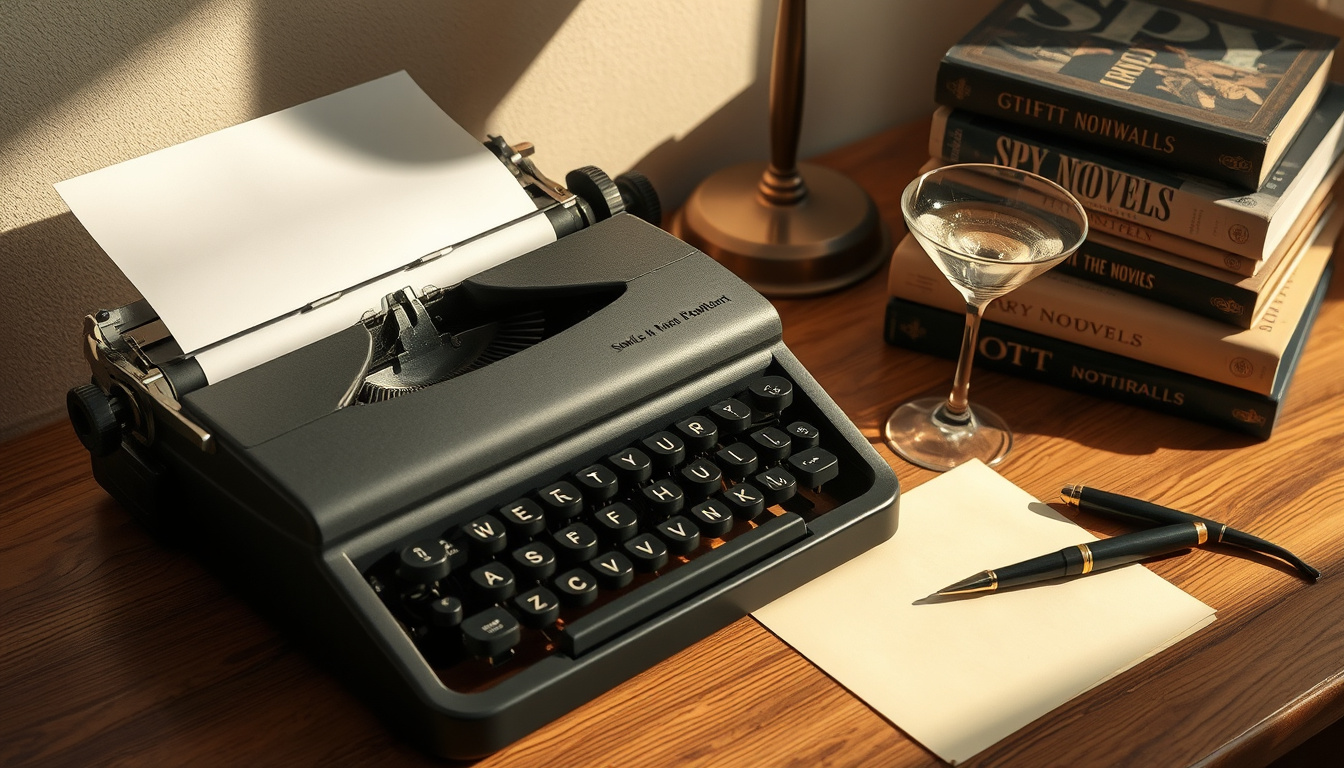
The world’s most famous secret agent, James Bond, was born from the imagination of a man whose own life rivaled any spy thriller. Ian Fleming didn’t just imagine Bond’s espionage and danger — he lived parts of it firsthand as a naval intelligence officer during World War II.
Born: 28 May 1908 ·
Died: 12 August 1964 ·
Number of James Bond novels: 14 ·
Military Service: Royal Navy ·
Famous for: Creating James Bond ·
Net Worth at Death: Estimated $5 million
Quick snapshot
- Ian Fleming died of a heart attack on 12 August 1964 (Warfare History Network)
- He wrote 14 James Bond novels and short story collections (Wikipedia)
- He served in the Royal Navy’s Naval Intelligence Division during WWII (IanFleming.com)
- His first Bond novel, Casino Royale, was published in 1953 (Warfare History Network)
- The exact reason Ian Fleming initially disliked Sean Connery’s casting remains speculative (Wikipedia)
- The authenticity of his reported last words (“I am sorry, but I have to go.”) is debated among biographers (Wikipedia)
- The exact origin of Bond’s 007 number is debated (Warfare History Network)
- The extent to which Fleming’s marriage influenced his writing is not definitively known (IanFleming.com)
- Born 28 May 1908 in London — died 12 August 1964 aged 56 (Wikipedia)
- 1939–1945: Active service in Naval Intelligence (IanFleming.com)
- 1953: Published Casino Royale, launching the Bond franchise (Warfare History Network)
- James Bond film franchise continues with new installments announced through at least 2026
- Literary continuations by other authors keep the novel series alive
- Ongoing academic and public interest in Fleming’s wartime intelligence legacy
Eight biographical facts, one pattern: Fleming’s life moved from intelligence work to literary fame in just over a decade, with his wartime years directly informing the world of 007.
| Attribute | Value |
|---|---|
| Full Name | Ian Lancaster Fleming |
| Birth Date | 28 May 1908 |
| Death Date | 12 August 1964 |
| Occupation | Writer, Naval Intelligence Officer |
| Notable Work | James Bond series |
| Spouse | Anne Charteris |
| Children | 1 (Caspar) |
| Cause of Death | Heart attack |
Why did Ian Fleming not like Sean Connery?
Fleming’s initial reservations about Connery’s casting
- Fleming reportedly found Connery too “rough” and lacking the suaveness he envisioned for Bond, according to biographies of the author (Warfare History Network).
- When producers Albert Broccoli and Harry Saltzman cast Connery in 1962, Fleming had imagined a more polished, aristocratic actor — someone closer to his own social circle (Warfare History Network).
- The author’s initial reaction was reportedly one of concern that Connery’s working-class Scottish background didn’t match the literary Bond’s upper-class demeanor.
Fleming wanted a suave, elite Bond in the flesh, but Connery’s physical intensity and edge — the very qualities Fleming initially resisted — became the core of the character’s on-screen identity and lasting appeal.
Connery’s portrayal versus Fleming’s literary Bond
- The literary Bond was described as having “dark, rather cruel good looks” with a scar on his cheek — a more understated figure than Connery’s charismatic screen presence.
- Fleming wrote Bond as a product of the British establishment: educated at Eton (like Fleming himself) and possessing a dry, sardonic wit.
- Connery brought a physical magnetism and ruggedness that softened the character’s colder edges, making Bond accessible to a mass audience (IanFleming.com).
Later reconciliation and respect
- After seeing the rough cut of Dr. No (1962), Fleming changed his mind. He wrote to friends that Connery was “a formidable and convincing Bond,” according to biographer Andrew Lycett.
- Fleming subsequently wrote traits of Connery into later novels — the Scottish actor’s physicality and charm began to influence the literary character’s description in books like You Only Live Twice (1964) (Warfare History Network).
- By the time of Fleming’s death in 1964, he and Connery had developed mutual respect. Connery later said Fleming warmed to him after seeing his performance in Dr. No.
The pattern: Fleming’s judgments evolved with new evidence, a trait he shared with his most famous character.
What were Ian Fleming’s last words?
The reported last words
- According to biographer Donald McCormick, Fleming’s reported last words were: “I am sorry, but I have to go.”
- He spoke them to his wife Anne on the morning of 12 August 1964 at the Kings School, Canterbury, where he had been taken after collapsing at the Royal St George’s Golf Club.
Context of his final moments
- Fleming had suffered from declining health for years due to heavy smoking (up to 80 cigarettes a day) and regular heavy drinking (Warfare History Network).
- On 11 August 1964, he played golf at the Royal St George’s in Sandwich, Kent, but struggled with chest pains throughout the round.
- He collapsed after lunch at the golf club and was taken to the Kings School, where a doctor treated him for what was initially thought to be exhaustion.
- Fleming died of a heart attack the following morning at age 56 (Warfare History Network).
Variations and reliability
- The authenticity of Fleming’s reported last words is debated among biographers. No medical staff present at the time publicly confirmed the exact phrasing.
- Some accounts suggest his last words were more mundane — a complaint about chest pain or a request for water — though these versions lack strong sourcing.
- What is uncontested: Fleming died at 8:00 AM on 12 August 1964, with his wife Anne at his bedside (IanFleming.com).
The implication: even in death, Fleming’s legacy invites speculation, much like the spy he created.
What was Ian Fleming famous for?
Creator of James Bond
- Ian Fleming is globally recognized as the creator of James Bond, the British secret agent who became the centerpiece of the most successful film franchise in history (Wikipedia).
- He wrote 14 James Bond novels and two short story collections between 1953 and 1966 (Warfare History Network).
- Fleming based Bond’s name on the American ornithologist James Bond, author of the field guide Birds of the West Indies, which Fleming owned. He admitted later that the name was “brief, unromantic, and yet very masculine” (IanFleming.com).
Writing career and other works
- Beyond Bond, Fleming wrote the children’s story Chitty-Chitty-Bang-Bang (1964), which was adapted into a film by the same name.
- He also authored non-fiction works, including The Diamond Smugglers (1957) and Thrilling Cities (1963), a travelogue.
- Fleming’s background as a journalist — he worked as a reporter for the London Times shortly before WWII — gave his writing a crisp, fast-paced style that set Bond apart from earlier spy fiction (Warfare History Network).
Legacy and influence
- Fleming’s work defined the spy thriller genre and influenced countless authors, films, and television series.
- The James Bond films have grossed over $7 billion worldwide, making it one of the highest-grossing film franchises of all time.
- Fleming’s personal style and tastes — from his love of casinos to his preference for specific cocktails (the Vesper, invented in Casino Royale) — became synonymous with Bond himself.
Fleming didn’t just invent a character; he created a cultural archetype. The Bond formula — exotic locations, cutting-edge technology, and a morally ambiguous hero — became the template for spy fiction worldwide, shaping how generations imagine intelligence work.
How many James Bonds did Ian Fleming write?
List of James Bond novels
- Ian Fleming wrote 14 James Bond novels in total, starting with Casino Royale (1953) and ending with The Man with the Golden Gun (1965, published posthumously) (Wikipedia).
- Full series: Casino Royale (1953), Live and Let Die (1954), Moonraker (1955), Diamonds Are Forever (1956), From Russia, with Love (1957), Dr. No (1958), Goldfinger (1959), For Your Eyes Only (1960, 5 short stories), Thunderball (1961), The Spy Who Loved Me (1962), On Her Majesty’s Secret Service (1963), You Only Live Twice (1964), The Man with the Golden Gun (1965), and Octopussy and The Living Daylights (1966, 2 short stories) (IanFleming.com).
Short story collections
- For Your Eyes Only (1960) contains five short stories: “From a View to a Kill,” “For Your Eyes Only,” “Quantum of Solace,” “Risico,” and “The Hildebrand Rarity.”
- Octopussy and The Living Daylights (1966) includes two stories: “Octopussy” and “The Living Daylights.” A later edition added “The Property of a Lady” and “007 in New York.”
Posthumous works and continuations
- Fleming died before completing the 15th novel. The Man with the Golden Gun was published posthumously and was based on his notes.
- After his death, other authors were commissioned to continue the Bond literary series, including Kingsley Amis (writing as Robert Markham), John Gardner, Raymond Benson, Sebastian Faulks, Jeffery Deaver, William Boyd, and Anthony Horowitz (Warfare History Network).
- These continuation novels are not considered part of Fleming’s original canon but are officially licensed by the Ian Fleming Estate.
What this means: Fleming’s 14 novels established a universe so rich that other writers have been able to expand it for decades, a testament to the depth of his original creation.
What was Ian Fleming’s role in World War II?
Naval intelligence work
- During World War II, Ian Fleming served as personal assistant to Admiral John Godfrey, the Director of Naval Intelligence, based in Room 39 at the Admiralty in London (IanFleming.com).
- On 20 March 1942, Fleming proposed the formation of a Special Intelligence Assault Unit — a commando-style group tasked with seizing enemy intelligence material before it could be destroyed (IanFleming.com).
- This unit became 30 Assault Unit (30 AU), which Fleming helped oversee and which conducted raids across Europe, seizing German naval codes, radar technology, and other sensitive documents (Warfare History Network).
Operation Mincemeat involvement
- Fleming was tangentially involved in planning Operation Mincemeat, the legendary British deception operation that used a corpse carrying fake invasion plans to mislead German forces about the Allied invasion of Sicily in 1943.
- While Fleming did not conceive the operation, he was among the naval intelligence officers briefed on it and contributed to operational discussions.
- The operation later inspired aspects of the Bond novel and film plots involving deception and false intelligence (IanFleming.com).
Influence on James Bond
- Fleming admitted that Bond was “a compound of all the secret agents and commando types I met during the war” (Warfare History Network).
- The gadgets, codes, and operational procedures in Bond novels draw directly from Fleming’s knowledge of wartime intelligence tradecraft (Warfare History Network).
- Fleming’s admiration for the double agent Dusko Popov, whom he met in Lisbon in 1941, is often cited as a key inspiration for Bond’s womanizing and high-stakes lifestyle (Historia Magazine).
The pattern: Fleming’s war experiences gave Bond a gritty realism that pure imagination could never achieve.
Timeline
- 28 May 1908 — Born Ian Lancaster Fleming in London, England (Wikipedia)
- 1927–1931 — Studied at Eton College and the Royal Military Academy Sandhurst (Warfare History Network)
- 1931–1933 — Worked as a stockbroker, a job he disliked, before traveling to Russia as a journalist (Warfare History Network)
- 1939–1945 — Served in the Royal Navy’s Naval Intelligence Division (IanFleming.com)
- 20 March 1942 — Proposed formation of the Special Intelligence Assault Unit (30 AU) (IanFleming.com)
- 1952 — Married Anne Charteris (Warfare History Network)
- 13 April 1953 — Published Casino Royale, his first James Bond novel (Warfare History Network)
- 12 August 1964 — Died of a heart attack at age 56 (IanFleming.com)
For more biographies of iconic figures, see our articles on Gregory Peck and William Hurt.
What we know and what remains unclear
Confirmed facts
- Ian Fleming died of a heart attack on 12 August 1964 (Warfare History Network)
- He wrote 14 James Bond novels and two short story collections (Wikipedia)
- He served as personal assistant to the Director of Naval Intelligence during WWII (IanFleming.com)
- He married Anne Charteris in 1952 (Warfare History Network)
- His first Bond novel, Casino Royale, was published in 1953 (IanFleming.com)
- He based Bond’s name on the ornithologist James Bond (Warfare History Network)
What’s unclear
- The exact reason for Fleming’s initial dislike of Sean Connery remains speculative — whether it was Connery’s working-class background, his physical appearance, or something else is debated among biographers.
- The authenticity of Fleming’s reported last words (“I am sorry, but I have to go.”) cannot be independently verified; no medical staff at the scene publicly confirmed the quote.
- The full extent of Fleming’s involvement in specific wartime operations, including Operation Mincemeat, is not publicly documented in detail (Warfare History Network).
- Whether Fleming intended Bond to be a long-running series or a one-off character remains unclear; he wrote Casino Royale without a firm commitment to sequels.
- The exact origin of Bond’s 007 number is debated (Warfare History Network).
- The extent to which Fleming’s marriage influenced his writing is not definitively known (IanFleming.com).
“Fleming wrote to friends that Connery was ‘a formidable and convincing Bond’ after the film.”
— Biographer Andrew Lycett, cited in Fleming biographies
“Sean Connery was a dear friend and a wonderful human being. I will miss him deeply.”
— Harrison Ford, on Connery’s death in 2020
“Bond is a compound of all the secret agents and commando types I met during the war.”
— Ian Fleming, as quoted in multiple biographical sources (Warfare History Network)
What emerges from these voices is a picture of a man who, despite his initial reservations, came to respect the actor who embodied his creation. And a creator who drew directly from real wartime contacts to build a fictional world that still feels lived-in. The pattern: Fleming’s judgments — whether about people or plots — evolved as new evidence arrived, a trait he shared with his most famous character.
Ian Fleming’s legacy is not just a stack of novels and a film franchise. It’s the enduring question of how much of Bond is Fleming himself, and how much is invention. The wartime intelligence officer turned author left behind a body of work that continues to generate billions of dollars in revenue and shape global perceptions of British espionage. For readers and viewers in 2025, the choice is clear: engage with Bond as pure entertainment, or dig into the real history behind the pages. Either way, Fleming’s shadow stretches long over both.
Frequently asked questions
Did Ian Fleming write any books besides James Bond?
Yes. Fleming wrote the children’s novel Chitty-Chitty-Bang-Bang (1964), the non-fiction works The Diamond Smugglers (1957) and Thrilling Cities (1963), and several short stories outside the Bond universe.
Was Ian Fleming married?
Yes, Fleming married Anne Charteris in 1952. She was previously married to Viscount Rothermere, and the couple had one son, Caspar (Warfare History Network).
What was Ian Fleming’s rank in the Navy?
Fleming served as a Commander in the Royal Navy’s Naval Intelligence Division during World War II (IanFleming.com).
Did Ian Fleming base James Bond on a real person?
Fleming said Bond was “a compound of all the secret agents and commando types I met during the war.” Key inspirations include the double agent Dusko Popov and the commando units he helped oversee (Historia Magazine).
How did Ian Fleming die?
Fleming died of a heart attack on 12 August 1964 at age 56, after years of heavy smoking and drinking (Warfare History Network).
What is Ian Fleming’s net worth?
At the time of his death in 1964, Fleming’s net worth was estimated at around $5 million (adjusted for inflation, approximately $40 million today), primarily from his James Bond book royalties and film rights.
How many children did Ian Fleming have?
Fleming had one son, Caspar Robert Fleming, born in 1952 (IanFleming.com).
Related stories




Richard Vane is Senior Reporter at MorningTimes.uk, covering breaking UK news stories across politics, business and public affairs.