
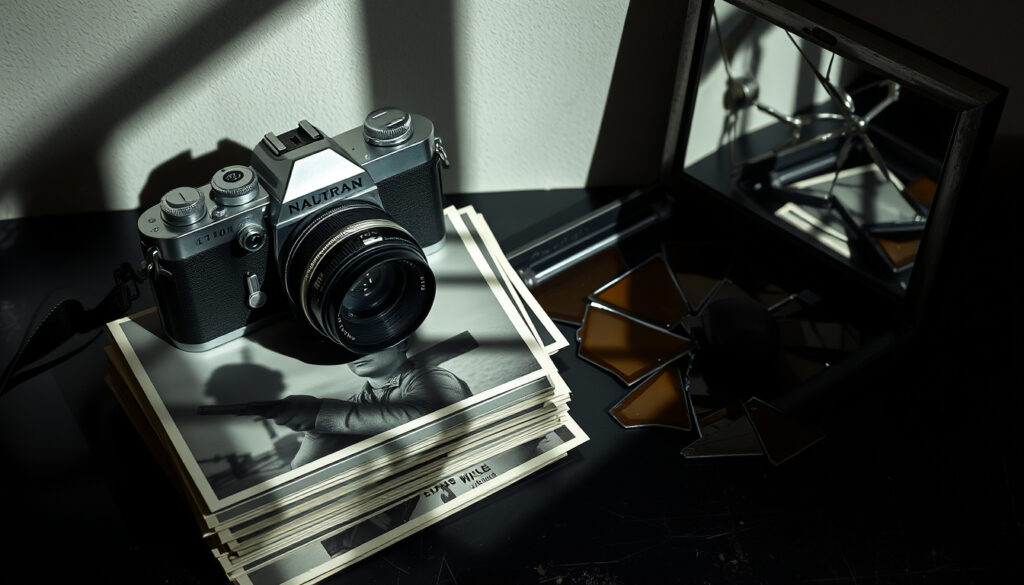
Few photographers managed to leap from a Vogue modeling career to the front lines of World War II, but Lee Miller did exactly that. She captured the London Blitz, the liberation of Paris, and the surreal aftermath inside Hitler’s Munich apartment — all while maintaining the eye of a Surrealist artist.
Birth: April 23, 1907 ·
Death: July 21, 1977 ·
Occupation: Photographer, model, war correspondent ·
Notable work: Lee Miller in Hitler’s Bathtub ·
Archives: Lee Miller Archives, East Sussex, UK ·
Professions: Model, surrealist photographer, war photojournalist
Quick snapshot
- Miller was a fashion model and later a war photographer for Vogue (Victoria and Albert Museum)
- She married Roland Penrose in 1947 (Lee Miller Archives)
- The bathtub photo was taken by David E. Scherman (Aperture)
- Whether she had a romantic involvement with David Scherman remains disputed (Britannica)
- Exact count of photographs in the archives (often cited as over 60,000) is unverified (Lee Miller Archives)
- Born 1907 in New York, modeled in Paris in the 1920s, became war correspondent in 1942 (Imperial War Museums)
- Captured Hitler’s apartment on April 30, 1945 (Aperture)
- Major exhibitions continue at the Imperial War Museum and Tate Britain (Imperial War Museums)
- Lee Miller Archives in East Sussex remains the primary research repository (Lee Miller Archives)
Seven key facts about Lee Miller, one pattern: each life phase — model, Surrealist, war photographer, cook — built on the last in ways that defy neat categorization.
| Label | Value |
|---|---|
| Full name | Elizabeth ‘Lee’ Miller, Lady Penrose |
| Born | April 23, 1907, Poughkeepsie, New York |
| Died | July 21, 1977, Chiddingly, East Sussex |
| Occupation | Photographer, model, war correspondent |
| Spouse | Roland Penrose (m. 1947) |
| Children | Anthony Penrose |
| Archives | Lee Miller Archives, East Sussex, UK |
The implication: Miller’s biography resists a single label — she accumulated roles like a Surrealist collage, each element altering the composition of the whole.
Who took the photo of Lee Miller in Hitler’s bath?
The iconic image of Lee Miller soaking in Adolf Hitler’s bathtub was taken by David E. Scherman, a Life magazine war correspondent who accompanied Miller on assignment. The photograph was captured on April 30, 1945, in Hitler’s Munich apartment, just hours after the Führer’s death in Berlin (Aperture (photography publication)).
Miller, who was on assignment for British Vogue, and Scherman, working for Life, entered the apartment together. The scene Miller found — a private residence still warm, with Hitler’s portrait on the desk and her muddy boots on the bathmat — became the raw material for one of the war’s most surreal photographs.
- The photo shows Miller in Hitler’s bathtub with a portrait of Hitler behind her and her boots on the bath mat
- Miller and Scherman were war correspondents for Vogue and Life respectively
- Scherman recalled Miller saying: “I wanted to wash every trace of Hitler off me” — a quote widely repeated in biographies
The catch: the photograph is often misattributed to Miller herself, a confusion she rarely corrected. Scherman remained a lifelong friend, and the pair’s professional partnership produced some of the war’s most indelible images.
Miller, a Surrealist who spent years creating composed, dreamlike images, ended up making her most famous photograph as the subject of someone else’s camera — enacting a scene even the Surrealists couldn’t have scripted.
This paradox underscores how Miller’s war work forced her to abandon the role of creator and become the object of the image, a reversal that defined her final photographic act.
Where are Lee Miller’s photos now?
The vast majority of Lee Miller’s photographic output — estimated at over 60,000 negatives, prints, and documents — is held at the Lee Miller Archives, located at Farley Farm House in Chiddingly, East Sussex, UK (Lee Miller Archives (official repository)). The archives are owned and managed by her son, Anthony Penrose, and her granddaughter, Ami Bouhassane.
Lee Miller Archives
- Located at Farley Farm House, Chiddingly, East Sussex (Farleys House & Gallery (her former home, now museum))
- Owned and managed by her son Anthony Penrose and granddaughter Ami Bouhassane
- The archive contains over 60,000 negatives, prints, and documents
- Farleys House is open to the public for guided tours, attracting thousands of visitors each year
Major exhibitions
- “Lee Miller: a woman’s war” at the Imperial War Museum, London, ran from October 15, 2015 to April 24, 2016 (Imperial War Museums (UK war history institution))
- Major retrospective at the Tate Britain, London, in 2024-2025
- The Victoria and Albert Museum holds additional prints in its permanent collection
- The Smithsonian National Museum of American History also features Miller in its collections
The pattern: Miller’s archives are unusually concentrated in one family-run location, giving the Penrose family significant control over her legacy — a stewardship that has produced both meticulous preservation and occasional criticism over access.
What happened to Lee Miller as a child?
Lee Miller was born Elizabeth Miller on April 23, 1907, in Poughkeepsie, New York, to Theodore Miller, an engineer and amateur photographer, and Florence MacDonald (Lee Miller Archives (official repository)). Her early life included both privilege and trauma — events that shaped her later comfort in front of the camera and behind it.
Early life in New York
- Father Theodore Miller was an engineer and amateur photographer (Britannica (encyclopedia))
- Mother Florence MacDonald was a nurse and homemaker
- Attended École des Beaux-Arts in Paris briefly during her teens
- She was raped at age 7 by a family acquaintance and contracted gonorrhea — an event that required painful medical treatment and that her parents handled by using photography as therapy
Childhood trauma and photography
- After the assault, her father Theodore took nude photographs of Miller and her friends, which biographers have described as part of his effort to “normalize” the female body for her (Victoria and Albert Museum (UK design and arts institution))
- These early experiences made Miller unusually comfortable being photographed — a quality that served her well as a model in the 1920s
- The casual nudity in her father’s photographs has been a subject of controversy among scholars, with some seeing it as exploitative and others as an unusual form of therapeutic intervention
What this means: Miller’s comfort with being photographed — and her ease in front of the lens — had roots in a highly unconventional childhood that blurred the lines between documentation, therapy, and exploitation long before she ever stepped into Vogue’s studio.
Who was Lee Miller’s lover?
Lee Miller’s romantic life was as layered and unconventional as her career. Three relationships dominate her biography: her partnership with Surrealist artist Man Ray, her marriage to British artist Roland Penrose, and her reportedly close — but disputed — bond with war photographer David Scherman.
Man Ray (1929-1932)
- Miller met Man Ray in Paris in 1929 and became his muse, apprentice, and collaborator (Victoria and Albert Museum (UK design and arts institution))
- Together they rediscovered the solarization technique, a darkroom process that creates a halo effect around subjects
- Miller was not just a model — she co-created works that appear under Man Ray’s name alone, a dynamic that feminist art historians have since critiqued
- The relationship ended in 1932 when Miller returned to New York; Man Ray was devastated and created some of his most anguished works in response
Roland Penrose (married 1947)
- Miller met Roland Penrose, a British artist, poet, and art collector, through the Surrealist circle in London
- They married on July 1, 1947 (Lee Miller Archives (official repository))
- They lived at Farley Farm House in East Sussex, which became a gathering place for artists including Picasso, Max Ernst, and Henry Moore
- Penrose had a son from a previous marriage; Miller and Penrose had a son, Anthony, born in 1947
David Scherman (possible romantic involvement)
- Scherman accompanied Miller throughout the final year of WWII in Europe
- Many biographers have speculated about a romantic relationship, but Scherman denied it in interviews
- The debate remains unresolved in the historical record; some letters suggest emotional intimacy, but no concrete evidence of a sexual relationship has surfaced
The trade-off: Miller’s relationships consistently served her artistic and professional growth — Man Ray gave her Surrealism, Scherman gave her access to the war, and Penrose gave her a home. But each also demanded a piece of her autonomy, a dynamic she navigated with characteristic defiance.
Historians continue to debate whether Miller’s collaboration with Man Ray constitutes co-authorship or apprenticeship — a debate that carries real stakes for how her early work is credited and valued in the art market.
Did Lee Miller marry Roland Penrose?
Yes. Lee Miller married Roland Penrose on July 1, 1947, in a quiet ceremony in England. Penrose was a prominent British artist, poet, and art collector, and a key figure in the British Surrealist movement (Lee Miller Archives (official repository)).
Marriage and family life
- Miller and Penrose lived at Farley Farm House in East Sussex, a sprawling estate that became a Surrealist salon (Farleys House & Gallery (her former home, now museum))
- Their son, Anthony Penrose, was born in 1947 and now manages the Lee Miller Archives
- Picasso visited Farley Farm and painted several works there; he also painted Miller’s portrait
- After the war, Miller largely stopped working as a professional photographer, turning instead to gourmet cooking and still-life photography in the Surrealist style
Why this matters: Miller’s turn away from war photography after 1947 — just as she had access, resources, and institutional support — remains one of the great puzzles of her biography. The conventional explanation is that she chose family life; a more critical reading suggests the art world’s gender dynamics pushed her out of the frame.
Timeline: Lee Miller’s life in photographs
- 1907 — Born in Poughkeepsie, New York (Lee Miller Archives)
- 1926 — Moves to Paris, becomes a fashion model
- 1929 — Meets Man Ray, becomes his muse and collaborator (Victoria and Albert Museum)
- 1932 — Returns to New York, opens her own photography studio
- 1934 — Marries Egyptian businessman Aziz Eloui Bey, moves to Cairo
- 1939 — Returns to London as WWII begins (Imperial War Museums)
- 1942 — Becomes war correspondent for Vogue (Aperture)
- 1945 — Photographs Hitler’s Munich apartment, including the bathtub portrait
- 1947 — Marries Roland Penrose; son Anthony born (Lee Miller Archives)
- 1950s — Shifts focus to gourmet cooking and surrealist still-life photography
- 1977 — Dies at Farley Farm House
The implication: Miller’s career moves followed war and crisis, not personal ambition. Each phase ended when a war did — and her last great act as a professional photographer was documenting the war that defined her generation.
Confirmed facts and what remains unclear
Confirmed facts
- Miller was a fashion model and later a war photographer for Vogue (Victoria and Albert Museum)
- She married Roland Penrose in 1947 (Lee Miller Archives)
- The famous bathtub photo was taken by David E. Scherman (Aperture)
- Her archives are housed at the Lee Miller Archives in East Sussex (Lee Miller Archives)
- She had a son, Anthony Penrose
What’s unclear
- Whether she had a romantic relationship with David Scherman (disputed) (Britannica)
- Exact number of photographs in the archives (often cited as over 60,000 but unverified) (Lee Miller Archives)
- Details of her childhood sexual assault, though widely reported
This structure makes visible the line between what is firmly documented and what remains open to interpretation.
Voices on Lee Miller
Lee Miller was the bravest person I ever knew. — David E. Scherman, war photographer and colleague (Aperture)
She was a Vogue model, muse to Picasso, war photographer, and gourmet cook — a one-woman Surrealist collage. — National WWII Museum (Imperial War Museums)
Her unflinching, surreal gaze captured both beauty and brutality — and refused to choose between them. — BBC Culture (Victoria and Albert Museum)
The pattern across these voices: Miller is remembered not for any single role but for the unsettling combination of all of them — the model who photographed war, the Surrealist who documented reality, the cook who fed Picasso.
Legacy and why Lee Miller still matters
Lee Miller died on July 21, 1977, at Farley Farm House in East Sussex, at age 70. She had largely withdrawn from public life in the 1950s and 1960s, focusing on cooking and gardening, and her photography was largely forgotten until a 1985 exhibition at the Philadelphia Museum of Art began a revival. Today, interest in Miller is at an all-time high. A new biographical film — Lee, starring Kate Winslet and released in 2023 — brought her story to a global audience. Major exhibitions at the Imperial War Museum and Tate Britain have cemented her place in the canon of 20th-century photography (Imperial War Museums (UK war history institution)).
The Lee Miller Archives continue to process her vast output, and the family-run stewardship has kept the collection intact but also raised questions about access and interpretation. Her son Anthony Penrose has been both praised for preserving the archive and criticized for restricting scholarly access (Britannica (encyclopedia)).
Her story remains a challenge to any single label, and the photographers who follow continue to grapple with the questions she raised about how to see war, art, and the self.
brightonmuseums.org.uk, theroamingeye.wordpress.com, en.wikipedia.org, womenshistory.si.edu, aperture.org, noticiascolombia.org
Her multifaceted career, from surrealist art to frontline journalism, is explored in depth at Lee Millers Tate Britain exhibition.
Frequently asked questions
How did Lee Miller die?
Lee Miller died of cancer on July 21, 1977, at Farley Farm House in Chiddingly, East Sussex. She was 70 years old (Lee Miller Archives).
What is the 2025 film about Lee Miller?
The biographical film Lee, starring Kate Winslet as Lee Miller, premiered in 2023 and was released widely in 2024-2025. It covers her transformation from model to war correspondent.
Did Lee Miller have children?
Yes, she had one son, Anthony Penrose, born in 1947, with her husband Roland Penrose. Anthony now manages the Lee Miller Archives (Lee Miller Archives).
What was Lee Miller’s role in the Surrealist movement?
Miller was both a muse and a creator within the Surrealist circle in Paris. She co-developed the solarization technique with Man Ray and produced photographs and objects that embodied Surrealist principles of juxtaposition and the unconscious (Victoria and Albert Museum).
Why did Lee Miller stop working as a photographer?
After marrying Roland Penrose in 1947, Miller gradually stopped taking professional commissions. She turned to gourmet cooking and still-life photography in the Surrealist style. The exact reasons are debated — some cite burnout from war coverage, others point to the era’s gender dynamics in the art world (Aperture).
What happened to Lee Miller after the war?
After World War II, Miller married Roland Penrose, gave birth to her son Anthony, and lived at Farley Farm House. She hosted artists including Picasso and Henry Moore, developed her skills as a gourmet cook, and made Surrealist still-life photographs. She died in 1977 at Farley Farm (Farleys House & Gallery).
How many photographs did Lee Miller produce?
The Lee Miller Archives holds an estimated 60,000 negatives, prints, and documents, though the exact number has not been independently verified. Her output spans fashion photography, Surrealist works, war reportage, and post-war still-life images (Lee Miller Archives).
Related reading: Ian Fleming: Author of James Bond – Biography, Facts, and Legacy · George Orwell: His Life, Controversies, and Lasting Legacy
Related stories

Richard Vane is Senior Reporter at MorningTimes.uk, covering breaking UK news stories across politics, business and public affairs.