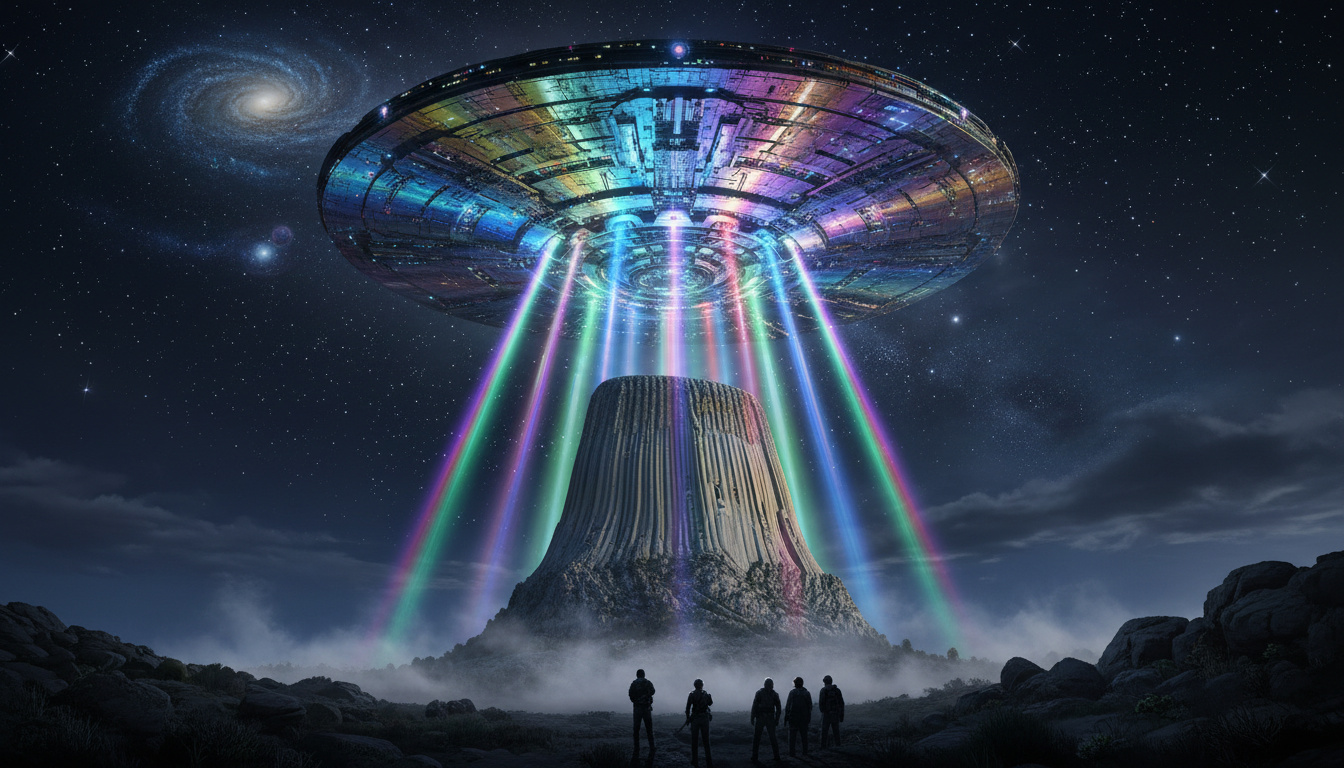

Released in 1977, Close Encounters of the Third Kind represents Steven Spielberg’s optimistic counterpoint to the blockbuster terror of Jaws. The film stars Richard Dreyfuss as Roy Neary, an Indiana utility lineman whose mundane existence fractures after a nocturnal encounter with an unidentified flying object.[1]
The narrative weaves together global scientific investigation and personal obsession, anchored by John Williams’s iconic five-tone musical motif. Rather than depicting extraterrestrials as hostile invaders, the production explores themes of communication, wonder, and transcendence through the real-world geological landmark of Devil’s Tower in Wyoming.[2]
Drawing inspiration from astronomer J. Allen Hynek’s UFO classification system, the movie became a cultural touchstone that grossed over $300 million worldwide and earned eight Academy Award nominations, winning for cinematography and original score.[3]
What Is Close Encounters of the Third Kind?
The film follows Roy Neary’s psychological transformation after he witnesses strange lights in the night sky. His obsession with a subliminal image of Devil’s Tower drives him from suburban normalcy toward a climactic rendezvous with extraterrestrial intelligence. Parallel narratives track French scientist Claude Lacombe (François Truffaut) as he investigates worldwide UFO phenomena, including the rediscovery of lost aircraft and ships in remote deserts.[4]
Steven Spielberg
1977
Science Fiction
135 minutes
- Blockbuster Status: The production grossed $307 million against a $20 million budget.
- Academy Recognition: Received eight Oscar nominations, winning for Cinematography and Original Score.
- Musical Innovation: John Williams’s five-tone motif became instantly recognizable as alien communication.
- Scientific Consultation: Real astronomer J. Allen Hynek advised on set and endorsed the portrayal.
- Multiple Versions: Three distinct cuts exist: theatrical (1977), special edition (1980), and collector’s edition (1998).
- Cultural Pivot: Spielberg intentionally created hopeful science fiction contrasting with contemporary dystopian films.
- Location Authenticity: Primary photography occurred at the actual Devil’s Tower National Monument in Wyoming.
| Fact | Details |
|---|---|
| Director | Steven Spielberg |
| Release Date | November 16, 1977 |
| Lead Performer | Richard Dreyfuss (Roy Neary) |
| Composer | John Williams |
| Production Budget | $20 million |
| Global Box Office | $307 million |
| Academy Awards | 2 wins, 6 nominations |
| Mpaa Rating | PG |
| Primary Location | Devil’s Tower, Wyoming |
| Scientific Basis | Hynek UFO Classification |
What Does ‘Close Encounters of the Third Kind’ Mean?
The title derives directly from astronomer J. Allen Hynek’s scale of UFO encounters. A “close encounter of the first kind” involves visual sighting of an unidentified object; the second kind includes physical effects on the environment; the third kind—represented in the film—denotes observation of animate beings associated with the craft.[5]
Hynek served as technical consultant during production, lending credibility to the methods depicted. The classification system transformed ufology from anecdotal storytelling into structured data collection, though the film dramatizes these categories for narrative effect.
Hynek’s scale categorizes encounters progressively: First Kind (visual), Second Kind (physical trace), Third Kind (occupant sighting). The film focuses exclusively on the third category, emphasizing visual contact rather than abduction or aggression.
Who Directed Close Encounters of the Third Kind and Key Cast?
Steven Spielberg directed and wrote the screenplay, conceiving the project as an answer to the paranoia prevalent in 1970s science fiction. Working with cinematographer Vilmos Zsigmond and special effects supervisor Douglas Trumbull, the production team achieved unprecedented visual realism for UFO depictions.[6]
Principal Cast
Richard Dreyfuss anchors the film as Roy Neary, capturing the character’s descent from suburban normalcy into obsessive conviction. Melinda Dillon portrays Jillian Guiler, a single mother whose son Barry becomes central to the abduction narrative. François Truffaut appears as Claude Lacombe, the French scientist leading the government investigation, while Teri Garr plays Ronnie Neary, Roy’s wife who cannot comprehend his transformation. Bob Balaban appears as David Laughlin, Lacombe’s interpreter.[7]
Cary Guffey delivers a memorable performance as Barry Guiler, the toddler drawn to the alien visitors. The ensemble avoided sensationalist acting, instead grounding extraordinary events in documentary-style realism.
Creative Crew
John Williams composed the score, creating the five-tone motif (Re, Mi, Do, Sol, Do in C major) that functions as the primary communication method between species. Producers Julia Phillips and Michael Phillips secured financing during the post-Jaws euphoria surrounding Spielberg’s work.
What Happens at the End and Key Symbols?
The climax occurs at Devil’s Tower, Wyoming, where the military has established a covert landing zone under the cover of a fake nerve gas spill. Scientists use a light-and-sound billboard to exchange the five musical tones with approaching unidentified craft. The sequence builds to the arrival of a massive mothership, which returns long-missing humans—including Barry Guiler and the Flight 19 pilots—who have not aged since their disappearance.
Lacombe ultimately selects Roy Neary to board the craft as part of “Project Mayflower,” representing humanity’s invitation to interstellar society. The final moments show an alien leader mimicking hand signs and the five tones, smiling warmly before departing with Roy. Emphasis falls entirely on communication and wonder rather than threat or invasion.
John Williams devised the iconic five-note sequence (Re, Mi, Do, Sol, Do) to serve as both musical theme and plot device. Within the narrative, scientists transmit these tones into space, receiving coordinate responses that identify Devil’s Tower as the landing site. The motif recurs throughout the score in variations ranging from solo synthesizer to full orchestral arrangement.
The film’s conclusion implies a government program selecting civilian representatives for extraterrestrial contact. Roy’s boarding of the mothership suggests voluntary participation in an interspecies exchange program, though the film deliberately leaves the destination and duration unspecified.
How Did Close Encounters of the Third Kind Develop Through Releases?
-
Spielberg completes initial screenplay, envisioning the project as his next feature following Jaws.
-
Theatrical release debuts to critical acclaim and commercial success, establishing the theatrical cut lasting 135 minutes.
-
Special Edition releases with additional footage, including interior shots of the mothership that Spielberg later reconsidered.
-
Collector’s Edition restores Spielberg’s preferred vision while refining visual effects using contemporary technology.
-
DVD remaster introduces enhanced audio and retrospective documentaries examining the production’s cultural impact.
-
40th Anniversary Blu-ray edition features 4K restoration of the original camera negative and remastered surround sound.
-
Streaming availability across multiple platforms introduces the film to new generations via digital distribution.
Is Close Encounters of the Third Kind Based on a True Story?
The narrative constitutes fiction, though Spielberg incorporated elements from documented UFO lore. The screenplay references the 1945 disappearance of Flight 19 over the Bermuda Triangle and the 1925 vanishing of the SS Cotopaxi, both real maritime mysteries. The India sequences reference 1970s reports of tonal sounds associated with sightings.
| Established Information | What Remains Unclear |
|---|---|
| Screenplay written by Steven Spielberg as fiction | Whether specific abduction accounts directly inspired individual scenes |
| Hynek classification system scientifically documented | Government knowledge of extraterrestrial contact (remains speculative) |
| Flight 19 and SS Cotopaxi represent real disappearances | Meaning of individual musical tones beyond plot mechanics |
| Filming occurred at actual Devil’s Tower location | Location of other landing sites depicted in the film |
Astronomer Hynek consulted specifically to ensure accurate depiction of investigation methodology, though he never confirmed the reality of extraterrestrial visitation. The film’s power plant and Indiana settings derive from Spielberg’s imagination rather than specific case files.
What Is the Cultural Significance of Close Encounters?
Emerging in the post-Watergate era, the film offered a rare optimistic vision of government and extraterrestrial interaction. Unlike the dystopian science fiction dominating the 1970s, the narrative suggests that wonder and communication can bridge species boundaries. This thematic approach directly influenced Spielberg’s subsequent E.T. the Extra-Terrestrial and the broader genre shift toward benevolent alien depictions.
Commercially, the $307 million gross validated science fiction as mainstream blockbuster territory, paving the way for the genre’s dominance in subsequent decades. The What Does SOS Mean – Myths, Morse Code and History article explores similar themes of communication protocols in extraordinary circumstances, paralleling the film’s focus on musical language as rescue signaling.
The visual iconography—Devil’s Tower, the mothership’s undercarriage lighting, the five-tone sequence—entered permanent pop culture lexicon. Academic film studies frequently cite the work as a pivotal moment in special effects history and as an exploration of spiritual transcendence through science fiction tropes.
What Do the Filmmakers Say About Close Encounters?
Spielberg consistently emphasized the film’s musical core, noting that the alien communication method required something universally understood yet emotionally resonant. The production team approached UFO design as biological rather than mechanical, creating organic, luminous craft that moved with fluid grace rather than mechanical rigidity.
The music communicates where words fail, creating a bridge between species that transcends linguistic barriers.
— Steven Spielberg, Director
Hynek reportedly expressed satisfaction with the scientific methodology depicted, particularly the global coordination shown in the investigation sequences. Cinematographer Vilmos Zsigmond utilized natural lighting and practical effects to ground extraordinary events in visual reality.
Why Does Close Encounters of the Third Kind Endure?
Nearly five decades after release, the film maintains relevance through its humanistic treatment of contact narratives and technical virtuosity that remains visually compelling. The work stands as a monument to analog special effects craftsmanship while exploring timeless questions about humanity’s place in the cosmos. For those interested in atmospheric platforming adventures that similarly balance visual wonder with emotional depth, Ori and the Will of the Wisps – Platforms, Review and Length Guide offers contemporary interactive experiences that echo the film’s marriage of awe and intimacy.
Frequently Asked Questions
Where was Close Encounters of the Third Kind filmed?
Primary photography occurred at Devil’s Tower National Monument in Wyoming, with additional sequences shot in Muncie and Indianapolis, Indiana, the Sonoran Desert in Mexico, and Dharamsala, India.
What is the soundtrack like in Close Encounters of the Third Kind?
John Williams composed an orchestral score featuring the iconic five-tone motif used for alien communication, blending traditional symphonic arrangements with electronic synthesizer elements.
What does close encounter of the third kind mean?
The phrase derives from astronomer J. Allen Hynek’s classification system, specifically denoting observation of animate beings associated with unidentified flying objects.
Is Close Encounters of the Third Kind based on a true story?
No, the narrative is fictional, though it incorporates references to real unexplained disappearances like Flight 19 and the SS Cotopaxi, and consulted real UFO researcher J. Allen Hynek.
What are the five tones in Close Encounters?
The musical phrase consists of five notes—Re, Mi, Do, Sol, Do in the key of C major—used within the film as a mathematical and sonic basis for extraterrestrial communication.
Who played the little boy in Close Encounters of the Third Kind?
Cary Guffey portrayed Barry Guiler, the young boy abducted by extraterrestrials who later returns during the Devil’s Tower climax.
Related stories





Catherine Lowe is Managing Editor at MorningTimes.uk, running the daily news list and the publishing schedule.