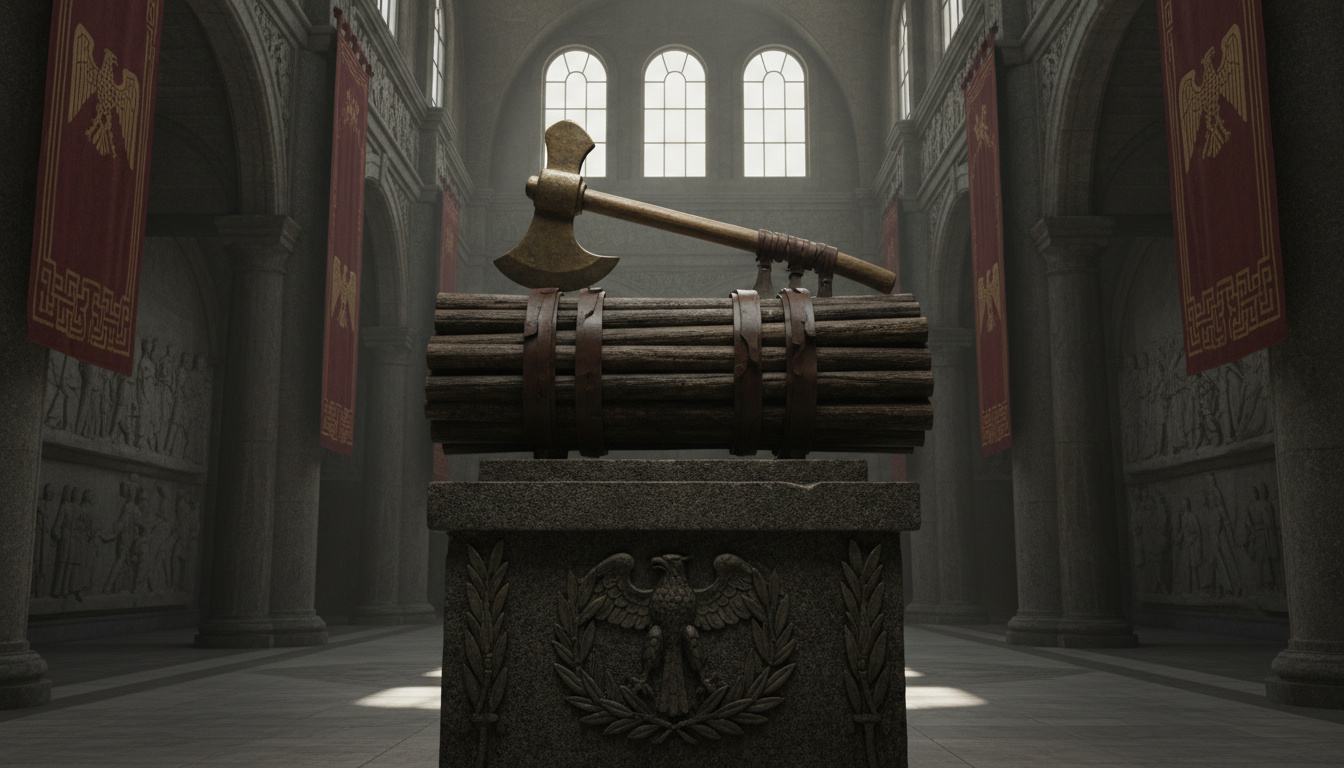

Fascism represents a far-right, authoritarian political ideology rooted in ultranationalism and dictatorial power. Emerging from post-World War I Italy, the movement prioritizes national unity above individual rights through centralized autocracy, militarism, and the forcible suppression of opposition. The term derives from the Italian fascio, referring to a bundle of rods—an ancient Roman symbol of collective strength and authority.
Historically, fascist regimes transformed societies through totalitarian control, economic corporatism, and rigid social hierarchies. These governments rejected Enlightenment ideals, liberal democracy, and Marxist socialism, viewing such systems as decadent weaknesses that prevented national rebirth. While primarily associated with interwar Europe, particularly Italy and Germany, the ideology spawned movements across multiple continents during the 1920s through 1940s.
Contemporary usage of “fascist” extends beyond historical accuracy, often serving as political rhetoric against authoritarian nationalism or right-wing populism. Understanding the specific characteristics that define historical fascism remains essential for distinguishing between technical definitions and pejorative applications.
What Does Fascist Mean?
Authoritarian ultranationalism with dictatorial leadership and centralized autocracy
Militarism, anti-liberalism, economic corporatism, and forcible suppression of opposition
Italy and Germany, 1920s–1940s, with movements across interwar Europe
Debated political label applied to contemporary authoritarian nationalism
- The ideology originated with Benito Mussolini’s Fasci Italiani di Combattimento in March 1919, established in Milan during post-war social chaos.
- Core philosophy centers on palingenetic ultranationalism—the myth of national rebirth and decadence recovery through revolutionary transformation.
- Fascist regimes operated as one-party states where power concentrated in a single leader or elite council, eliminating political pluralism.
- Economic systems rejected both laissez-faire capitalism and socialist internationalism in favor of state-directed corporatism and self-sufficiency.
- Social structures emphasized virilism, anti-egalitarian hierarchy, and the exclusion of designated outsiders to maintain national “purity.”
- Historical fascism specifically opposed liberal democracy, communism, and individual rights, viewing these as sources of national weakness.
- The Roman fasces—an axe bundled with rods carried by lictors—provided both the name and the symbolic emphasis on collective authority.
| Aspect | Details |
|---|---|
| Pronunciation | /ˈfæʃɪzəm/ (FASH-iz-əm) Merriam-Webster |
| Etymology | Italian fascio (bundle); Roman fasces symbol |
| Founded | 1919, Milan, Italy |
| Founder | Benito Mussolini |
| Political Spectrum | Far-right |
| Government Type | One-party dictatorship with totalitarian control |
| Economic Model | Corporatist state control integrating business and policy |
| Key Opposition | Liberalism, communism, democracy, individualism |
| First Regime | Kingdom of Italy (1922–1943) |
| Peak Period | Interwar years (1919–1945) |
What Is Fascist Ideology?
Core Characteristics and Traits
Fascism demands total societal transformation through revolutionary means rather than conservative preservation. The ideology emphasizes ultranationalism and militarism, requiring a strong military for territorial expansion and national defense while promoting extreme patriotism often coupled with assertions of racial superiority. Power concentrates in a dictator or elite leadership that employs propaganda, secret police, and violence to suppress dissent, pluralism, and democratic institutions.
The social doctrine rests upon beliefs in natural hierarchy and the subordination of individuals to the nation or race. This manifests as virilistic, anti-hedonistic cultural policies and the forcible exclusion of ethnic minorities, foreigners, or other designated outsiders to “cleanse” the national community. Fascist states regiment both society and economy, rejecting laissez-faire capitalism and socialist internationalism in favor of self-sufficiency and state-directed coordination.
This concept, central to fascist philosophy, refers to the belief in a nation’s imminent rebirth or regeneration following a period of perceived decadence and decline. Unlike conservative authoritarianism, which seeks to preserve existing structures, fascism demands revolutionary transformation to create a “new man” and unified national community (Volksgemeinschaft in German contexts).
Economic and Social Structure
Fascist economies operate through corporatism, a system where businesses integrate into policymaking under state direction. This model maintains private property and capitalist structures while subordinating economic activity to national objectives. The approach explicitly favors class collaboration over class struggle, attempting to harmonize labor and capital under state supervision to serve the national interest rather than individual profit or worker emancipation.
How Does Fascism Compare to Other Systems?
| Aspect | Fascism | Communism | Liberalism |
|---|---|---|---|
| Leadership | Dictatorial leader, rigid hierarchy | Classless in theory; one-party totalitarian in practice | Elected leaders, individual rights protected |
| Economy | Corporatist state control, regulated capitalism | State ownership, classless equality theoretical | Free markets, private property, limited intervention |
| Society | Ultranationalist, racist hierarchy, nation supreme | Internationalist, anti-hierarchy theoretical; often repressive | Pluralist, egalitarian, democratic participation |
| Opposition | Suppresses all dissent via violence and militarism | Suppresses bourgeoisie and capitalist classes | Protects dissent, rule of law, free speech |
| Goal | National rebirth, territorial expansion, racial purity | Global worker revolution, class abolition | Individual liberty, progress, human rights |
Historical analysis demonstrates that while communism seeks class equality and liberalism emphasizes individual rights, fascism pursues revolutionary anti-liberal nationalism that subordinates all interests to the state or racial community.
Who Are Famous Fascist Leaders and Examples?
Benito Mussolini and the Italian Origin
Benito Mussolini founded the first fascist movement in 1919 through the Fasci di Combattimento, transforming it into a national political force that seized power during the 1922 March on Rome. As Prime Minister and later Duce, Mussolini established the corporate state, invaded Ethiopia, and allied with Nazi Germany. His regime represented the prototype for subsequent fascist governments, emphasizing state supremacy and imperial expansion until his execution in 1945.
Adolf Hitler and German National Socialism
Adolf Hitler led Nazism, a distinct variant of fascism characterized by extreme biological racism and antisemitism. Rising to power in 1933, Hitler envisioned a racially unified Volksgemeinschaft achieved through the totalitarian Nazi state. While sharing fascism’s dictatorial structure and ultranationalism, Nazism placed unique emphasis on racial hygiene, anti-Jewish ideology, and the systematic genocide of the Holocaust.
While Nazism falls under the fascist umbrella, it represents a specific variant emphasizing extreme biological racism and antisemitism. Italian fascism under Mussolini initially prioritized cultural nationalism and state supremacy over racial theories, though it later adopted antisemitic policies under German influence in 1938.
Francisco Franco and Spanish Falangism
Francisco Franco headed a fascist-inspired authoritarian regime in Spain from 1939 until his death in 1975. Emerging victorious from the Spanish Civil War with aid from Italy and Germany, Franco blended fascist aesthetics and Falangist ideology with traditional conservatism and Catholic authoritarianism. His regime emphasized nationalism and anti-communism but remained less ideologically pure than Italian or German models, functioning more as military authoritarianism with fascist elements.
What Countries Had Fascist Governments?
Italy (1922–1943)
The Kingdom of Italy became the first fascist state when Mussolini assumed power in 1922. The regime centralized political authority, eliminated parliamentary opposition, and established the Corporate State (Stato Corporativo) integrating business, labor, and government. Italian fascism pursued imperial ambitions in Africa, most notably the 1935 invasion of Ethiopia, before collapsing in 1943 following Allied invasion and German occupation of northern Italy.
Germany (1933–1945)
Nazi Germany implemented the most extreme form of fascist totalitarianism under Hitler’s dictatorship. The regime dismantled democratic institutions, established concentration camps for political opponents and ethnic minorities, and directed the economy toward military rearmament. The United States Holocaust Memorial Museum documents how this government led directly to World War II and the genocide of six million Jews.
Spain, Portugal, and Other European Regimes
Francoist Spain maintained authoritarian control from 1939 to 1975, outlasting other European fascist regimes by three decades. Portugal under António de Oliveira Salazar operated a similar conservative-authoritarian corporatist state (the Estado Novo) from 1932 to 1974. Lesser fascist movements briefly governed Romania, Hungary, and Croatia during World War II, while Japan’s militarist government shared fascist characteristics despite distinct cultural origins.
While pure fascist regimes collapsed after 1945, Francoist Spain maintained authoritarian control until Franco’s death in 1975. Various neo-fascist movements continue to operate in contemporary Europe, though none have achieved state power comparable to interwar regimes.
How Did Fascism Emerge and Collapse?
- : Benito Mussolini establishes the Fasci Italiani di Combattimento in Milan, founding the first fascist movement amid post-war economic collapse and social unrest.
- : The March on Rome brings Mussolini to power as Prime Minister, establishing the first fascist regime.
- : Adolf Hitler becomes Chancellor of Germany, transforming the Weimar Republic into the Nazi totalitarian state.
- : The Spanish Civil War results in Francisco Franco’s victory, establishing a fascist-inspired authoritarian regime with support from Italy and Germany.
- : World War II sees the Axis powers (including fascist Italy, Nazi Germany, and militarist Japan) defeated by Allied forces.
- : Fascist regimes collapse across Europe; the ideology persists only in fringe political parties and neo-fascist movements without state power.
What Is Definitively Fascist vs. What Remains Debated?
| Established Historical Traits | Uncertain or Debated Applications |
|---|---|
| Dictatorial leadership with centralized autocracy | Modern right-wing populist movements labeled “fascist” by critics |
| Palingenetic ultranationalism (myth of national rebirth) | Whether contemporary authoritarian regimes qualify as fascist or merely authoritarian |
| One-party state structure with suppressed political pluralism | The precise boundaries between fascism, military dictatorships, and theocracies |
| Economic corporatism integrating business into state policy | Application of the term to non-European historical contexts |
| Explicit opposition to liberalism, communism, and democracy | Degree of continuity between historical fascism and current nationalist parties |
What Is the Historical Context of Fascism?
The emergence of fascism responded specifically to the aftermath of World War I, the Bolshevik Revolution, and economic depression across Europe. Disillusioned veterans, fearing communist uprisings and national decline, formed paramilitary squads that evolved into political movements. The Roman fasces provided symbolic continuity with ancient imperial grandeur, suggesting strength through unity and the authority to punish dissent. Understanding this context clarifies why fascism spread rapidly amid democratic instability during the 1920s and 1930s.
What Is Lyme Disease – Symptoms, Causes, Treatment
What Do Authoritative Sources Say About Fascism?
Fascism is a far-right, authoritarian, ultranationalist political ideology characterized by dictatorial leadership, centralized autocracy, militarism, forcible suppression of opposition, belief in natural social hierarchy, subordination of individuals to the nation or race, and strong regimentation of society and economy.
— Wikipedia
Fascist governments are one-party states led by an authoritarian leader who uses propaganda, secret police, and violence to suppress opposition to the government or nation.
— United States Holocaust Memorial Museum
Although fascist parties and movements differed significantly from one another, they had many characteristics in common, including extreme militaristic nationalism, contempt for electoral democracy and political and cultural liberalism, a belief in natural social hierarchy and the rule of elites, and the desire to create a Volksgemeinschaft.
What Defines a Fascist?
A fascist adheres to an ideology of revolutionary ultranationalism that demands dictatorial leadership, rejects democratic pluralism, and subordinates individual rights to the collective nation or race. Historical fascists established totalitarian regimes in Italy, Germany, and Spain during the interwar period, utilizing corporatist economics, militarism, and violent suppression of opposition. While the term persists in modern political discourse, historians reserve it for movements exhibiting the specific combination of palingenetic nationalism, anti-liberalism, and one-party autocracy characteristic of the 1919–1945 era.
What Is Type 1 Diabetes – Symptoms, Causes, Treatment Guide
Frequently Asked Questions
How do you pronounce “fascist”?
The word “fascist” derives from the Italian fascismo, pronounced /ˈfæʃɪzəm/ (FASH-iz-əm). The term traces back to the Latin fasces, a bundle of rods surrounding an axe that symbolized authority in ancient Rome.
What countries were fascist during the 20th century?
Primary fascist regimes included Italy (1922–1943), Germany (1933–1945 under Nazism), and Spain (1939–1975 under Franco). Lesser movements appeared in Portugal, Romania, Hungary, Croatia, and Japan, though with varying degrees of ideological purity.
Is fascism left-wing or right-wing?
Fascism occupies the far-right of the political spectrum due to its emphasis on hierarchy, nationalism, and opposition to egalitarianism and class struggle. While it rejected laissez-faire capitalism, it equally opposed socialism and communism.
What is the opposite of fascism?
Political systems opposing fascism include liberal democracy (emphasizing individual rights and pluralism) and communism (emphasizing class equality and internationalism). Both systems reject fascism’s ultranationalism and authoritarian hierarchy.
What was the first fascist party?
The Fasci Italiani di Combattimento (Italian Combat Leagues), founded by Benito Mussolini in March 1919 in Milan, became the first fascist party. It evolved from earlier fasci di combattimento formed in 1914.
Does fascism exist today?
Contemporary analysis indicates that while no governments currently identify as fascist, neo-fascist movements persist in Europe. Historians caution against labeling modern nationalist governments as fascist unless they exhibit core traits like palingenetic ultranationalism and revolutionary aims.
Related stories





Marcus Bell covers UK politics, public policy and government for MorningTimes.uk.