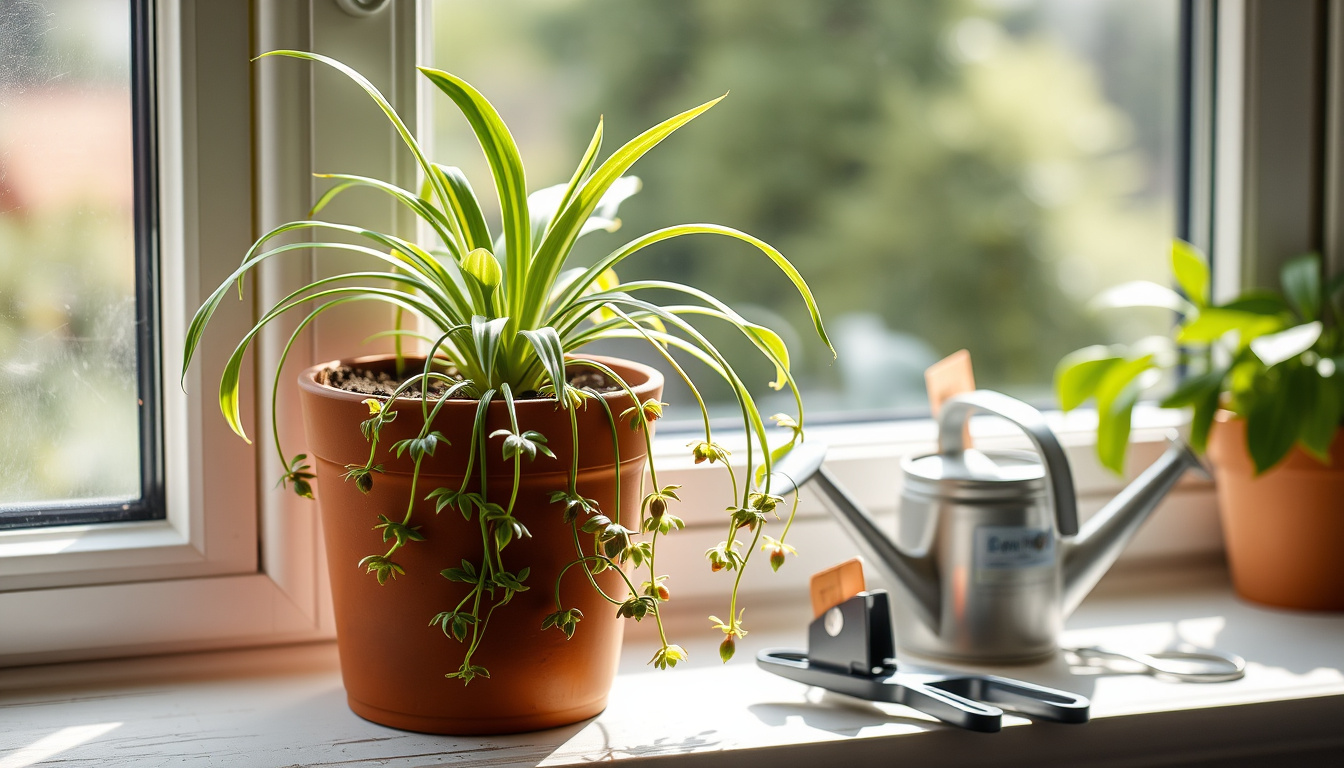
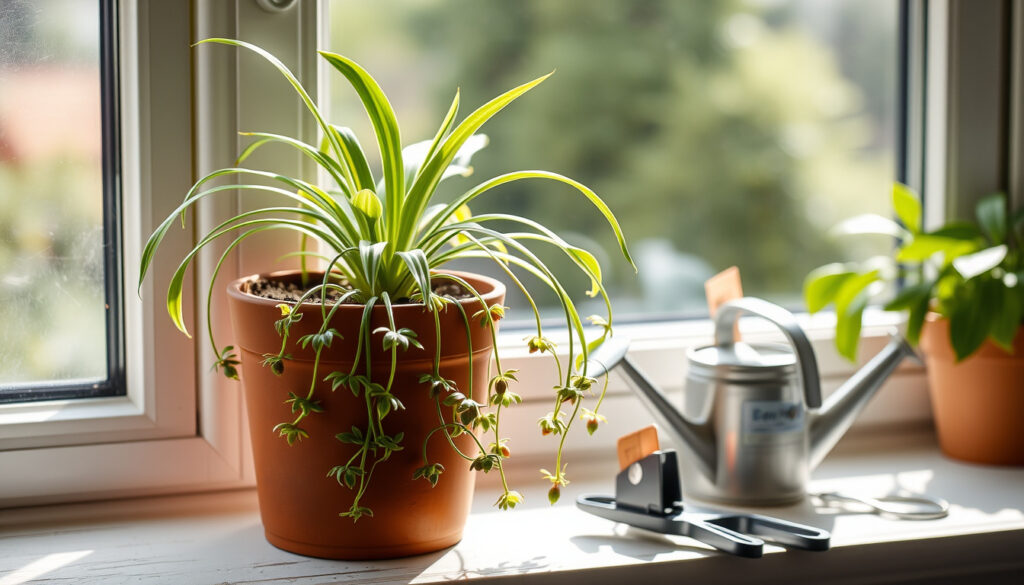
Anyone who has inherited a spider plant knows the pattern: you look away for a season, and suddenly there are plantlets trailing from every stem. That modest, repeatable cycle — a little water, indirect light, a stolon that keeps producing babies — is exactly why Chlorophytum comosum still fills UK windowsills. The practical care is simple; the folklore around it is where things get fuzzy.
Botanical name: Chlorophytum comosum · Plant family: Asparagaceae · Native range: South Africa · Typical height: Up to 60 cm · Common nicknames: Ribbon plant, airplane plant, spider ivy
Quick snapshot
- Chlorophytum comosum is the accepted botanical name for the common spider plant.
- Plantlets on stolons can be detached once they have their own roots (RHS).
- Spider plants are non-toxic to cats and dogs (ASPCA).
- The 78% airborne mold figure has no consistent, verifiable study citation.
- “24-hour oxygen” claims simplify how plants actually respire.
- Lucky-plant lists shift by culture and seller.
- Plantlets appear on stolons mainly in spring and summer.
- Winter means slower growth and lighter watering.
- Repot or divide every two to three years (RHS).
- Cut rooted babies from the stolon with clean scissors.
- Root them in water or moist peat-free compost.
- Resume balanced feeding when growth picks up in spring.
Seven quick identifiers, one pattern: this is a forgiving plant that mainly asks for decent light and a pot that drains.
| Identifier | Detail |
|---|---|
| Botanical name | Chlorophytum comosum |
| Family | Asparagaceae |
| Common names | Spider plant, ribbon plant, airplane plant |
| Native area | South Africa |
| Mature size | Up to 60 cm tall and wide |
| Light | Bright, indirect light |
| Pet safety | Non-toxic to cats and dogs |
How to look after spider plants in the UK?
Spider plants tolerate a fair amount of neglect, but they thrive on rhythm: consistent light, measured water, and a quiet winter. UK homes provide all three without much effort.
How often should I water a spider plant?
- Water when the top half of the compost feels dry to the touch, and never leave the pot standing in soggy compost (Royal Horticultural Society (UK gardening charity)).
- In a heated UK room, that usually lands on once a week in summer and every 10–14 days in winter.
- Empty saucers after watering; a wet rootball is the fastest route to rot.
The classic failure is love, not neglect. A spider plant bounces back from a missed drink far quicker than from a waterlogged pot.
Where should I place a spider plant in my home?
- Bright but indirect light suits it best; a spot a metre or two from an east or west window is ideal, matching RHS guidance.
- Harsh direct sun scorches the leaf tips, especially through glass.
- Partial shade is tolerated, but growth slows and the white stripes fade.
Rooms that keep other houseplants alive will keep a spider plant happy. Its only hard limit is punishing afternoon sun. In dry, heated UK rooms, brown leaf tips are common and mostly cosmetic; a light mist or humidity tray helps a little but is not essential.
What winter temperatures can a spider plant tolerate?
- Keep plants above 10°C — the RHS lists Chlorophytum comosum for house, under-glass, or frost-free cultivation, not a typical UK winter outdoors (Royal Horticultural Society (UK gardening charity)).
- Keep them clear of cold draughts, unheated conservatories, and windowsills that frost overnight.
- Cut watering back while growth slows, and pause feeding until spring (RHS Plants (horticultural retailer)).
Winter is when spider plants look tired in UK homes — almost always because they are cold and wet, not hungry.
A dry spider plant forgives you quickly; a waterlogged one does not. Most UK care problems come from a brimming saucer, not a dry pot.
The pattern is simple: consistent light, water by touch, a winter that stays warm enough and slightly dry. Nail that rhythm and the plant does the rest.
How to cut spider plant babies?
The stolon is a spider plant’s signature: a long stem that ends in a tiny copy of the parent. Cutting those babies is the easiest propagation win in houseplants.
When is a spider plant baby ready to remove?
- Wait until the plantlet has small roots of its own — RHS advice is to detach rooted offsets, then settle them into moist peat-free compost; plantlets also root happily in water (Royal Horticultural Society (UK gardening charity)).
- Babies without roots can still be rescued: peg them down onto damp compost and they will root within a few weeks.
- Cut the stolon just below the baby with clean, sharp scissors.
Root development matters more than timing. A baby with a couple of centimetres of root is a confident starter; a bare one needs hand-holding.
Can I grow a spider plant baby in water?
- Yes — water rooting is simple and shows visible progress within a week or two.
- Transfer to moist potting mix once roots reach a few centimetres; compost-rooted plants adapt to pots faster.
- Use small pots — a tiny baby in a huge pot just sits in damp compost and sulks.
Water is a great nursery, but compost is the permanent home. Move babies over early enough and they never notice the change.
Babies without roots rot quickly in a glass of water. Wait for the little white nubs before you cut — that patience prevents most propagation failures.
The trade-off is presentational, not botanical: water rooting is showy, compost rooting is steady. Both work because the plant grows the roots — your only job is to cut at the right moment.
What is the symbolic meaning of the spider plant?
Botanists describe the stolon; florists describe the symbolism. The two can coexist.
What is the feng shui meaning of a spider plant?
- Spider plants are commonly read as symbols of healing, renewal, or growth — a cultural layer rather than a botanical one.
- In feng shui practice, their long, trailing leaves are sometimes used to soften shelves and bring a gentle, downward energy.
- There is no single canonical rule; interpretations shift between traditions and teachers.
Most UK buyers choose a spider plant because it fills a shelf and survives the kitchen. The symbolism is a bonus, not a specification.
What plant says “I love you”?
- Heart-leaf hoya (Hoya kerrii) is the plant most often sold as a “love” plant, thanks to its heart-shaped leaves.
- Spider plants rarely appear on Valentine’s lists; their meaning leans toward steady growth rather than romance.
What are the 7 lucky plants?
- Lucky-plant lists are not standardised; they vary by culture, book, and market.
- Money plant, jade plant, peace lily, and snake plant appear in most roundups.
- Spider plants make some lists but not others, usually praised for resilience and fast growth.
Reportedly, the lists differ more by region than by plant — what matters is usually the giver’s intention rather than the species.
The implication: a plant’s meaning is assigned, not intrinsic. The spider plant’s genuine symbolism sits right in front of you — it keeps producing new life from its own stems.
What is the name of a spider plant?
One scientific name, several common names, and a nickname system that describes exactly what the plant does.
What is Chlorophytum comosum?
- The accepted botanical name is Chlorophytum comosum — the name used by the Royal Horticultural Society across its plant records (Royal Horticultural Society (UK gardening charity)).
- It belongs to the Asparagaceae family, alongside asparagus and yucca.
- It is a clump-forming perennial native to South Africa.
The name is stable, which keeps garden-centre labels consistent from one season to the next.
Why is it called a spider plant?
- The common name comes from the plant’s shape: arching rosettes of slender leaves and dangling plantlets that mimic a spider and her babies on threads.
- Ribbon plant, airplane plant, and spider ivy are the most common alternative names.
What this means: the scientific name locks down the identity, while the common names describe the habit. Each earns its keep in different conversations.
What plant is mistaken for a spider plant?
Most lookalike confusion involves the plant’s own cultivars, not a distant impostor.
How can I identify a true spider plant?
- True spider plants form tight rosettes of long, arching, linear leaves with green and white stripes.
- The giveaway is the stolon: a long stem carrying small plantlets, something the lookalikes rarely produce.
- Cultivars such as ‘Vittatum’ and ‘Variegatum’ are varieties of Chlorophytum comosum, not separate species.
If it has babies on strings, it is a spider plant. That single trait settles most identification questions.
Is there a false spider plant?
- Chlorophytum bichetii is a compact lookalike with similar grassy, arching leaves.
- It stays smaller and is often sold as a terrarium or desk plant; without stolons, it can be easy to mix up.
The mix-up is harmless — both are easy, undemanding plants. But if you want the plantlets, look for a label that says Chlorophytum comosum.
The pattern: check for stolons first, leaf shape second. Everything else is labelling.
What is the healthiest plant to have in your bedroom?
Bedroom-plant lists make big promises. The honest version is more modest and more useful.
What plant not to put in bedroom?
- No plant replaces ventilation and dust control; a stuffy, carpeted room needs moving air more than foliage.
- Plants that need constant moisture can grow mould in the soil, which is the opposite of a healthy bedroom.
The healthiest bedroom plant is the one you can keep alive without overwatering it.
Which plant gives 24 hours of oxygen?
- CAM plants such as snake plant are often credited with releasing oxygen at night.
- The real-world effect is modest: output depends on light, leaf area, and temperature, and a single small plant barely shifts a room’s oxygen balance.
The “24-hour oxygen” headline is simplified. CAM plants do respire differently, but a bedroom is not a sealed flask.
Which plants give off the most oxygen?
- Bigger, healthier plants with more leaf surface photosynthesise more.
- Several medium plants beat one tiny succulent — leaf area is the honest metric.
What plant removes 78% of airborne mold?
- The 78% airborne mold figure circulates widely on wellness sites.
- No consistent, verifiable study citation backs it; treat it as a repeating claim rather than a settled finding.
That number deserves the same scepticism as a miracle supplement: interesting, unverified, and no reason to skip ventilation.
The NASA Clean Air Study tested houseplants in sealed laboratory chambers — a context far removed from a ventilated bedroom. A spider plant is a living ornament with modest side benefits, not a substitute for a window.
The honest answer: the healthiest bedroom plant is the one you will keep alive without drowning it. For most UK rooms, that is a spider plant or a snake plant — and the comparison below settles which one suits you.
Spider plant vs snake plant: which fits your home better?
Six care checkpoints, one pattern: the spider plant asks for steady attention, the snake plant forgives long gaps between waterings.
| Checkpoint | Spider plant (Chlorophytum comosum) | Snake plant (Sansevieria) |
|---|---|---|
| Light | Bright, indirect light; scorches in harsh direct sun | Bright filtered light; avoid full summer sun |
| Watering | Water when the top half of compost is dry; never leave soggy | Tolerant of neglect; keep on the dry side |
| Winter care | Keep above 10°C; reduce watering | Protect from winter wet; keep frost-free |
| Propagation | Rooted plantlets on stolons; division; seed | Leaf cuttings, suckers, or division |
| Repotting | Every 2–3 years | Only when pot-bound |
| Best for | People who like visible growth and free babies | People who forget to water |
RHS guidance for snake plants calls for bright filtered light, protection from winter wet, and propagation by leaf cuttings, suckers, or division. Snake-plant propagation has one quirk that trips people up: leaf cuttings must keep their original up-down orientation, because reversed sections may fail to root (per EcoSpriglet (houseplant care notes)). Cuttings are also commonly left to dry for a day before planting, which reduces rot risk (EcoSpriglet (houseplant care notes)). Spider plants, by contrast, hand you a ready-made cutting at the end of a stem.
Choose by temperament, not aesthetics. A snake plant survives your busy months; a spider plant rewards your attention with a constant supply of plantlets.
The pattern points back to your habits: match the plant to your watering memory and both will thrive.
How to propagate a spider plant, step by step
Once a baby has roots, the rest is mechanical. Seven steps, a clean pair of scissors, and a small pot are the whole toolkit.
- Wait for roots. Leave the plantlet on the stolon until small white roots appear, usually when the baby has four or five leaves.
- Cut clean. Use sharp scissors to snip the stolon just below the baby.
- Pick a rooting method. A glass of tap water works for watching progress; damp peat-free compost gives a stronger start.
- Keep it bright. Put the cutting in bright, indirect light, away from direct sun (RHS Plants (horticultural retailer)).
- Pot up small. Once roots reach a few centimetres, plant into a small pot with drainage holes.
- Water lightly. Keep the compost just moist; a fresh baby has no rootball to drink with.
- Feed later. Start balanced feeding when growth picks up in spring; a new baby does not need fertiliser in its first few weeks.
Division is the adult alternative: mature clumps can be split, with each healthy section keeping at least one growing point (per RHS guidance).
Why this matters: the spider plant does the propagating; the grower just provides the moment and the pot.
What’s confirmed about spider plants, and what’s not
Separate the growth biology from the wellness copy and the picture clears up quickly.
Confirmed facts
- Chlorophytum comosum is the accepted botanical name for the common spider plant.
- Spider plants reproduce vegetatively via stolons carrying plantlets.
- They tolerate a wide range of indoor light but scorch in harsh direct sun.
- The NASA Clean Air Study tested houseplants for chemical removal in sealed chambers.
What’s unclear
- The 78% airborne mold figure lacks a clear consensus and is hard to verify in normal indoor-air studies.
- Claims that one plant gives 24-hour oxygen are usually simplified; real output depends on light and leaf surface.
- How much a spider plant actually cleans a full-size room is not settled by chamber tests.
- Lucky-plant lists vary by culture and have no single authoritative source.
The split is instructive: the solid facts describe how the plant grows, while the fuzzy claims describe what it can do for you. Trust the biology, question the marketing.
Expert voices on spider plants
The experts agree on the essentials: water with restraint, respect the winter minimum, and do not oversell the air-purifying magic.
“Grow spider plants in bright but indirect light, and water regularly without leaving them standing in soggy compost.”
Royal Horticultural Society (UK gardening charity)
“The NASA Clean Air Study tested houseplants in sealed laboratory chambers — a very different context from a full-size bedroom.”
NASA Clean Air Study
“Spider plants are listed as non-toxic to cats and dogs.”
ASPCA (animal poison control database)
“Division is the fastest snake-plant propagation route; leaf cuttings work but need patience and the correct orientation.”
Spider plants reward exactly the care they ask for: bright indirect light, water by touch, a winter above 10°C, and scissors ready when the stolons fill with babies. Skip those rhythms and the plant sulks with brown tips; follow them and one plant becomes a windowsill. For the UK grower, the spider plant versus snake plant decision comes down to memory — and if you want proof of progress, the stolons deliver it every single season.
More home-care reading: Flea Bites: Identification, Treatment, Home Pest Control · Loft Bed Buying Guide: Adults, IKEA, Stability, Wood vs Metal
Frequently asked questions
Are spider plants toxic to cats and dogs?
The ASPCA lists spider plants as non-toxic to cats and dogs. Keep plants out of reach if your pet likes to chew leaves, but poisoning is not the concern.
Why are spider plant tips turning brown?
Brown tips usually trace back to dry indoor air, inconsistent watering, or tap-water fluoride. Guidance for the variegated forms such as Chlorophytum comosum ‘Variegatum’ points to bright indirect light and reduced winter watering (RHS Plants (horticultural retailer)). Trim the brown ends and steady the watering rhythm.
Should I mist a spider plant?
A light mist helps briefly in dry, heated rooms, but the effect fades fast. A humidity tray or a group of plants works longer; brown tips are mostly cosmetic and rarely a health problem.
Can spider plants grow in low light?
They tolerate partial shade, but growth slows and the white stripes fade. Bright, indirect light keeps the variegation sharp and the plantlets coming.
Do spider plants need a lot of drainage?
Yes. Use a well-draining, peat-free houseplant compost and a pot with drainage holes, and empty saucers after watering. Soggy compost is the most common killer of spider plants.
When should I repot a spider plant?
Every two to three years, or when roots poke out of the drainage holes (per RHS guidance). Move it one pot size up and refresh the compost; mature plants can be divided at the same time.
Related stories





Richard Vane is Senior Reporter at MorningTimes.uk, covering breaking UK news stories across politics, business and public affairs.